


I thought it would be fun to find out: how much money did I save in 2025 by cycling and using transit compared to using a car as my primary way of getting around?
Urban congestion relief experiments through routing-app interventions
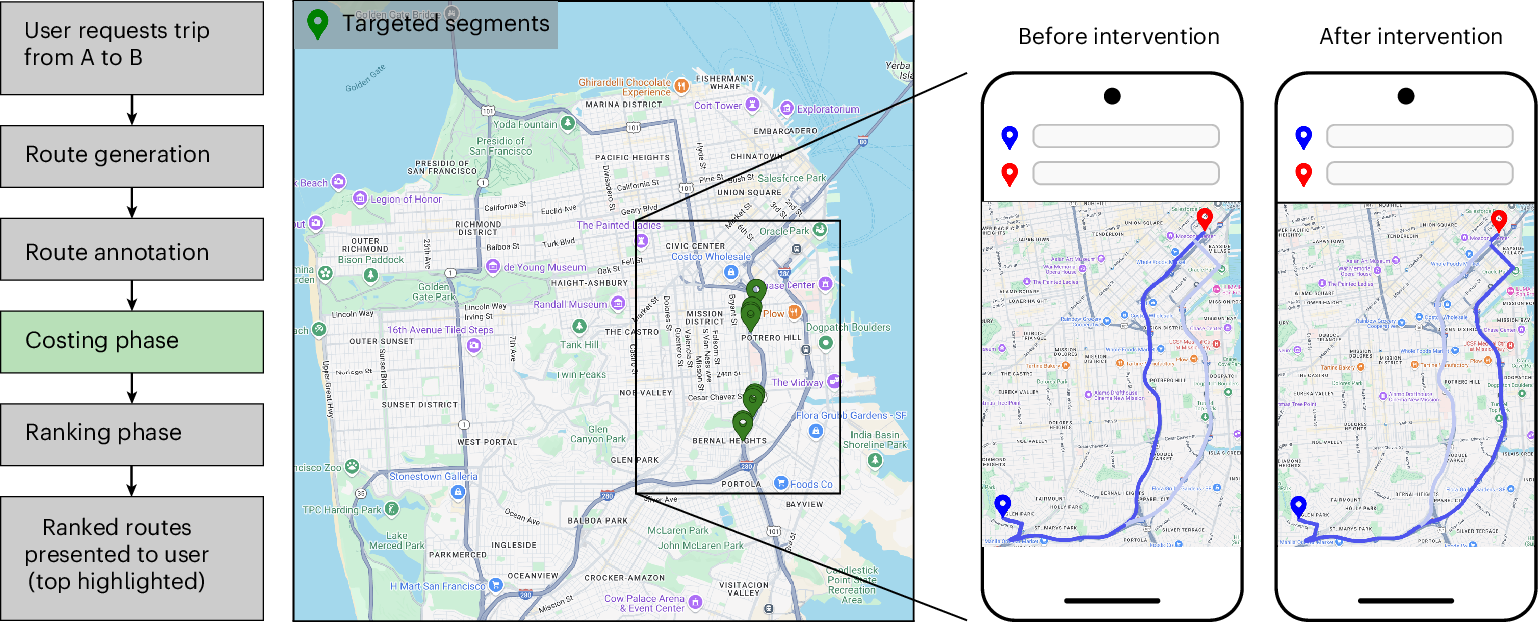
Traffic congestion remains a persistent challenge for urban mobility, increasing travel delays and elevating CO2 emissions. The widespread use of smartphones and GPS navigation creates new opportunities to mitigate congestion through routing optimizations in apps, yet real-world evidence for the effectiveness of such interventions is limited. Here we report large-scale empirical experiments evaluating routing-based traffic interventions on ~100 highly congested road segments across 10 major US cities. By rerouting a small share of Google Maps trips from targeted congested highway and arterial segments to less congested alternatives of equivalent road-classes with comparable travel times, we observe a city-average 2% increase in vehicle speeds on the intervened segments, along with improved travel times 0.7% and potential annual reductions exceeding 1,000 tons of CO2-equivalent emissions per city in the majority of studied locations. These findings provide evidence that marginal routing interventions involving a small proportion of vehicles can measurably enhance overall road network efficiency, offering a practical pathway to easing congestion and advancing urban sustainability.
Cycling Toward a Cooler Toronto | The Power of Bike Lanes
Modemix — Biking to transit, made effortless.
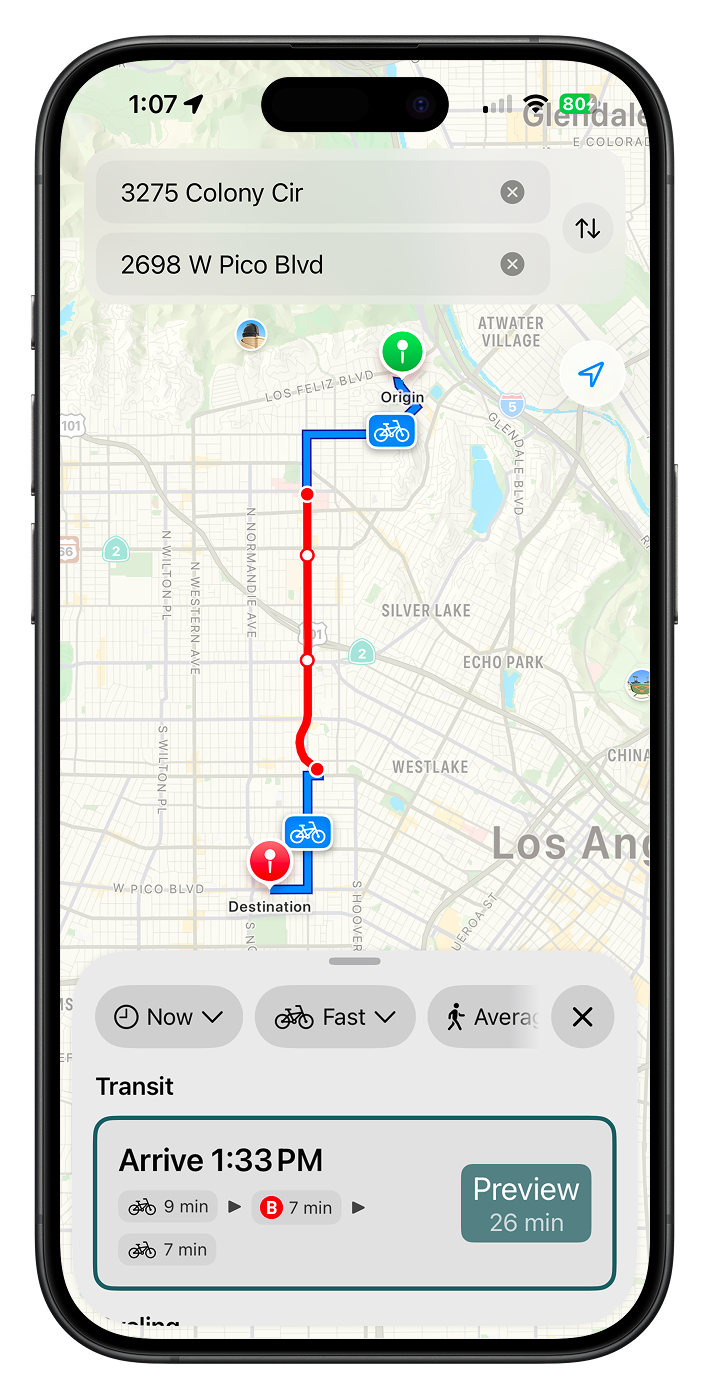
Biking to transit, made effortlessly simple. Turn your 20-minute walk into a 5-minute ride.
Hiking by Transit
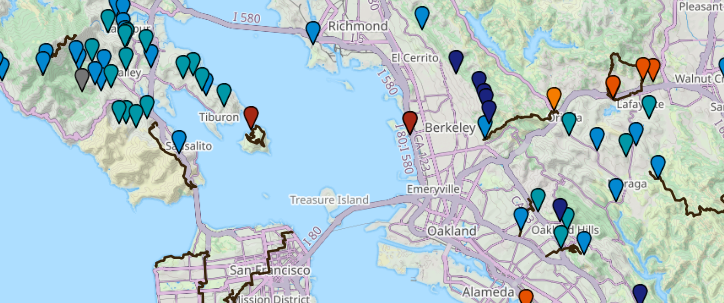
Transit-accessible hikes, parks, and trailheads across California.
A Year, Car-free, with a Brompton Bicycle | Offprint
Reflecting on a year of car-free living in the San Francisco Peninsula with a Brompton Bicycle

ale, today › One year of cargo biking
Some random notes from my first year with an electric cargo bike, and why you should (maybe) get one

ale, today › One year of cargo biking
Some random notes from my first year with an electric cargo bike, and why you should (maybe) get one
Digging Out of a Very Deep Hole: Saving Billions on 125th Street — Effective Transit Alliance New York
A 125 St subway should be a slam dunk. But at $7.7B and with stations more than 100 ft underground, it would be the most expensive subway in the world, and cost riders more than 5 minutes every trip before ever stepping on a train. By using international best practices & building more shallowly,

Bike Routes to Look Forward To | Offprint
A hopeful view toward the future of biking in the Bay

Harnessing naturally occurring data to measure the response of spending to income
Balancing your incomings and outgoings Economic theory predicts that when someone receives money should have little effect on their spending patterns. Gelman et al. constructed a data set of 60 million transactions made by 75,000 people to test this theory. People do seem to go on a mini–spending spree after they get their paychecks or pensions. However, closer inspection reveals that that's mostly explained by the convenience of linking regular payments, such as rent and utilities, to regular income. Unsurprisingly, cash-strapped people are more likely to increase their spending in response to receiving income. Science , this issue p. 212 , How do theoretical predictions of individual fiscal behaviors match up against real-world, real-time data? , This paper presents a new data infrastructure for measuring economic activity. The infrastructure records transactions and account balances, yielding measurements with scope and accuracy that have little precedent in economics. The data are drawn from a diverse population that overrepresents males and younger adults but contains large numbers of underrepresented groups. The data infrastructure permits evaluation of a benchmark theory in economics that predicts that individuals should use a combination of cash management, saving, and borrowing to make the timing of income irrelevant for the timing of spending. As in previous studies and in contrast to the predictions of the theory, there is a response of spending to the arrival of anticipated income. The data also show, however, that this apparent excess sensitivity of spending results largely from the coincident timing of regular income and regular spending. The remaining excess sensitivity is concentrated among individuals with less liquidity.
What's Driving Token Prices? January 14, 2026
This week on What’s Driving Token Prices, Katie Talati examines Zcash governance issues, Polygon’s payments shift, and planned changes at Pump.fun.

Reducing car dependence: benefits, strategies, unintended consequences, and future directions of post-car urban transitions
This paper presents the state of the art of post-car urban transitions. It begins with an overview of the impact of automobility on planetary and human well-being. The benefits of post-car cities a...

Designing a wayfinding concept for Vancouver's Skytrain system.
I wasn’t always a big fan of public transport.

What Would You Do with $500? Spending Responses to Gains, Losses, News, and Loans
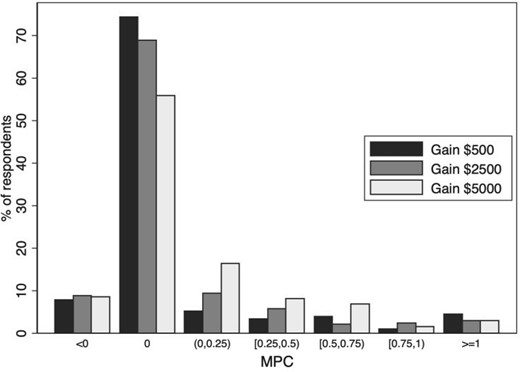
Abstract We use survey questions about spending in hypothetical scenarios to investigate features of propensities to consume that are useful for distinguishing between consumption theories. We find that (1) responses to unanticipated gains are vastly heterogeneous (either zero or substantially positive); (2) responses increase in the size of the gain, driven by the extensive margin of spending adjustments; (3) responses to losses are much larger and more widespread than responses to gains; and (4) even those with large responses to gains do not respond to news about future gains. These four findings suggest that limited access to disposable resources, and frictions in adjusting consumption, are important determinants of consumption behaviour. We also find that (5) households do not respond to the offer of a one-year interest-free loan, suggesting that this is not a consequence of short-term credit constraints; and (6) people do cut spending in response to news about future losses, suggesting that neither is this a consequence of myopia. A calibrated precautionary savings model with utility costs of changing consumption, and a sufficient fraction of low-wealth households, can account for these features of propensities to consume on both the extensive and intensive margins.
Analog Resistance: Why Mechanical Simplicity Matters in an Increasingly Digital Cycling World
