

Made with Tally, the simplest way to create forms.
Tally - Create Beautiful Forms for Free | Unlimited Forms & Submissions
The simplest way to create beautiful, professional forms in seconds. Unlimited forms, unlimited submissions, forever free. Just start typing - no coding needed.
Sam Barton on Twitter / X
using an agent to fill in bullshit poorly built forms is so damn satisfying. i use vercel's agent browser skill for this and it works great https://t.co/MN5k912fG9— Sam Barton (@samhbarton) September 17, 2026
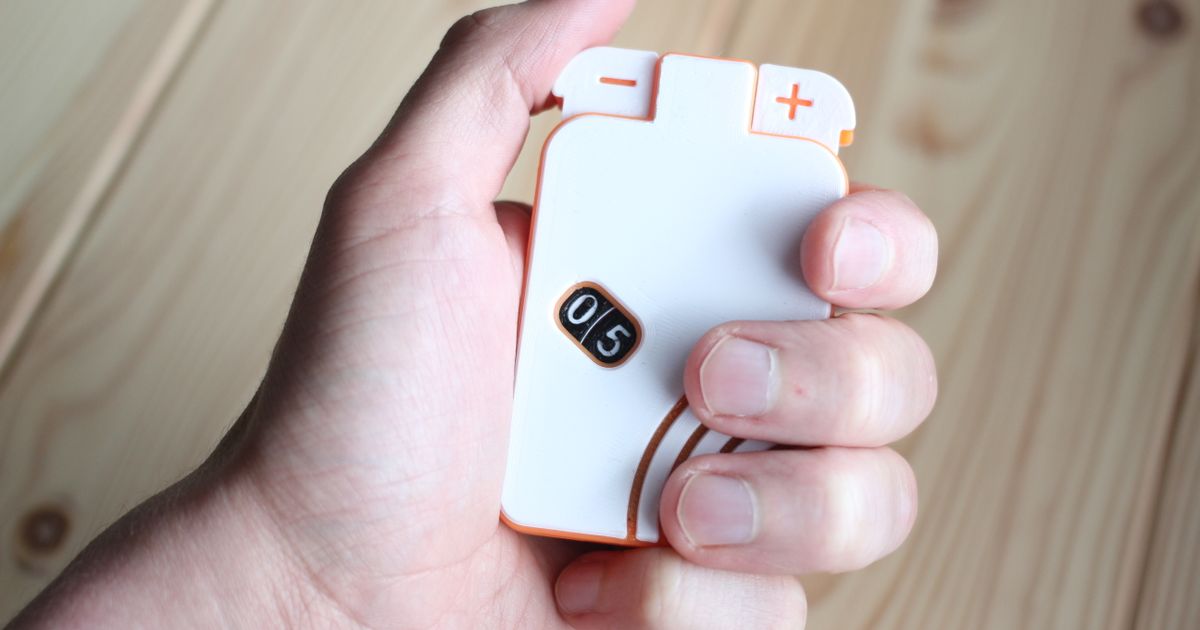
Mechanical Tally Counter 5.0 by FredrikHamrebjorkDesigns | Download free STL model | Printables.com
This is a non-commercial print, this means you are not allowed to sell files or prints of this model.
Superforms - Form library for SvelteKit
Superforms is a SvelteKit form library that brings you a comprehensive solution for server and client form validation. It supports a multitude of validation libraries:

ODK Collect
ODK Collect is an Android app for managing and filling out forms. It supports a wide range of question and answer types, and is designed to work well offline. ODK Collect downloads blank forms from...
Introduce the Vouch/Denouncement Contribution Model by mitchellh · Pull Request #10559 · ghostty-org/ghostty
This moves Ghostty to a vouch-based contribution system. The high-level idea is that only vouched users can participate in contributing to Ghostty. Users are vouched by maintainers commenting &...
Scribe — Meeting notes that never leave your Mac
Scribe records, transcribes and summarises your meetings on your Mac. Free and open source.



How I use Obsidian
My personal Obsidian vault template. A bottom-up approach to note-taking and organizing things I am interested in.

Cantrip: On summoning entities from language in circles | deepfates
With Cantrip, deepfates reimagines the fundamentals of language model agents. Available as a ghost library with generative test specification.

Cantrip: On summoning entities from language in circles | deepfates
With Cantrip, deepfates reimagines the fundamentals of language model agents. Available as a ghost library with generative test specification.
SyRA: Sybil-Resilient Anonymous Signatures with Applications to Decentralized Identity
We study Sybil-Resilient Anonymous (SyRA) signatures, a cryptographic primitive that enables credentialed users to generate, on demand, unlinkable pseudonyms tied to any given context, and issue signatures on behalf of these pseudonyms. Concretely, SyRA allows a distributed issuer to turn any legacy identity or personhood identifier, possibly of low entropy, into a unique associated cryptographic key of high pseudoentropy, for use in generating signatures for any given context. Sybil-resilient anonymous signatures achieve three main objectives: 1) Sybil resilience: every user is entitled to at most one digital identity, 2) anonymity: no information about the user’s real identity is leaked, and 3) non-interactive context switching: users can create on their own at most one credential for any given context in a manner that is unlinkable across contexts. We conceptualize the SyRA primitive as an ideal functionality in the Universal Composition (UC) setting and put forth SASSI, an efficient, pairing-based construction that realizes it by utilizing two levels of verifiable random functions (VRFs), a design which may be of independent interest. The first level consists of threshold VRF issuance of a user’s unique secret key tied to their real-world identifier. The second level allows a user to create signatures for each context, under a unique pseudonym per context. Compared to prior cryptographic tools capable of realizing SyRA, SASSI has the unique feature that issuers are stateless and hence do not need to retain any information about past user interactions, a relevant property for a decentralized implementation. We overview various applications of SASSI in multiparty systems, such as cryptocurrency account management and airdrops, e-voting (e.g., for decentralized governance), and privacy-preserving regulatory compliance (e.g., AML/CFT checks). In the context of creating addresses for digital assets, SyRA signatures enable users to embed their legacy identity into their address in a manner that protects their privacy for each application with which they interact. We demonstrate the practicality of SASSI by providing an implementation and performance evaluation of our construction.

Who is writing this idea up? I think we’re going to need it. There are a lot of objects out there being created as regular database entries or associated with the PDS of person who first entered them, but ideally we want to allow the creator or publisher to claim them and redirect without recreating

Paul Rohr
Ah, you're brute forcing this without asking @bnewbold.net + @dholms.at for the AT equivalent of an HTTP 301 or 308 response Mad respect
