Blogging platform with advanced tools for arts and sciences.

the quintal is open
Introducing quintal: a collective blogging platform on atproto, no algorithm, no metrics, one axolotl mascot. The small internet I always wanted to live in.

Blog - Vercel
Blog posts from the Vercel team and community. Discover the latest in web development.

Getting started - Docs
Discourse Graphs are a tool and ecosystem for collaborative knowledge synthesis, enabling researchers to map ideas and arguments in a modular, composable graph format.
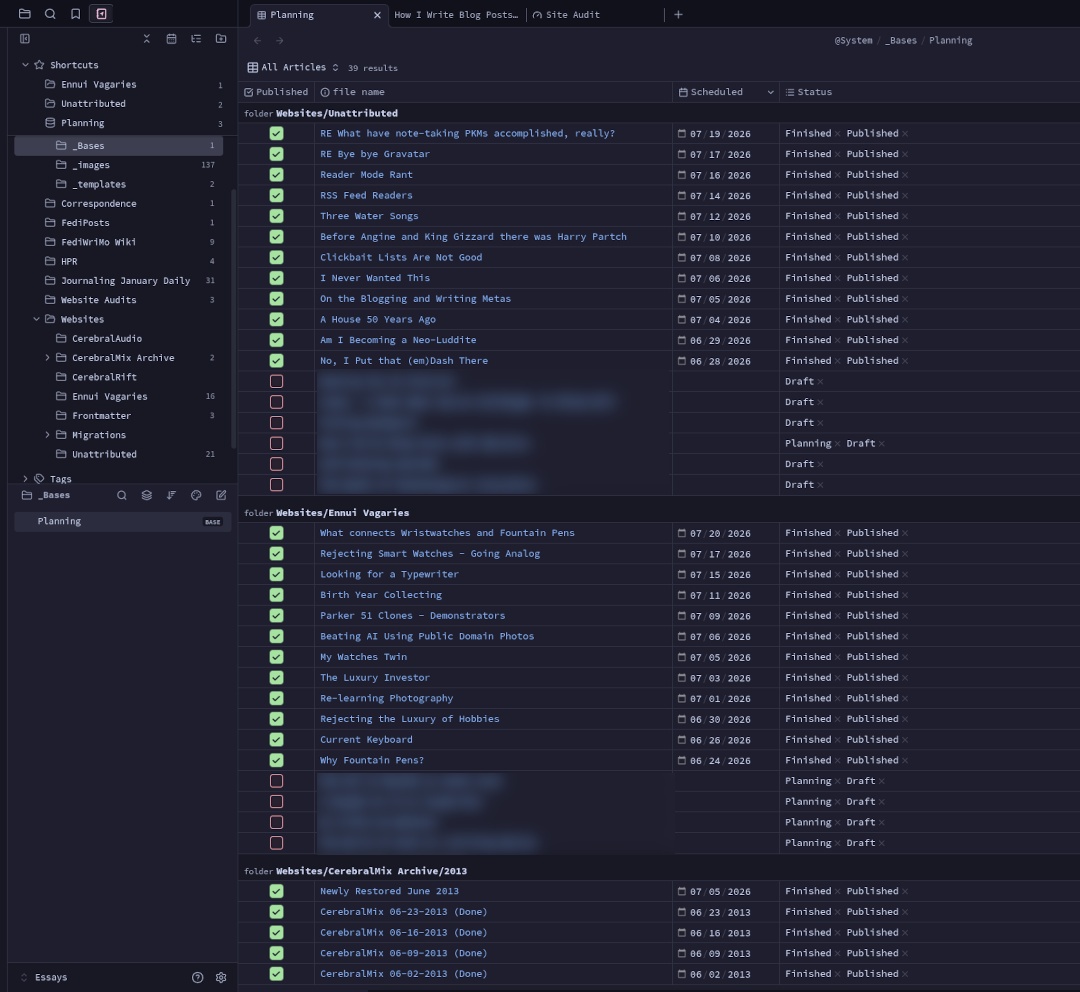
How I Write Blog Posts with Obsidian — Unattributed
You've probably run into some Obsidian evangelist espousing some convoluted system of organizing all their notes, and building some knowl...
Jared Goering on Twitter / X
Saw this and immediately built it. Open-sourced the whole thing:Ingest URLs, PDFs, tweets, images → LLM compiles a linked markdown wiki → Q&A with citations, knowledge graph, contradiction linting, auto-research, export to HTML/PDF/slides.Been using it nonstop as a personal… https://t.co/ypaXlEA7pn pic.twitter.com/8Z2DLAyQjH— Jared Goering (@jaredgoering) April 4, 2026

Metagov x Future of Science Seminar - Discourse Graphs with Matt Akamatsu
Introducing Sequoia: Publishing for the Open Web
Today I'm excited to release a new tool for the AT Protocol: Sequoia. This is a CLI tool that can take your existing self-hosted blog and publish it to the ATmosphere using Standard.site lexicons.

GreenGale - Atmospheric Blogging
A Markdown blogging platform built on AT Protocol. Write and share blog posts with the Bluesky ecosystem.

Steps Towards an Infrastructure for Scholarly Synthesis
Sharing, reusing, and synthesizing knowledge is central to the research process, both individually, and with others. These core functions are not supported by our formal scholarly publishing infrastructure: instead of the smooth functioning of functional infrastructure, researchers resort to laborious "hacks" and workarounds to "mine" publications for what they need, and struggle to efficiently share the resulting information with others. Information scientists have proposed an alternative infrastructure based on the more appropriately granular model of a discourse graph of claims, and evidence, along with key rhetorical relationships between them. However, despite significant technical progress on standards and platforms, the predominant infrastructure remains steadfastly document-based. Drawing from infrastructure studies, we locate the current infrastructural bottlenecks in the lack of local systems that integrate discourse-centric models to augment synthesis work, from which an infrastructure for synthesis can be grown. Through 3 years of research through design and field deployment in a distributed community of hypertext notebook users, we elaborate a design vision of what can and should be built in order to grow a discourse-centric synthesis infrastructure: a thriving "installed base" of researchers authoring local, shareable discourse graphs to improve synthesis work, enhance primary research and research training, and augment collaborative research. We discuss how this design vision -- and our empirical work -- contributes steps towards a new infrastructure for synthesis, and increases HCI's capacity to advance collective intelligence and solve infrastructure-level problems.

Steps Towards an Infrastructure for Scholarly Synthesis
Sharing, reusing, and synthesizing knowledge is central to the research process, both individually, and with others. These core functions are not supported by our formal scholarly publishing infrastructure: instead of the smooth functioning of functional infrastructure, researchers resort to laborious ”hacks” and workarounds to ”mine” publications for what they need, and struggle to efficiently share the resulting information with others. Information scientists have proposed an alternative infrastructure based on the more appropriately granular model of a discourse graph of claims, and evidence, along with key rhetorical relationships between them. However, despite significant technical progress on standards and platforms, the predominant infrastructure remains steadfastly document-based. Drawing from infrastructure studies, we locate the current infrastructural bottlenecks in the lack of local systems that integrate discourse-centric models to augment synthesis work, from which an infrastructure for synthesis can be grown. Through 3 years of research through design and field deployment in a distributed community of hypertext notebook users, we elaborate a design vision of what can and should be built in order to grow a discourse-centric synthesis infrastructure: a thriving “installed base” of researchers authoring local, shareable discourse graphs to improve synthesis work, enhance primary research and research training, and augment collaborative research. We discuss how this design vision — and our empirical work — contributes steps towards a new infrastructure for synthesis, and increases HCI’s capacity to advance collective intelligence and solve infrastructure-level problems.
Wish there was a better academic publishing system? Bluesky and its underlying ATProto technology, along with services like @chive.pub and the broader @atproto.science ecosystem, could do the job. #AcademicSky 🧪 leaflet.pub/2f431faf-c125-4d34-ac52-e41a2…
Each academic paper should have its own Bluesky account
leaflet.pubChive
We're ramping up our alpha, and we'd love for you to join at chive.pub! Since we launched back in January, we've been adding a ton of fun features; and to introduce them, we're going to be doing a series of deep dives over the next couple weeks on chive.leaflet.pub.
resources and blogs for publishing your writing to standard.site, where it becomes searchable across several platforms and affords you a fancy link on Bluesky

Pushing this blog to ATProto through standard.site

Making a Ghost Blog a Valid standard.site Publication
standard.site validator

Publishing My Eleventy Blog to the ATmosphere with Standard.site
Publishing on the Atmosphere with Standard.site
Publishing · Standard Reader