

While the economic climate in the United States remains uncertain, economists and pundits alike continue to define our recent fiscal crisis with words like recession, downturn and depression. But labeling America’s current financial woes should not be the focus for Americans as the overall economy struggles to free itself from its malaise. What really matters is how the current circumstances affect you and what they mean to your future. In his book, The Great Reset, Richard Florida calls periods like the one currently facing the United States “Great Resets.” There have been two such periods before the current one, and both of these earlier downturns changed our culture in profound ways. We all know the stories of mass unemployment and hardships suffered by American citizens during the Great Depression. But what often becomes lost in these stories is that a reset plays out as a process and not as much as an event. It represents a shift in values, economic tastes and preferences, business structures, and industries. In fact, it is a fundamental change in our culture as a whole. I like to think of it as cleaning out a closet — the world rids itself of old, outdated principles to make way for the new.
Deepening crisis traps America's have-nots
The US is drifting from a financial crisis to a deeper and more insidious social crisis. Self-congratulation by the US authorities that they have this time avoided a repeat of the 1930s is premature.

Why to Start a Startup in a Bad Economy
October 2008The economic situation is apparently so grim that some experts fear we may be in for a stretch as bad as the mid seventies.When Microsoft and Apple were founded.As those examples suggest, a recession may not be such a bad time to start a startup. I'm not claiming it's a particularly good time either. The truth is more boring: the state of the economy doesn't matter much either way.If we've learned one thing from funding so many startups, it's that they succeed or fail based on the qualities of the founders. The economy has some effect, certainly, but as a predictor of success it's rounding error compared to the founders.Which means that what matters is who you are, not when you do it. If you're the right sort of person, you'll win even in a bad economy. And if you're not, a good economy won't save you. Someone who thinks "I better not start a startup now, because the economy is so bad" is making the same mistake as the people who thought during the Bubble "all I have to do is start a startup, and I'll be rich."So if you want to improve your chances, you should think far more about who you can recruit as a cofounder than the state of the economy. And if you're worried about threats to the survival of your company, don't look for them in the news. Look in the mirror.But for any given team of founders, would it not pay to wait till the economy is better before taking the leap? If you're starting a restaurant, maybe, but not if you're working on technology. Technology progresses more or less independently of the stock market. So for any given idea, the payoff for acting fast in a bad economy will be higher than for waiting. Microsoft's first product was a Basic interpreter for the Altair. That was exactly what the world needed in 1975, but if Gates and Allen had decided to wait a few years, it would have been too late.Of course, the idea you have now won't be the last you have. There are always new ideas. But if you have a specific idea you want to act on, act now.That doesn't mean you can ignore the economy. Both customers and investors will be feeling pinched. It's not necessarily a problem if customers feel pinched: you may even be able to benefit from it, by making things that save money. Startups often make things cheaper, so in that respect they're better positioned to prosper in a recession than big companies.Investors are more of a problem. Startups generally need to raise some amount of external funding, and investors tend to be less willing to invest in bad times. They shouldn't be. Everyone knows you're supposed to buy when times are bad and sell when times are good. But of course what makes investing so counterintuitive is that in equity markets, good times are defined as everyone thinking it's time to buy. You have to be a contrarian to be correct, and by definition only a minority of investors can be.So just as investors in 1999 were tripping over one another trying to buy into lousy startups, investors in 2009 will presumably be reluctant to invest even in good ones.You'll have to adapt to this. But that's nothing new: startups always have to adapt to the whims of investors. Ask any founder in any economy if they'd describe investors as fickle, and watch the face they make. Last year you had to be prepared to explain how your startup was viral. Next year you'll have to explain how it's recession-proof.(Those are both good things to be. The mistake investors make is not the criteria they use but that they always tend to focus on one to the exclusion of the rest.)Fortunately the way to make a startup recession-proof is to do exactly what you should do anyway: run it as cheaply as possible. For years I've been telling founders that the surest route to success is to be the cockroaches of the corporate world. The immediate cause of death in a startup is always running out of money. So the cheaper your company is to operate, the harder it is to kill. And fortunately it has gotten very cheap to run a startup. A recession will if anything make it cheaper still.If nuclear winter really is here, it may be safer to be a cockroach even than to keep your job. Customers may drop off individually if they can no longer afford you, but you're not going to lose them all at once; markets don't "reduce headcount."What if you quit your job to start a startup that fails, and you can't find another? That could be a problem if you work in sales or marketing. In those fields it can take months to find a new job in a bad economy. But hackers seem to be more liquid. Good hackers can always get some kind of job. It might not be your dream job, but you're not going to starve.Another advantage of bad times is that there's less competition. Technology trains leave the station at regular intervals. If everyone else is cowering in a corner, you may have a whole car to yourself.You're an investor too. As a founder, you're buying stock with work: the reason Larry and Sergey are so rich is not so much that they've done work worth tens of billions of dollars, but that they were the first investors in Google. And like any investor you should buy when times are bad.Were you nodding in agreement, thinking "stupid investors" a few paragraphs ago when I was talking about how investors are reluctant to put money into startups in bad markets, even though that's the time they should rationally be most willing to buy? Well, founders aren't much better. When times get bad, hackers go to grad school. And no doubt that will happen this time too. In fact, what makes the preceding paragraph true is that most readers won't believe it—at least to the extent of acting on it.So maybe a recession is a good time to start a startup. It's hard to say whether advantages like lack of competition outweigh disadvantages like reluctant investors. But it doesn't matter much either way. It's the people that matter. And for a given set of people working on a given technology, the time to act is always now.
Was America’s Economic Prosperity Just a Historical Accident? - Nymag
What if everything we’ve come to think of as American is predicated on a freak coincidence of economic history? And what if that coincidence has run its course?

Is America Encouraging the Wrong Kind of Entrepreneurship?
In a 1990 paper, “Entrepreneurship: Productive, Unproductive, and Destructive,” late economist William Baumol argued that not all entrepreneurs are equal: there are both “productive” and “unproductive” endeavors. Most people think of all entrepreneurship to be what Baumol referred to as the “productive” kind, where the companies that founders launch commercialize something new or better, benefiting society and themselves in the process. Baumol was worried, however, by a very different sort of entrepreneur, the “unproductive” ones who exploit special relationships with the government to construct regulatory moats, secure public spending for their own benefit, or bend specific rules to their will — in the process, stifling competition to create advantage for their firms. Two recent trends indicate that this may be happening in the U.S. today: rising profits, especially those earned by the largest businesses in the economy, and suggestive evidence of an increase in efforts to shape the rules of the game. Baumol may have been ahead of his time. If the U.S. is going to tackle its many problems, we are going to have to find ways to encourage would-be entrepreneurs to start innovative, productive businesses, rather than dedicating their efforts to co-opting government in order to secure economic advantage.
1890’s America: A Peek at the Past You’re Repeating | NEWS JUNKIE POST
It has been said that a definition of insanity is to do the same thing over and expect a different result. While in one sense this may be considered persistence – to try, and try again – to do so against all evidence to the contrary must certainly be considered some sort of madness. Yet, despite the egregious crimes committed against the American people by Big Banks, Big Finance, Big Oil, Big Pharma and the corporate and financial elite as a whole, the American people seem determined to place even more trust in them by allowing the dissolution of organized labor out of a misplaced faith that their best interests will be taken care of by those who have just finished raping their economy.
Attention Is All You Need #2: This Time Is Different
What can we learn from the 2007 Global Financial Crisis and the 1990’s dot-com bubble?

The Quiet Rewiring of American Finance
Stablecoins, Treasury markets, and the most significant shift in financial infrastructure that almost nobody is discussing.

America’s ‘Retail Apocalypse’ Is Really Just Beginning
The spillover from retailer debt will flow far and wide across the economy.

A New American Manifesto
From time to time in human societies, things get so bad with the governments that we set up that we have to take a step back, stop being…

Here's Why I Wrote a Book When the World is on Fire.
Regenerative Economics: Revolutionary Thinking for a World in Crisis
A difficult decision to set us up for the future
As an almost 25-year-old company, we’re bound to go through difficult economic cycles.

The Joy of Becoming Worthless…except to each other — Douglas Rushkoff
My last piece, The Intentional Collapse, seems to have agitated a few people. I know it came off a bit dark. I talked about how the Uber wealthy believe the world as we know it is ending and that there won’t be enough essential resources to go around, so they need to take control of as much money and stuff and land as possible in order to position themselves for the end of days.
Recent USA Sectoral Balances: Goldilocks, the Global Crash, and the Perfect Fiscal Storm
In the previous blog, we did some heavy lifting. Unless you are an economics or accounting nerd, you found it quite boring. This week we will take a little break from pure accounting, and apply what w
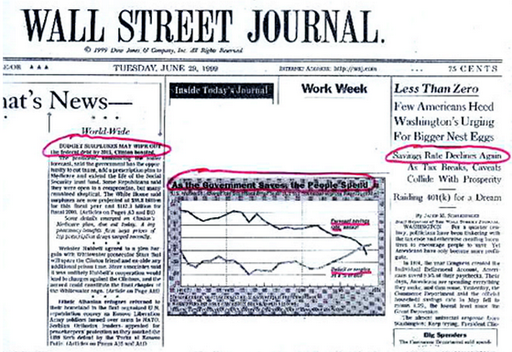
The Rot Economy
At the center of everything I’ve written for the last few months (if not the last few years), sits a cancerous problem with the fabric of how capital is deployed in modern business. Public and private investors, along with the markets themselves, have become entirely decoupled from the concept of what “good” business truly is, focusing on one metric — one
America Will be Broke by 2050
Whether you slash spending, hike taxes, inflate or simply do nothing and wait for a crisis the result is the same: American standard of living is in terminal decline.

Spurned by the economy, young Americans are feeling so lonely and powerless they plunged the nation’s happiness score
221 votes, 68 comments. 1.1M subscribers in the economy community. Forum for economy, business, politics, stocks, bonds, product releases, IPOs…