


Now that the Mailbox sale to Dropbox is complete, let’s move on to the next native iOS app that everyone wants to replace: The Calendar. Yes, the calendar. Nearly every other conversation I had this past week included some chatter about all the new calendar apps (see the screenshot of my iPhone). Peeling back the layers on all these calendar apps and the herd-like interest in the space, however, reveals both challenges and opportunities that go much deeper than comparing mobile apps based on product features. For those among us who use Android, Google Now is the type of anticipatory computing, powered by data and algorithmic learning, that enables a machine to guide us in life almost like an assistant would. On Apple’s iOS, however, there is no such thing like “Apple Now,” and as a result, savvy entrepreneurs are seeking to build that service as a third-party application. And, curiously, they’re using the mobile calendar on Apple to kickstart this game and using calendar "intent" to infer what to send to the user.
Calendar App Sunrise Showcases Where iOS 8 Widgets Shine | TechCrunch
Sunrise has been one of my favorite mobile apps for years now. But the brand new 3.0 update for iOS, combined with iOS 8, makes it one of the best

Sunrise was the best calendar app ever and now I feel lost | TechCrunch
Update: Sunrise isn't shutting down just yet. Servers will keep running until more Sunrise features are ported over to Outlook's calendar feature, then

A delightfully fresh take on email + calendar, from 37signals
Gmail, Outlook, and Apple got complacent and took their eye off the ball. Then along came HEY.
SaTS’26
Mobile super apps have evolved into complex ecosystems that integrate diverse services through third-party miniapps, plugins, and APIs. These super apps, offering a plethora of services often in the form of third-party integrated, self-contained packages and capabilities, have greatly extended the versatility of the platforms, offering unprecedented convenience but also introducing significant security and privacy challenges. In the past decade, super apps have evolved into a comprehensive OS-alike ecosystem, with millions of miniapps hosted by built-in stores akin to Google Play and the Apple App Store. Nevertheless, the surging popularity of these apps, such as WeChat, Alipay, TikTok, Line, Zalo, and Grab, has resulted in an immense volume of user data being generated, stored, and transmitted via these platforms. Emerging Operating Systems have also provided such light-weight integration, such as QuickApps as advocated by Huawei, Xiaomi, and Oppo. With their integration of diverse services within a single platform or application, these super apps pose significant security and privacy challenges. Recently, the rise of agentic AI frameworks and AI-enabled application development has further transformed the ecosystem of super apps. Agentic frameworks enabling automatic multi-modal interaction, as well as AI-augmented app development, has significantly reformed the landscape of software development and user interactions. However, these advancements have also expanded the attack surface, introducing novel risks such as data leakage, malicious integrations, privilege escalation, and adversarial manipulation. Our desire of SaTS workshop is to bring together researchers and practitioners from academia, industry, and government to share the latest research efforts and advances, exploring emerging threats, defense, and research directions at the intersection of AI-empowered mobile super apps, miniapp ecosystems, and security analysis.
Why I switched to Android after 7 years of iOS
Monday of last week I was all excited. I had just gotten the green light to start prototyping a new Progressive Web App for a client I've been working with.

With App Actions and Slices, Google introduces more ways for users to interact with the apps on their phones | TechCrunch
With Instant Apps, Google offers a feature for Android users that allows them to load a small part of an app right from the search results and get a

What Isn’t There an App For? (Published 2015)
A writer spent three weeks trying to improve his life through apps.

Google Shames Apple's iOS For Adding What Android Did Years Ago | TechCrunch
Apple's Tim Cook insulted Google at WWDC earlier this month saying "Android dominates the market in malware", and quoted an article calling the fragmented

Google and Ambient Computing
Google presented a vision of ambient computing that goes beyond the smartphone. The company is well-placed, but faces challenges both in the marketplace and in the mirror.

Google I/O 2018: What’s new in Android
As Android has grown exponentially over the past ten years, we've also seen our developer community grow dramatically. In countries like China, India, and Brazil, the number of developers using our IDE almost tripled - in just two years. With such growth, we feel an even greater responsibility to invest in our developer experience. Guided by your feedback, we've focused our efforts on making mobile development fast and easy, helping you get more users by making apps radically smaller, and increasing engagement to keep users coming back. We're also pretty excited to see Android Things go to 1.0, creating new opportunities for you to develop - everything from major consumer devices, to cool remote control vehicles!

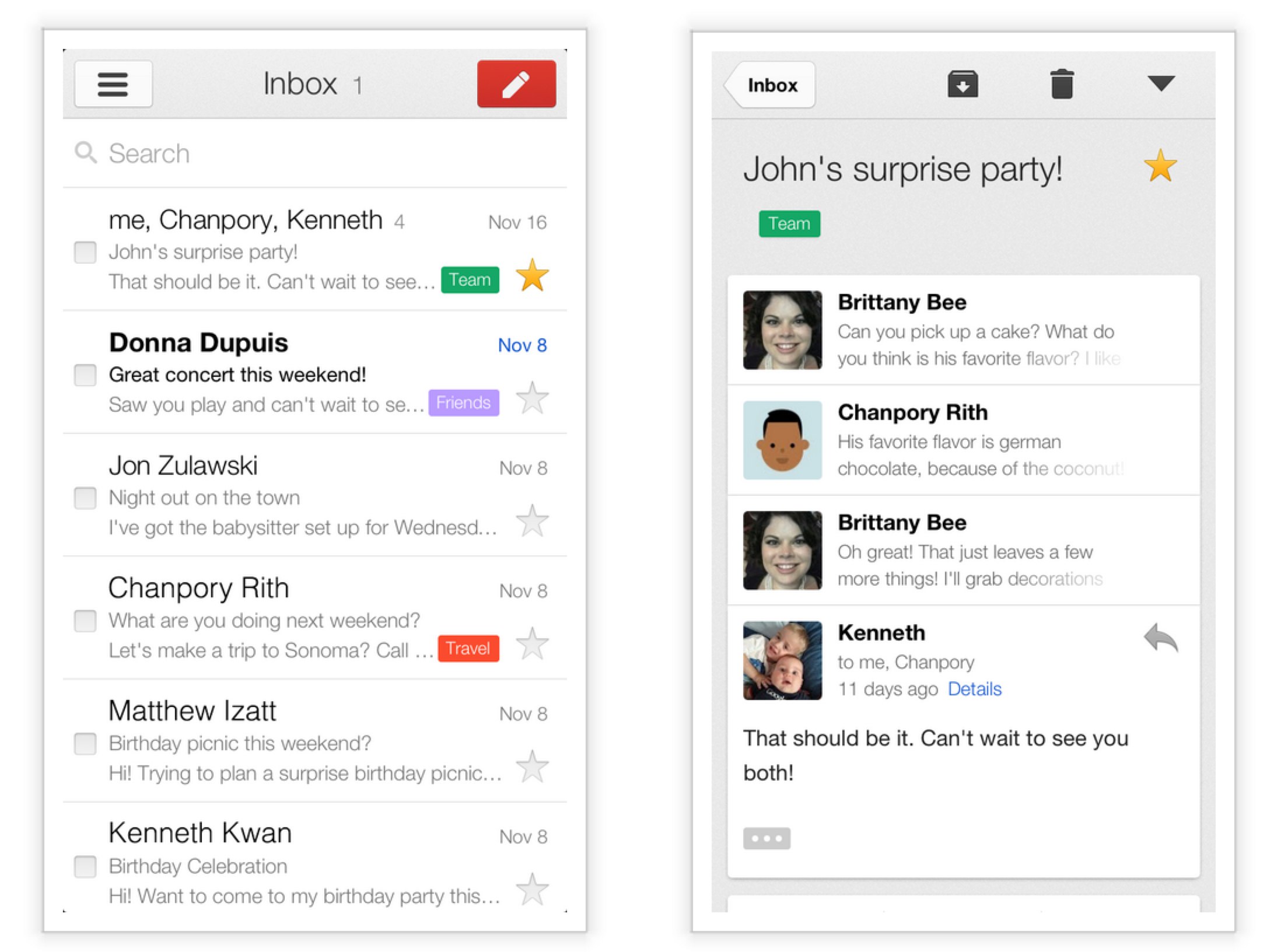
Google Launches Gmail 2.0 On iOS With New Design, Support For Multiple Accounts, Calendar And Google+ Integration & More | TechCrunch
Google today is announcing a refreshed version of its native app on iOS devices, with the launch of Gmail 2.0. The app most noticeably introduces a cleaner-looking user interface, but it also brings a number of flourishes to improve the overall experience, including the addition of profile pictures in messages, new animations, infinite scrolling, and more, as well as a hugely in-demand feature: support (at last!) for multiple accounts.
Why Apps Need A New Data Center Stack | TechCrunch
The Internet has changed a lot about people’s lives in the past couple decades. Web and mobile applications let us search for information, buy products, and communicate frictionlessly, from anywhere -- at speeds and in ways never before possible. We get movie recommendations on the dashboards of our cars, produce and publish videos on our phones, and buy thermostats that predict when we will be at work so they can turn down the heat.

