


In a country that's increasingly polarized, where partisan politics shape perception, the question of how to create a compelling argument -- rooted in
How Technology Is Shaping Modern Politics
Discover how technology is reshaping politics, from digital campaigns to AI, and the challenges of misinformation and election security.

Persuasion and resistance: A survey experiment on messaging for and against One Nation | School of Politics & International Relations
Since the May 2025 federal election, One Nation's primary vote has risen sharply across published polling. If an election were held today, it would likely be the second-largest bloc in the House of Representatives. What drives this surge — and what, if anything, suppresses it — remains contested, with explanations ranging from economic grievance and cultural backlash to anti-establishment disaffection. While these accounts have been tested experimentally for radical-right parties abroad, they remain largely untested in Australia.
The social media discourse of engaged partisans is toxic even when politics are irrelevant
Abstract. Prevailing theories of partisan incivility on social media suggest that it derives from disagreement about political issues or from status compet
The social media discourse of engaged partisans is toxic even when politics are irrelevant
Abstract. Prevailing theories of partisan incivility on social media suggest that it derives from disagreement about political issues or from status compet
Study: Want To Reduce Partisanship? Make Font Harder To Read | TechCrunch
A new study shows that the media can significantly reduce partisan bias by simply making the text more difficult to read. Researchers found that

How to break populist parties’ appeal? An experimental evaluation of communication counter-strategies
Right-wing populist parties have become a major challenge to liberal democracies worldwide. How can mainstream parties effectively counter their appeal? While prior research has focused on the drivers of populist support, much less is known about how to counter right-wing populist rhetoric. We test four communication counter-strategies that target core elements of right-wing populist appeals: (i) undermining populists’ claims to democratic credibility, (ii) promoting inclusive in-group identity to counter exclusionary narratives, (iii) highlighting their performance legitimacy, and (iv) emphasizing the procedural legitimacy of mainstream parties. Drawing on real-world party communications from social media, manifestos, and press releases, we created 170 experimental treatments (posters and social media posts varying in format and complexity) to simulate how voters encounter political messages in everyday life. In a large-scale survey experiment with over 24,000 respondents in Germany, messages undermining right-wing populists’ democratic credibility prove most effective, particularly among citizens with high initial support for such parties.
LLM-generated messages can persuade humans on policy issues
The emergence of large language models (LLMs) has made it possible for generative artificial intelligence (AI) to tackle many higher-order cognitive tasks, with critical implications for industry, government, and labor markets. Here, we investigate whether existing, openly-available LLMs can be used to create messages capable of influencing humans’ political attitudes. Across three pre-registered experiments (total N = 4829), participants who read persuasive messages generated by LLMs showed significantly more attitude change across a range of policies - including polarized policies, like an assault weapons ban, a carbon tax, and a paid parental-leave program - relative to control condition participants who read a neutral message. Overall, LLM-generated messages were similarly effective in influencing policy attitudes as messages crafted by lay humans. Participants’ reported perceptions of the authors of the persuasive messages suggest these effects occurred through somewhat distinct causal pathways. While the persuasiveness of LLM-generated messages was associated with perceptions that the author used more facts, evidence, logical reasoning, and a dispassionate voice, the persuasiveness of human-generated messages was associated with perceptions of the author as unique and original. These results demonstrate that recent developments in AI make it possible to create politically persuasive messages quickly, cheaply, and at massive scale.

The social media discourse of engaged partisans is toxic even when politics are irrelevant
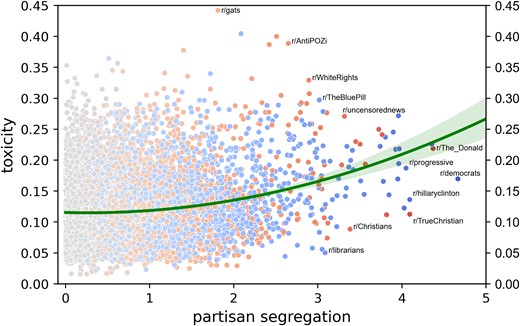
Abstract Prevailing theories of partisan incivility on social media suggest that it derives from disagreement about political issues or from status competition between groups. This study—which analyzes the commenting behavior of Reddit users across diverse cultural contexts (subreddits)—tests the alternative hypothesis that such incivility derives in large part from a selection effect: Toxic people are especially likely to opt into discourse in partisan contexts. First, we examined commenting behavior across over 9,000 unique cultural contexts (subreddits) and confirmed that discourse is indeed more toxic in partisan (e.g. r/progressive, r/conservatives) than in nonpartisan contexts (e.g. r/movies, r/programming). Next, we analyzed hundreds of millions of comments from over 6.3 million users and found robust evidence that: (i) the discourse of people whose behavior is especially toxic in partisan contexts is also especially toxic in nonpartisan contexts (i.e. people are not politics-only toxicity specialists); and (ii) when considering only nonpartisan contexts, the discourse of people who also comment in partisan contexts is more toxic than the discourse of people who do not. These effects were not driven by socialization processes whereby people overgeneralized toxic behavioral norms they had learned in partisan contexts. In contrast to speculation about the need for partisans to engage beyond their echo chambers, toxicity in nonpartisan contexts was higher among people who also comment in both left-wing and right-wing contexts (bilaterally engaged users) than among people who also comment in only left-wing or right-wing contexts (unilaterally engaged users). The discussion considers implications for democratic functioning and theories of polarization.
Generative AI for Pro-Democracy Platforms · From Novel Chemicals to Opera
Online discourse faces challenges in facilitating substantive and productive political conversations. Recent technologies have explored the potential of generative AI to promote civil discourse, encourage the development of mutual understanding in a discussion, produce . . .

The Internet Doesn’t Have to Be Bad for Democracy
A new form of online survey uses crowdsourcing and data visualization to reveal the hidden nuances in partisan debates.

The Internet Doesn’t Have to Be Bad for Democracy
A new form of online survey uses crowdsourcing and data visualization to reveal the hidden nuances in partisan debates.
Opinionrot: Toward a Theory of Collective Reasoning Decay in the Age of Synthetic Consensus
This article introduces the concept of opinionrot to describe the structural erosion of collective reasoning within contemporary information systems. Rather than treating post-truth politics as a failure of individual rationality or as a decline in information quality alone, the article argues that public reasoning is increasingly shaped by infrastructures that capture attention, monetize cognitive bias, and automate the conditions under which claims become visible and credible. Methodologically, the article proceeds through a conceptual-historical reconstruction, tracing how persuasion became institutionalized, platformized, and increasingly predictive. It identifies three mechanisms through which opinionrot intensifies today: cognitive capture, infrastructural decay, and discursive saturation. The framework is illustrated through debates over equality and affirmative action, showing how communicative infrastructures can transform contested political concepts into predictable and polarized semantic routines. By shifting the analysis from discrete falsehoods to the conditions under which public judgment is formed, contested, and revised, the article offers a diagnostic vocabulary for studying how information infrastructures increasingly convert deliberation into statistical efficiency within contemporary economies of attention.

Persuasion Index: A Theory-Guided Framework for Persuasion Analysis
Identifying persuasive rhetorical cues is critical across domains, from detecting information manipulation and improving AI safety to advancing public health communication. We propose Persuasion...

SimPolitics
For more than six decades, the public has been promised that computers will revolutionize politics, both nationally and internationally. In SimPolitics, Fenw...

How Big Tech Monopolies Distort Our Public Discourse
Long before the pandemic crisis, there was widespread concern over the impact that tech was having on the quality of our discourse, from disinformation campaigns to influence campaigns to

The levers of political persuasion with conversational artificial intelligence
There are widespread fears that conversational artificial intelligence (AI) could soon exert unprecedented influence over human beliefs. In this work, in three large-scale experiments ( N = 76,977 participants), we deployed 19 large language models (LLMs)—including some post-trained explicitly for persuasion—to evaluate their persuasiveness on 707 political issues. We then checked the factual accuracy of 466,769 resulting LLM claims. We show that the persuasive power of current and near-future AI is likely to stem more from post-training and prompting methods—which boosted persuasiveness by as much as 51 and 27%, respectively—than from personalization or increasing model scale, which had smaller effects. We further show that these methods increased persuasion by exploiting LLMs’ ability to rapidly access and strategically deploy information and that, notably, where they increased AI persuasiveness, they also systematically decreased factual accuracy. , Editor’s summary Many fear that we are on the precipice of unprecedented manipulation by large language models (LLMs), but techniques driving their persuasiveness are poorly understood. In the initial “pretrained” phase, LLMs may exhibit flawed reasoning. Their power unlocks during vital “posttraining,” when developers refine pretrained LLMs to sharpen their reasoning and align with users’ needs. Posttraining also enables LLMs to maintain logical, sophisticated conversations. Hackenburg et al . examined which techniques made diverse, conversational LLMs most persuasive across 707 British political issues (see the Perspective by Argyle). LLMs were most persuasive after posttraining, especially when prompted to use facts and evidence (information) to argue. However, information-dense LLMs produced the most inaccurate claims, raising concerns about the spread of misinformation during rollouts of future models. —Ekeoma Uzogara , INTRODUCTION Rapid advances in artificial intelligence (AI) have sparked widespread concerns about its potential to influence human beliefs. One possibility is that conversational AI could be used to manipulate public opinion on political issues through interactive dialogue. Despite extensive speculation, however, fundamental questions about the actual mechanisms, or “levers,” responsible for driving advances in AI persuasiveness—e.g., computational power or sophisticated training techniques—remain largely unanswered. In this work, we systematically investigate these levers and chart the horizon of persuasiveness with conversational AI. RATIONALE We considered multiple factors that could enhance the persuasiveness of conversational AI: raw computational power (model scale), specialized post-training methods for persuasion, personalization to individual users, and instructed rhetorical strategies. Across three large-scale experiments with 76,977 total UK participants, we deployed 19 large language models (LLMs) to persuade on 707 political issues while varying these factors independently. We also analyzed more than 466,000 AI-generated claims, examining the relationship between persuasiveness and truthfulness. RESULTS We found that the most powerful levers of AI persuasion were methods for post-training and rhetorical strategy (prompting), which increased persuasiveness by as much as 51 and 27%, respectively. These gains were often larger than those obtained from substantially increasing model scale. Personalizing arguments on the basis of user data had a comparatively small effect on persuasion. We observe that a primary mechanism driving AI persuasiveness was information density: Models were most persuasive when they packed their arguments with a high volume of factual claims. Notably, however, we documented a concerning trade-off between persuasion and accuracy: The same levers that made AI more persuasive—including persuasion post-training and information-focused prompting—also systematically caused the AI to produce information that was less factually accurate. CONCLUSION Our findings suggest that the persuasive power of current and near-future AI is likely to stem less from model scale or personalization and more from post-training and prompting techniques that mobilize an LLM’s ability to rapidly generate information during conversation. Further, we reveal a troubling trade-off: When AI systems are optimized for persuasion, they may increasingly deploy misleading or false information. This research provides an empirical foundation for policy-makers and technologists to anticipate and address the challenges of AI-driven persuasion, and it highlights the need for safeguards that balance AI’s legitimate uses in political discourse with protections against manipulation and misinformation. Persuasiveness of conversational AI increases with model scale. The persuasive impact in percentage points on the y axis is plotted against effective pretraining compute [floating-point operations (FLOPs)] on the x axis. Point estimates are persuasive effects of different AI models. Colored lines show trends for models that we uniformly chat-tuned for open-ended conversation (purple) versus those that were post-trained using heterogeneous, opaque methods by AI developers (green). pp, percentage points; CI, confidence interval.
