

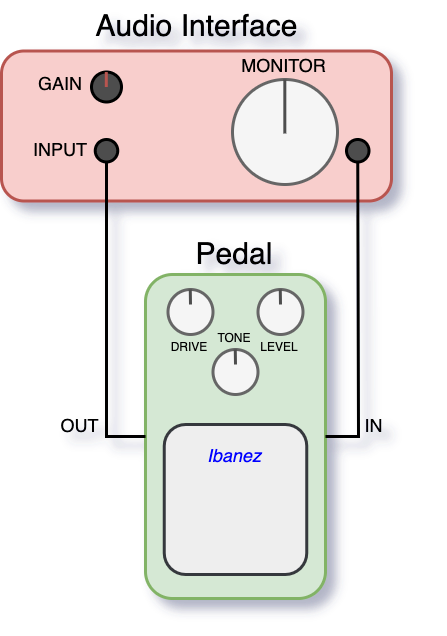
Since the 1940s, electric guitarists, keyboardists, and other instrumentalists have been using effects pedals, devices that modify the sound of the original audio source. Typical effects include distortion, compression, chorus, reverb, and delay. Early effects pedals consisted of basic analog circuits, often along with vacuum tubes, which were later replaced with transistors. Although many pedals today apply effects digitally with modern signal processing techniques, many purists argue that the sound of analog pedals can not be replaced by their digital counterparts. We’ll follow a deep learning approach to see if we can use machine learning to replicate the sound of an iconic analog effect pedal, the Ibanez Tube Screamer. This post will be mostly a reproduction of the work done by Alec Wright et al. in Real-Time Guitar Amplifier Emulation with Deep Learning (Wright et al., 2020).
This AI guitar pedal let me roll my own effects
That new sound you’ve been looking for?

Welcome to Das Musikding Onlineshop
Das Musikding is your online store for building guitar effect pedals, bass effect pedals , guitar amps, bass amps, synthesizer and many other musical related electronics projects. You can get pedal parts or complete kits, for all stages of building experi
Making a Neural Synthesizer Instrument
In a previous post, we described the details of NSynth (Neural Audio Synthesis), a new approach to audio synthesis using neural networks. We hinted at furthe...

The goal of this project is to be a comprehensive directory of patches, programs, or banks for the Spin Semiconductor FV-1 DSP integrated circuit (IC) that can be used in DIY guitar effects pedals, and other hobbiest projects. It is community-driven and built entirely of contributions from people like you, so please submit any programs you'd like to share.
Devices | Audiotool
Explore Audiotool's collection of synthesizers, drum machines, and effects. From powerful synths like Heisenberg and Pulverisateur to classic drum machines and professional effects.
Deep learning for assisting the process of music composition (part 1)
This is part 1 of my explorations of using deep learning for assisting the process of music composition. In this part, I look at some almost-winning output of a model trained by deep learning metho…

runoffgroove.com
This is the Runoff Groove, featuring do-it-yourself guitar stompbox mp3 sound clips and my notes on building one fuzz box after another. Also, schematics and articles related to effect pedals.
Learning Synths | Hacker News
It teaches you step by step all the aspects of a synth engine: oscillators, wave shapes, amplitude, filters, modulation, unison, FM… But most of all it trains your ear, which allows you to replicate the sound in your head and build it from scratch.
Neural Translation of Musical Style
Can we teach a neural network to perform like a human?

Jimi Hendrix Was a Systems Engineer
How did Jimi Hendrix turn his guitar into a wave synthesizer? Dive into the engineering behind his iconic sound.

Our New SAM Audio Model Transforms Audio Editing
We're introducing SAM Audio, a state-of-the-art AI model that enables you to segment sound.

AI Slop, Vibe-Coded Clones & Indie Plugins | Audio Damage
Vibe-coded clones, AI pitch spam, and Big Tech gunning for music software. After nearly 25 years, our take on AI and why plugin buyers should be skeptical.

The secret story of the vocoder, the military tech that changed music forever
On Version History: how to play your voice like an instrument, with a little help from Chromeo.

