

If you’ve been working with 3D computer graphics for any amount of time, then you’ve probably heard that normal vectors transform differently than ordinary vectors. That is, if t is an ordinary column vector that’s tangent to some surface, and m is a \(3 \times 3\) matrix that transforms t with the product \(\mathbf t' = \mathbf{mt}\), then calculating \(\mathbf n' = \mathbf{mn}\) for some normal vector n perpendicular to the surface doesn’t necessarily produce the correct results. By correct results, I mean that if the vectors t and n are initially perpendicular to each other, then their transformations \(\mathbf t'\) and \(\mathbf n'\) must also be perpendicular to each other. This fails to hold if the matrix m contains a nonuniform scale, skew, or anything else that makes it nonorthogonal. For example, consider the case in which the triangle below is scaled by a factor of two in the horizontal direction only. If we apply the same matrix m used to transform the sides of the triangle to transform the normal vector n, then the transformed normal vector is no longer perpendicular to the diagonal side.
Eigenvalues and eigenvectors
In linear algebra, an eigenvector (/ˈaɪɡən-/ EYE-gən-) or characteristic vector is a (nonzero) vector that has its direction unchanged (or reversed) by a given linear transformation. More precisely, an eigenvector v {\displaystyle \mathbf {v} } of a linear transformation T {\displaystyle T} is scaled by a constant factor λ {\displaystyle \lambda } when the linear transformation is applied to it: ⁠ T v = λ v {\displaystyle T\mathbf {v} =\lambda \mathbf {v} } ⁠. The corresponding eigenvalue, characteristic value, or characteristic root is the multiplying factor λ {\displaystyle \lambda } (possibly a negative or complex number).
Columnar Storage is Normalization
Something I didn't understand for a while is that the process of turning row-oriented data into column-oriented data isn't a totally bespoke, foreign concept...


Higher Dimensional Syntax - Eric Finster
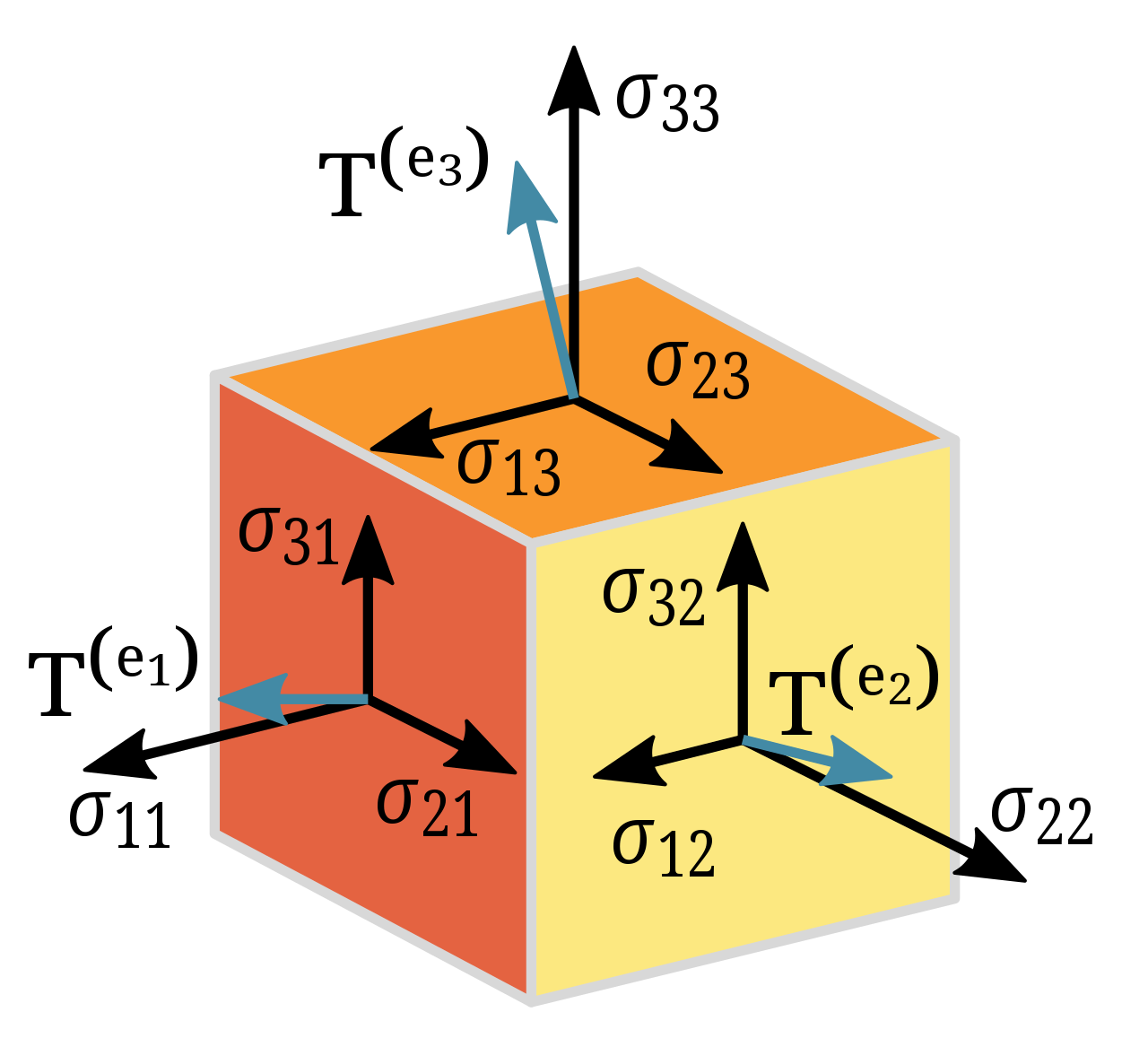
Tensor
In mathematics, a tensor is an algebraic object that describes a multilinear relationship between sets of algebraic objects associated with a vector space. Tensors may map between different objects such as vectors, scalars, and even other tensors. There are many types of tensors, including scalars and vectors, dual vectors, multilinear maps between vector spaces, and even some operations such as the dot product. Tensors are defined independent of any basis, although they are often referred to by their components in a basis related to a particular coordinate system; those components form an array, which can be thought of as a high-dimensional matrix.
Cosine similarity
In data analysis, cosine similarity is a measure of similarity between two non-zero vectors defined in an inner product space. Cosine similarity is the cosine of the angle between the vectors; that is, it is the dot product of the vectors divided by the product of their lengths. It follows that the cosine similarity does not depend on the magnitudes of the vectors, but only on their angle. The cosine similarity always belongs to the interval [ − 1 , + 1 ] . {\displaystyle [-1,+1].} For example, two proportional vectors have a cosine similarity of +1, two orthogonal vectors have a similarity of 0, and two opposite vectors have a similarity of −1. In some contexts, the component values of the vectors cannot be negative, in which case the cosine similarity is bounded in [ 0 , 1 ] {\displaystyle [0,1]} .
Evaluating and Sampling Glinty NDFs in Constant Time
Geometric features between the micro and macro scales produce an expressive family of visual effects grouped under the term 'glints'. Efficiently rendering these effects amounts to finding the highlights caused by the geometry under each pixel. To allow for fast rendering, we represent our faceted geometry as a 4D point process on an implicit multiscale grid, designed to efficiently find the facets most likely to cause a highlight. The facets' normals are generated to match a given micro-facet normal distribution such as Trowbridge-Reitz (GGX) or Beckmann, to which our model converges under increasing surface area. Our method is simple to implement, memory-and-precomputation-free, allows for importance sampling and covers a wide range of different appearances such as anisotropic as well as individually colored particles. We provide a base implementation as a standalone fragment shader.
From State- to Delta-Based Bidirectional Model Transformations: the Asymmetric Case.
Journal of Object Technology
Tim Cook stepping down as Apple CEO, John Ternus taking over | TechCrunch
Senior Vice President of Hardware Engineering John Ternus will take over as CEO at the start of September.

The Palladian grammar
A parametric shape grammar that generates the ground plans of Palladio's villas is developed as a definition of the Palladian style. The grammar is applied to generate the plan for the Villa Malcontenta.
Scaling Laws for Autoregressive Generative Modeling
We identify empirical scaling laws for the cross-entropy loss in four domains: generative image modeling, video modeling, multimodal image$\leftrightarrow$text models, and mathematical problem solving. In all cases autoregressive Transformers smoothly improve in performance as model size and compute budgets increase, following a power-law plus constant scaling law. The optimal model size also depends on the compute budget through a power-law, with exponents that are nearly universal across all data domains. The cross-entropy loss has an information theoretic interpretation as $S($True$) + D_{\mathrm{KL}}($True$||$Model$)$, and the empirical scaling laws suggest a prediction for both the true data distribution's entropy and the KL divergence between the true and model distributions. With this interpretation, billion-parameter Transformers are nearly perfect models of the YFCC100M image distribution downsampled to an $8\times 8$ resolution, and we can forecast the model size needed to achieve any given reducible loss (ie $D_{\mathrm{KL}}$) in nats/image for other resolutions. We find a number of additional scaling laws in specific domains: (a) we identify a scaling relation for the mutual information between captions and images in multimodal models, and show how to answer the question "Is a picture worth a thousand words?"; (b) in the case of mathematical problem solving, we identify scaling laws for model performance when extrapolating beyond the training distribution; (c) we finetune generative image models for ImageNet classification and find smooth scaling of the classification loss and error rate, even as the generative loss levels off. Taken together, these results strengthen the case that scaling laws have important implications for neural network performance, including on downstream tasks.

huh, yikes at bsky's svg conversion original: upload.wikimedia.org/wikipedia/commons/c/c5/Compar…
huh, yikes at bsky's svg conversion original: upload.wikimedia.org/wikipedia/commons/c/c5/Compar…
