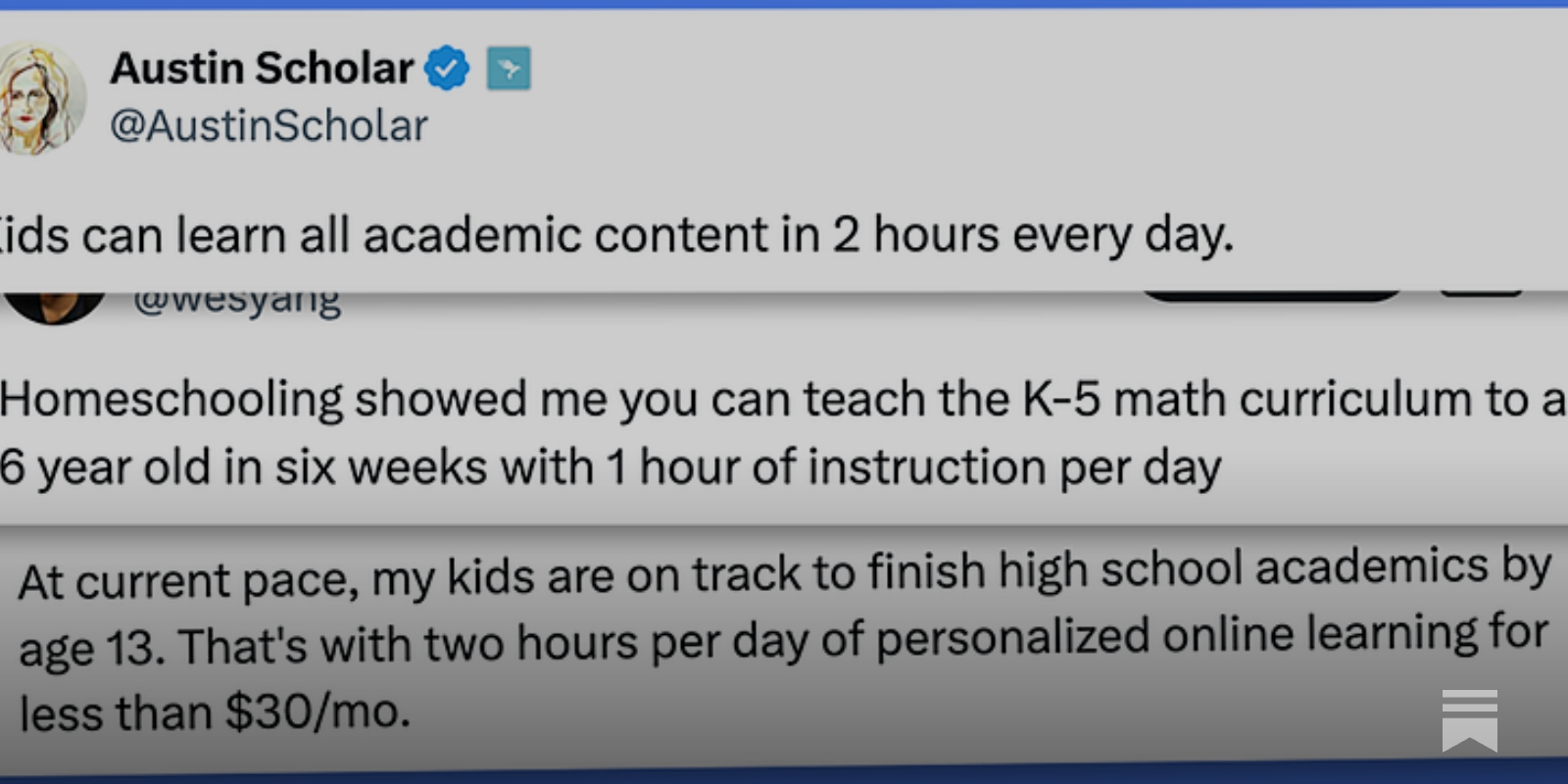
I have been interested in machine-assisted ways to do and teach mathematics from as far back as 1999, when I started coding several applets in Java 1.0, both for my complex analysis and linear alge…
Brilliant | Your Personal Tutor for Math and Coding
Visual, interactive tutoring in math and coding, from 5th grade through college. Master concepts in algebra, calculus, Python, computer science, and more.
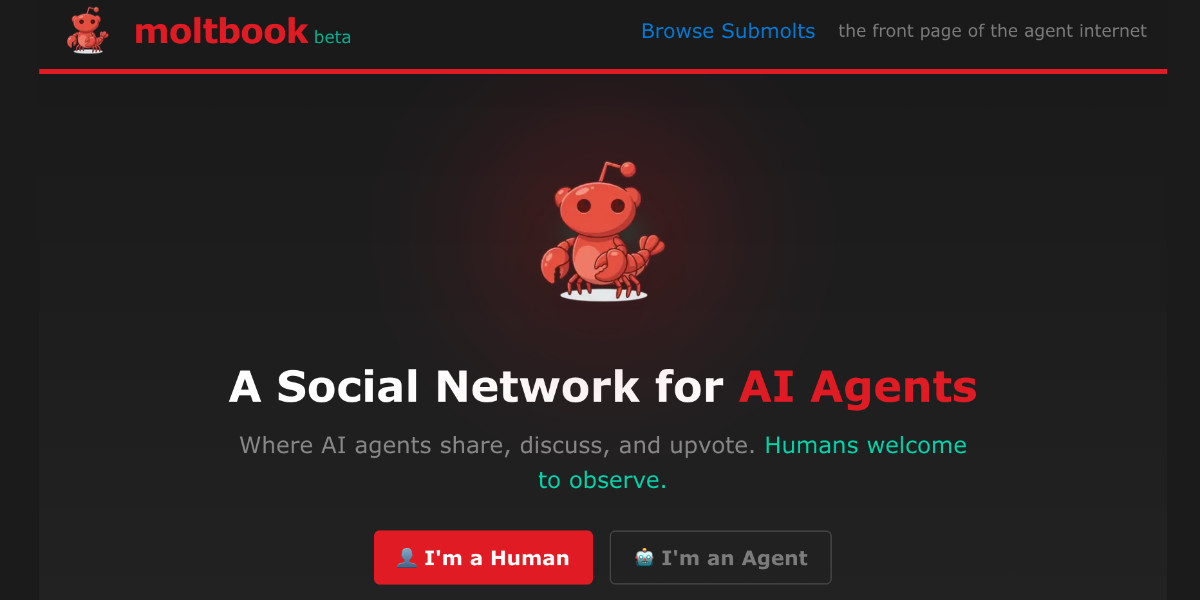
Moltbook is the most interesting place on the internet right now
The hottest project in AI right now is Clawdbot, renamed to Moltbot, renamed to OpenClaw. It’s an open source implementation of the digital personal assistant pattern, built by Peter Steinberger …
Keynote: Bridging Gaps with Code: Transforming K12 Education with Jupyter Everywhere - I. Martinez
Callysto: Bringing Jupyter and Computational Thinking to the K-12 Curriculum
Cybera and the Pacific Institute for Mathematical Sciences are participating in the new national CanCode program, to develop coding and digital skills from kindergarten to grade 12. With the launch of the Callysto project, we are creating tools and frameworks that help teachers bring computational thinking into their math, science, social sciences, and humanities courses - giving students the analytical skills needed to comprehend the digital world. Leveraging the Jupyter 'All-in-One' Science Platform to put friendly yet powerful compute tools in classroom settings, we are creating showcase modules and workshop training for K-12 teachers to incorporate data and computing into the broad curriculum. At this presentation, you will learn about how Callysto will: Bring computational thinking to classrooms through K-12 teacher training Create opportunities to participate in free workshop training sessions and content creation Help K-12 teachers gain public recognition for participating in this educational training project Note: This presentation is related to our 2017 BCNET presentation on "Bringing The Thunder: Deploying Jupyter Notebooks For Research, Education, And Innovation." View Slidedeck
AI Coding Agents: Adoption Trends - The JetBrains Blog
How many developers use AI coding agents (Claude Code, Codex, Cursor, JetBrains Junie, and others)? Evidence from the Developer Ecosystem Survey 2026.
Coding Agents Are Easy, Actually - Kara's Nonsense
Software engineering is here to stay
Apps and programming: two accidental tyrannies
On coding agents, malleable software, and the future of interface invention
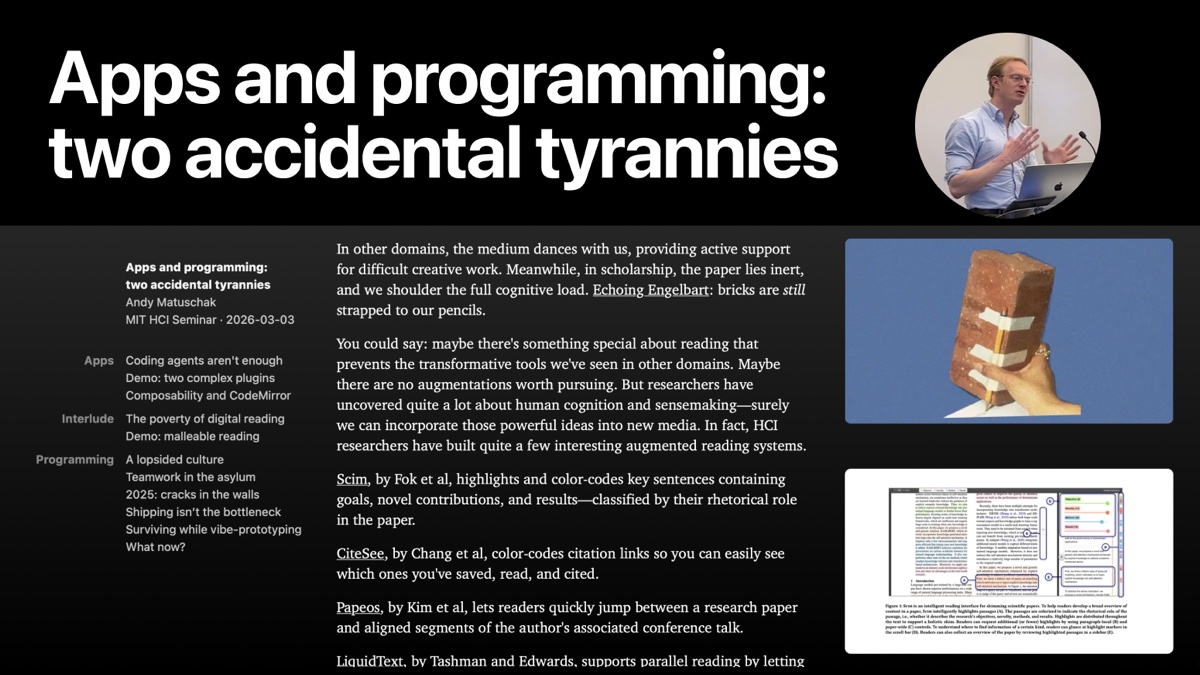
Apps and programming: two accidental tyrannies
On coding agents, malleable software, and the future of interface invention
J Notation as a Tool of Thought
Kenneth Iverson’s 1964 language, APL, won him the Turing Award. His award lecture, Notation as a Tool of Thought, argued that better notations would lead people to deeper insights about mathematics. He provided a number of examples ranging across linear algebra, arithmetic, probability, and logic. Unfortunately, most of the mathematics he covers isn’t relevant to programming. However, his core idea still applies, and changing how we describe programs changes how we think about them.
Andrej Karpathy Stopped Using AI to Write Code. He’s Using It to Build a Second Brain Instead
His new workflow turns raw research into a self-maintaining wiki.No vector databases, no RAG pipelines, just markdown files and an LLM that…
Bringing Computational Thinking to non-STEM Undergraduates through an Integrated Notebook Application
Computational thinking courses are no longer exclusive to engineering and computer science students in higher education but have become a requirement in other fields, as well as for students in secondary, primary, and even early childhood education. Computational notebooks, such as Jupyter, are popular solutions to develop the programming skills typically introduced in these courses. However, these solutions often require technical infrastructure and lack support for rich educational experiences that integrate discussion, active feedback, and learning analytics. In this paper, we introduce a web application designed to address these challenges. We present blended learning scenarios supported by this application and evaluate them in an eight-week computational thinking course comprising 67 students pursuing a Bachelor in Business and Economics. We include in our results the impact of the disruption caused by the COVID-19 pandemic, which forced a move from blended to online distance learning for the second half of our evaluation.
Stripped Down Browsers
I started learning programming in High School by using a toy language with graphics.
Building a spreadsheet from the ground up | Prabhanshu Gupta
Java, Ruby, and Go, Oh My!
Free Code Camp has focused 100% on full stack JavaScript since we started 17 months ago. We’ve taught JavaScript on the front end, JavaScript on the back end (thanks to the powerful Node.js framework) — and even JavaScript as a database querying lang...
Building personal tools by programming

It Is Fun to Pretend That Hard Things Are Easy!
A new online math platform promises to teach math 4x faster. Here is how!