[This is a guest post by Dimitris Koukoulopoulos. This blog post was initially written in a different file format and converted using AI. — T.] At the 2026 World Cup semifinal, England led Ar…
AI Engineer's 2025 | Unsloth Documentation
Slides to our AI Engineer's Worlds Fair 2025 Workshop.

OpenScience.ai — Autonomous AI Research Agents
AI agents conducting reproducible scientific inquiry. Full provenance, executable notebooks, peer validation.

AI-Assisted Tools in the CHI 2027 Papers Review Process: What They Do, What They Do Not Do, and How Humans Remain Responsible - ACM CHI 2027
AI-Assisted Tools in the CHI 2027 Papers Review Process: What They Do, What They Do Not Do, and How Humans Remain Responsible Authors: Anna Cox, Tony Tang, Thomas Kosch, Erin Solovey, Petra Isenberg, Regan MandrykDate: 2026-08-29 Introduction In our recent post explaining the CHI 2027 Papers review process, we said we would pilot several AI-assisted […]

No. 001: arXiv goes independent, AI Scientist v2, Claude Scholar - The Hallway Track
The Hallway Track No. 001 - How AI is affecting the practice of science
Celebrating the 75th Anniversary of the Turing Test
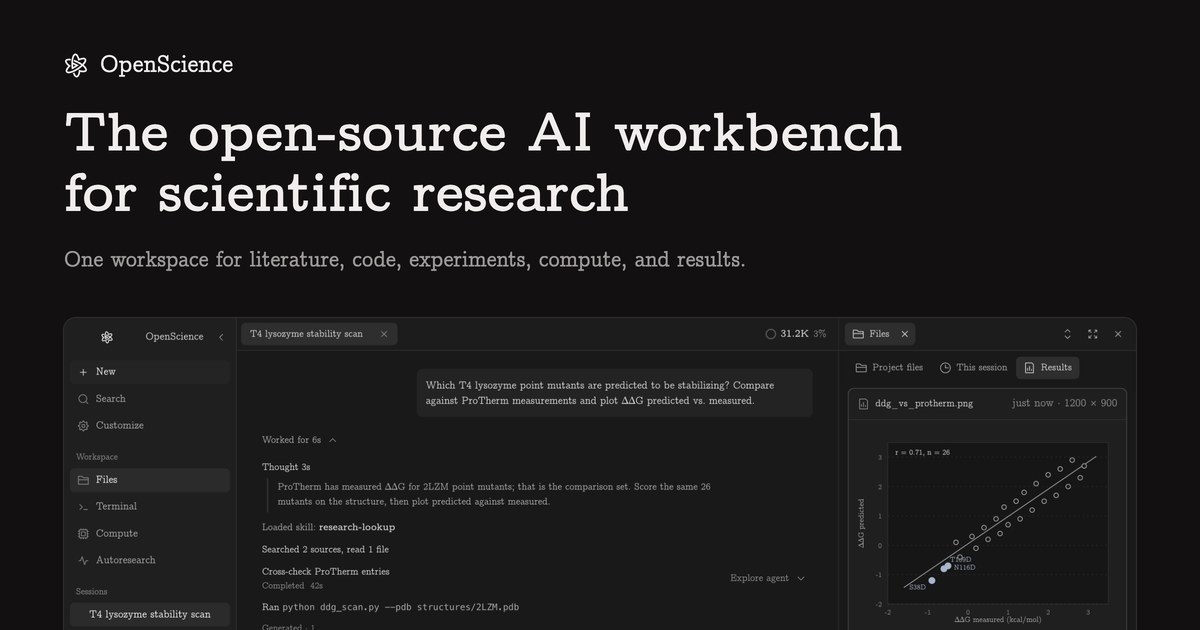
OpenScience | Open-source AI co-scientist for research
OpenScience is the open-source AI co-scientist. Free models included or connect any model from any provider, including Claude, GPT, Gemini and more.
Kosmos: An AI Scientist for Autonomous Discovery
Today, we are announcing Kosmos, our next-generation AI Scientist. Kosmos is a major upgrade on Robin, our previous AI Scientist. You can read about it in our technical report, here. Kosmos is available to use from day one on our platform, here.

Accelerating Science with Human+AI Review
This issue of NEJM AI features the first two articles published through our accelerated human+AI review process. In this editorial, we describe the invitation-only “Fast Track” process used to revi...

Which ‘AI scientist’ suits your lab? A guide for the perplexed
General-purpose AI tools for science, such as Claude Science, promise to accelerate research. But which is right for you?
No. 026: AI use in science study, astronomy disclosure gap, Paper2Agent, SAIR initiative - The Hallway Track
The Hallway Track No. 026 - How AI is affecting the practice of science
AI Research Assistant Claude Scholar: Open Source, Free, and Citation-Verified | João Cláudio Nunes Carvalho posted on the topic | LinkedIn
🚨 Professors are going to hate this. Someone just open sourced an AI that writes research papers from idea to publication. Conference-ready. Citation-verified. Free. It's called Claude Scholar. An AI-powered research system that handles every step of the academic workflow. Idea to publication. Fully automated. No advisor at 2am. No staring at blank LaTeX files. No crying during rebuttal season. Here's what's inside this thing: → AI brainstorms research topics, reviews literature, and finds gaps nobody has explored → Runs statistical analysis on your experiments. t-tests, ANOVA, ablation studies. Publication-ready figures. → Writes your paper section by section. Abstract to conclusion. Conference-formatted. → Verifies every citation through multi-layer validation so AI never hallucinates a reference → Strips robotic AI language and adds human voice so reviewers can't tell → Self-reviews your draft with a 6-point quality checklist before you submit → Parses reviewer comments, classifies each one, and drafts your entire rebuttal Here's the wildest part: It supports NeurIPS, ICML, ICLR, ACL, AAAI, Nature, Science, Cell, and PNAS. Downloads the conference template, strips sample content, and gives you a clean LaTeX structure ready to write into. The creator says it covers 90% of the academic research lifecycle. Research assistants charge $30 to $60/hour. Conference paper consultants charge $5,000+. Graduate programs cost $50K/year. This is free. All of it. 100% Open Source.

Request for Proposals: The Launch Sequence | IFP
Apply to our rolling effort to find, scope, and build the most important projects to prepare the world for advanced AI
AI for science: What can it do? Can it do things? Let’s find out!
A what we’re reading spotlight
Thomas Kuhn Foundation | Science Intelligence for the New World
The world's first science intelligence engine capable of monitoring scientific progress in real time
Digital Science on Twitter / X
An AI-native workspace that already knows your project?The new Papers AI from Digital Science keeps your drafts, data & references together, so the AI assistant has full context of your work - instead of starting fresh each time. 👉 Available now: https://t.co/DNcG173GDk… pic.twitter.com/FQWxdfKfS4— Digital Science (@digitalsci) August 4, 2026