


A look at modern news websites. How programmatic ad-tech, huge payloads and hostile architecture destroyed the reading experience.
The death of the newsfeed — Benedict Evans
What do we do now that there’s more in the newsfeed than we can possibly read? Can the algorithmic sample ever actually work, or do we swing back to 1:1 messaging? How do Stories rebundle that? And what happens to all the traffic that the newsfeed provides?

Death by a thousand likes: How Facebook and Twitter are killing the open web
Here’s one way to understand the symbiotic relationship between publications and platforms in the digital age. Publications depend on advertising dollars to keep producing content, so they need to hold readers’ attention. Big platforms like Facebook and Twitter already have plenty of attention, but they need vast quantities of content to fill up their newsfeeds. It seems natural, then, that publications have started relying on platforms to drive readership.

It's time to rebuild the web
The web was never supposed to be a few walled gardens of concentrated content owned by a few major publishers; it was supposed to be a cacophony of different sites and voices.

Web bloat isn’t a knowledge problem | Christian Heilmann
There is a consensus among all browser makers and lovers of the web: the current state of the web is a mess. The average web page is 2.4 megabyte big and has over 200 requests.
news/faster-builds
A delightful language with friendly error messages, great performance, small assets, and no runtime exceptions.
What Was the Internet?
As AI overtakes the web, five writers reflect on how far it’s fallen and what comes next.

What Was the Internet?
As AI overtakes the web, five writers reflect on how far it’s fallen and what comes next.
Foundations: the accessibility tree - TetraLogical
There's a common misconception that when browsing the web using a screen reader, it's reading the actual screen. This is not really surprising, as the name suggests that's exactly what it's doing. And, this is what early screen readers did, so, we can't really blame anybody for thinking that!
The Mediated Web
<p>Large Language Models have the potential to hugely shift what it means to interact with a web browser.</p> <p>Here’s a prediction: the web will soon be mediated by agents, not just rendered by web browsers. Every user will have their own AI interpreting information for them, and executing tasks on their behalf.</p> <p>What does this mean now, and what does it mean for the future of the web? Let’s delve into what a mediated web might look like, and how it could impact the internet ecosystem.</p>

homepages.news — News Homepages documentation
An open-source archive that gathers, saves, shares and analyzes news homepages
How the small web is creating an anti-slop internet
What is the small web? A new crop of platforms are answering algorithmic fatigue with a return to human-curated basics.

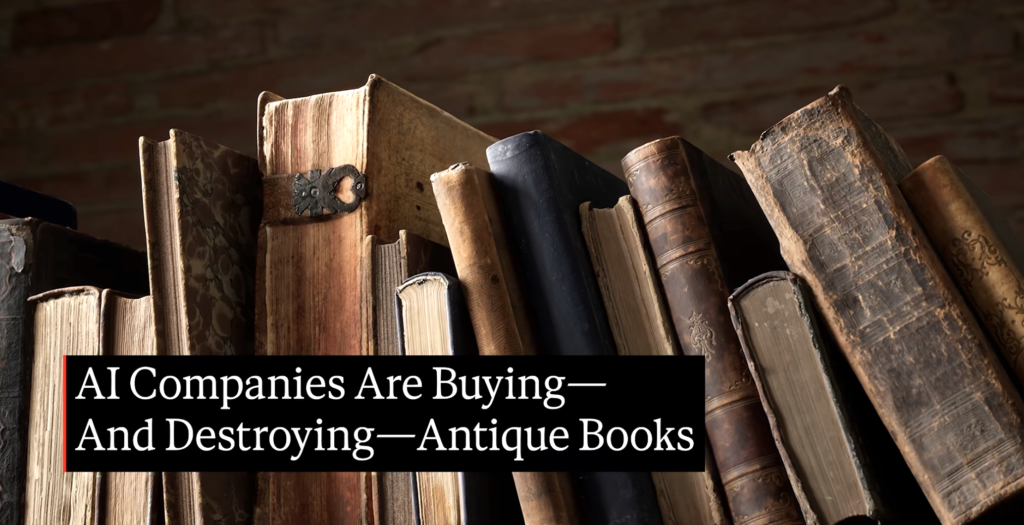
Why AI Companies Are Buying—And Then Destroying—Old Books
We've long joked about delaying bedtime in order to read the entire internet, but the prospect of actually doing so doesn't sound as appealing as it used to. An ever-growing proportion of text online, we may sense, hasn't been written by humans, but generated by artificial intelligence.
Matter
Matter brings newsletters, feeds, and read-later into one beautiful interface. It’s the ultimate reading client for the open web.

How Google helped destroy adoption of RSS feeds
Learn how one of the biggest tech companies played a major role in the reason many people stopped using RSS feeds

How to create reading experiences that "go beyond information transmission and toward reader transformation.” Great paper by @blue-phia.bsky.social @lepidopterane.bsky.social @yijunliu.bsky.social Sarah Sterman @sh1m.bsky.social @maxkreminski.bsky.social arxiv.org/abs/2606.04308 >
