

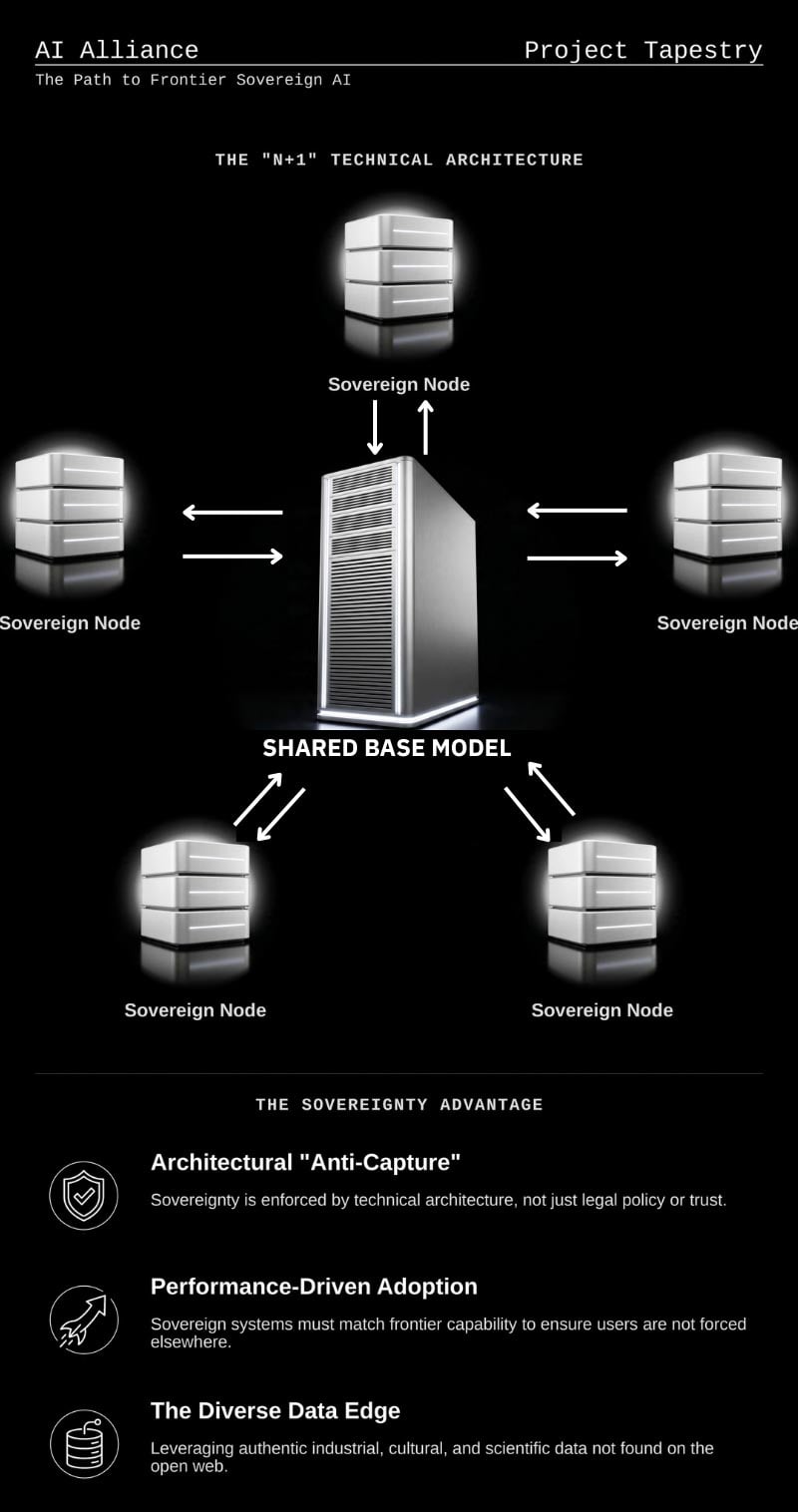
Project Tapestry is the AI Alliance's open consortium for co-training frontier AI- share one base model while keeping data and sovereign derivatives.
AI Alliance Launches Project Tapestry to Build a Collaborative Foundation for Open and Sovereign AI
AI Alliance launches Project Tapestry, an open-source platform for collaborative AI development that preserves sovereignty and enables local control.

MOSAIC — Modular Open Science, AI & Collective Intelligence
MOSAIC is an R&D program to build a new medium for large-scale, AI-augmented networked research.
co/core — an AI cooperative
co/core is a cooperative for AI inference — people pooling the Macs they already own to run open models for each other, instead of renting from the big clouds. An experiment in AI infrastructure we build, share, and own together. Bring your existing OpenAI-compatible code, or share a Mac and help run it.
co/core — an AI cooperative
co/core is a cooperative for AI inference — people pooling the Macs they already own to run open models for each other, instead of renting from the big clouds. An experiment in AI infrastructure we build, share, and own together. Bring your existing OpenAI-compatible code, or share a Mac and help run it.
Fabric — the AI workspace that thinks with you
Write, make, collaborate, and publish – with a personal AI that knows your projects, files, and ideas. For thinkers, researchers, designers, and teams.
AI alliance Cohere and Aleph Alpha
Cohere and Aleph Alpha, two trusted sovereign AI providers for governments and regulated industries, today announce their plan to join forces. This transatlantic alliance would combine Cohere’s global AI scale with Aleph Alpha’s strong research excellence and deep institutional relationships, forging a globally competitive AI champion backed by their Canadian and German ecosystems. The initiative reflects a shared vision: To provide the world with an independent, enterprise-grade sovereign alternative in an era of growing AI concentration and to ensure that organizations do not need to relinquish control over their own AI stack.

Union.ai: Ship fast. Scale big. Orchestrate the future.
The AI development platform to go from experimentation to production faster. Orchestrate, train, and serve AI.

Global Coordination | Windfall Policy Atlas
How can international cooperation ensure the benefits of AI are shared globally?
AI Commons - One Project
What if we could redefine AI? What if we could shift its development from a capitalist model to a more disruptive, inclusive, and decentralized one?

Idea Nation | Alexandre Plennevaux 🇧🇪🇪🇺 | Offprint
Free Skills and plugins to collaboration with AI agents better and cheaper.

Generative AI and the Digital Commons — The Collective Intelligence Project
The aim of this paper is to build models of governance for generative foundation models that enable broadly shared benefit. Our initial hypothesis is that data is a high-value lever of governance. Many of these models are trained on publicly available data and use public infrastructure, but 1) may d
Frontier Pre-training at Microsoft AI | Microsoft AI
In June, we announced MAI-Thinking-1, a general-purpose foundation model post-trained on top of MAI-Base-1 with strong reasoning performance. We’ve recently completed pre-training our new state-of-the-art model, MAI-Base-2, an MoE foundation model with 80 billion active and 2.8 trillion total parameters.
co/core · 5.0 ★ | at-store
co/core is a cooperative for AI inference — people pooling the Macs they already own to run open models for each other. Tag: Developer.

On the Opportunities and Risks of Foundation Models
AI is undergoing a paradigm shift with the rise of models (e.g., BERT, DALL-E, GPT-3) that are trained on broad data at scale and are adaptable to a wide range of downstream tasks. We call these models foundation models to underscore their critically central yet incomplete character. This report provides a thorough account of the opportunities and risks of foundation models, ranging from their capabilities (e.g., language, vision, robotics, reasoning, human interaction) and technical principles(e.g., model architectures, training procedures, data, systems, security, evaluation, theory) to their applications (e.g., law, healthcare, education) and societal impact (e.g., inequity, misuse, economic and environmental impact, legal and ethical considerations). Though foundation models are based on standard deep learning and transfer learning, their scale results in new emergent capabilities,and their effectiveness across so many tasks incentivizes homogenization. Homogenization provides powerful leverage but demands caution, as the defects of the foundation model are inherited by all the adapted models downstream. Despite the impending widespread deployment of foundation models, we currently lack a clear understanding of how they work, when they fail, and what they are even capable of due to their emergent properties. To tackle these questions, we believe much of the critical research on foundation models will require deep interdisciplinary collaboration commensurate with their fundamentally sociotechnical nature.

MOSAIC

Modular Open Science, AI & Collective Intelligence (mosaic-program.org)
Humans are Missing from AI Coding Agent Research
ci.acm.org

Reinventing Discovery

Human learning is an understudied but promising lever for boosting human–AI synergy

AI for science needs reasoning, not just data
MOSAIC — Modular Open Science, AI & Collective Intelligence