

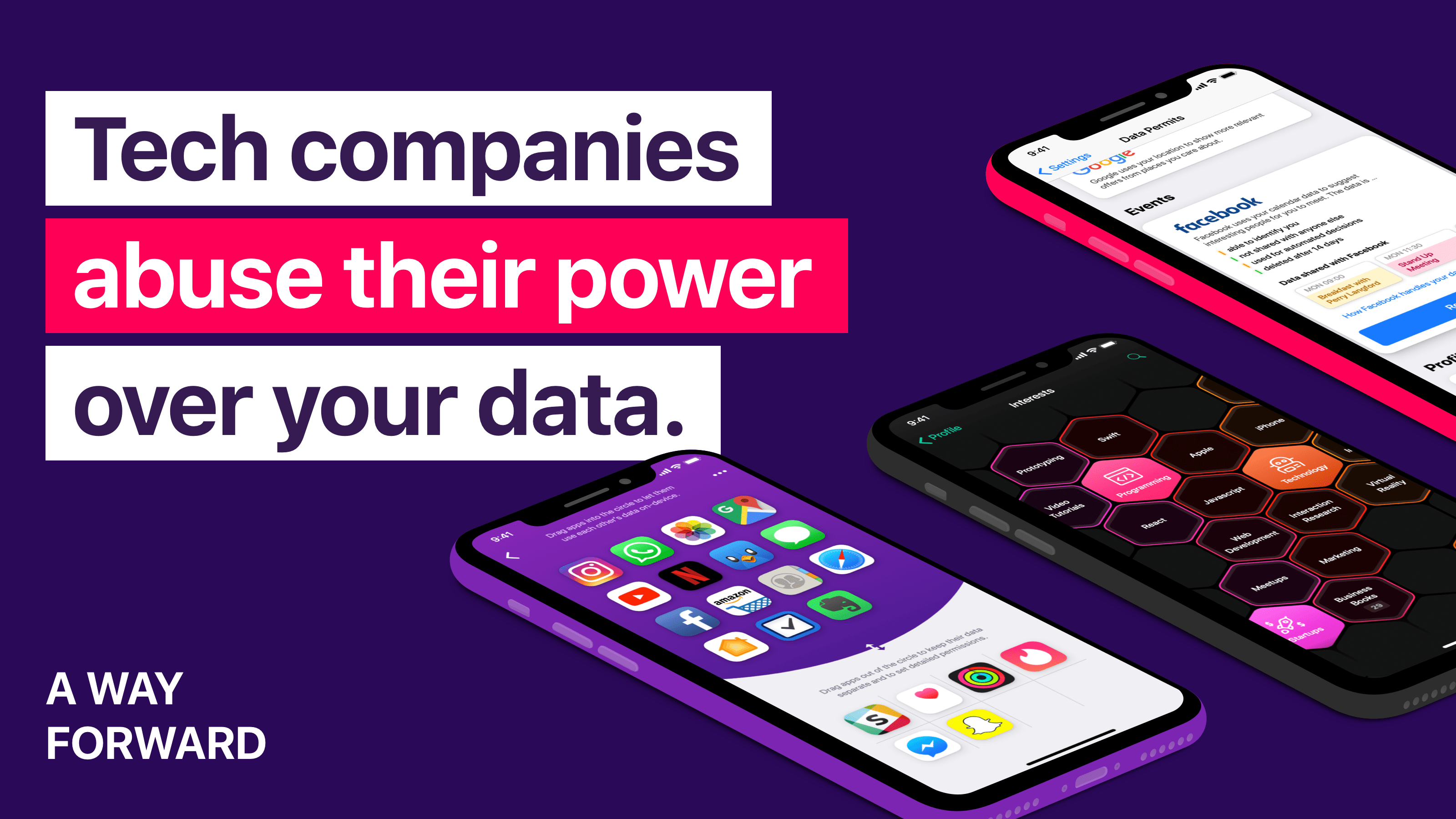
This essay explores visually how keeping data and AI on‑device could empower not only users, but also companies.
Can “Conscious Data Contribution” Help Users to Exert “Data Leverage” Against Technology Companies?
Tech users currently have limited ability to act on concerns regarding the negative societal impacts of large tech companies. However, recent work suggests that users can exert leverage using their role in the generation of valuable data, for instance by withholding their data contributions to intelligent technologies. We propose and evaluate a new means to exert this type of leverage against tech companies: "conscious data contribution" (CDC).
A Collectivist, Economic Perspective on AI
Information technology is in the midst of a revolution in which omnipresent data collection and machine learning are impacting the human world as never before. The word ``intelligence'' is being...

Data privacy concerns in AI companion apps - Surfshark
As AI grows, digital companions help with loneliness but raise questions about user data privacy. Many seek virtual relationships, but it's important to remember they are business-driven, not personal bonds.

Personal data storage is an idea whose time has come
Data Ownership as a conversation changes when data resides primarily with people-governed institutions rather than corporations.

Data Leverage: A Framework for Empowering the Public in its Relationship with Technology Companies
Many powerful computing technologies rely on implicit and explicit data contributions from the public. In this paper, we synthesize emerging research that seeks to better understand and help people action this data leverage. Drawing on prior work in areas including machine learning, human-computer interaction, and fairness and accountability in computing, we present a framework for understanding data leverage that highlights new opportunities to change technology company behavior related to privacy, economic inequality, content moderation and other areas of societal concern.
Reclaim Control | over your technology, your devices, your data, your digital life.
You have the right to control your data, devices, and services. We coordinate, develop and foster communities of Reclaimers who want digital independence. Together, let's reclaim the right to a technical future of data sovereignty, digital autonomy, responsible governance, and collective care online for all.
Something Big Is Happening
A personal note for non-tech friends and family on what AI is starting to change.
HUGE — AI Without Giving Up Your Privacy
We're building an Agentic AI Platform running on your Device that lives with YOU, isolated from the cloud, fundamentally reimagining the relationship between humans and artificial intelligence through ownership, privacy, and massive context. In an age of capture and control, HUGE sells independence and sovereignty.
Blog
For quite some time now, i have been working on and off on a fully self-hosted search engine, in hope to make it easier to search across Personal data in an end to end manner. Even as individuals, we are hoarding and generating more and more data with no end in sight. Such "personal" data is being stored from local hard-disks to corporate controlled cloud-centers which makes it distributed in nature. So for following discussion, "Personal" meaning would be flexible enough to accommodate resources on a remote server and/or on different devices, as long the user could prove authentication and/or authorization to that data. Current implementation supports only "images", but eventual goal is also to support other modalities like video, text and audio, some code would be shared, while some new code would be required to better extract Features for each modality.
A Collectivist, Economic Vision for AI
Information technology is in the midst of a revolution in which omnipresent data collection and machine learning are impacting the human world as never before. The word “intelligence” is being used as a North Star for the development of this technology, with human cognition viewed as a baseline. This view neglects the fact that humans are social animals and that much of our intelligence is social and cultural in origin. Moreover, failing to properly situate aspects of intelligence at the social level contributes to the treatment of the societal consequences of technology as an afterthought. The path forward is not merely more data and compute, and not merely more attention paid to cognitive or symbolic representations, but a thorough blending of economic and social concepts with computational and inferential concepts at the level of algorithm design. , The recent focus of AI has been on the exploitation of massive data to mimic and augment human cognitive capabilities. A complementary focus is provided by the social and economic aspects of intelligence.

MyData
The human-centric approach to data is aimed at a fair, sustainable, and prosperous digital society. In such a society, people get value from their data and set the agenda on how it is used. And for organisations, the ethical use of data is always the most attractive option.

Living in Data: A Citizen's Guide to a Better Information Future (Paperback)
Jer Thorp’s analysis of the word “data” in 10,325 New York Times stories written between 1984 and 2018 shows a distinct trend: among the words most closely associated with “data,” we find not only its classic companions “information” and “digital,” but also a variety of new neighbors—from “scandal” and “misinformation” to “ethics,” “friends,” and “play.”To live in data in the twenty-first century

How Artificial Intelligence Constrains the Human Experience
AbstractArtificial intelligence (AI) and related technologies are transforming many consumption activities, powering breakthroughs that expand the human experience by enhancing human capabilities, performance, and creativity. While this explains the consumer enthusiasm and rapid adoption of these technologies, AI systems can also have the opposite effect: reducing and constraining the range of experiences that are available to consumers. This article examines the mechanisms through which AI can constrain the human experience, considering individual, interpersonal, and societal processes. Our analysis uncovers a complex interplay between the advantages of AI and its inadvertent negative repercussions, which potentially restrict human autonomy, self-identity, relational dynamics, and social behavior. In this article, we propose three different mechanisms at the core of these constraining forces: parametric reductionism, agency transference, and regulated expression. Our exploration of these mechanisms highlights the risks connected to system design and points to questions and implications for future researchers and policymakers.

Alexander Obenauer
Exploring new and renewed ideas for how personal computing and the interfaces we think with can better serve people’s lives – expanding opportunity, agency, curiosity, and creativity.
Nonrivalry and the Economics of Data
(September 2020) - Data is nonrival: a person's location history, medical records, and driving data can be used by many firms simultaneously. Nonrivalry leads to increasing returns. As a result, there may be social gains to data being used broadly across firms, even in the presence of privacy considerations. Fearing creative destruction, firms may choose to hoard their data, leading to the inefficient use of nonrival data. Giving data property rights to consumers can generate allocations that are close to optimal. Consumers balance their concerns for privacy against the economic gains that come from selling data broadly.
Quantified self
Quantified self is both the cultural phenomenon of self-tracking with technology and a community of users and makers of self-tracking tools who share an interest in "self-knowledge through numbers". Quantified self practices overlap with the practice of lifelogging and other trends that incorporate technology and data acquisition into daily life, often with the goal of improving physical, mental, and emotional performance. The widespread adoption in recent years of wearable fitness and sleep trackers such as the Fitbit or the Apple Watch, combined with the increased presence of Internet of things in healthcare and in exercise equipment, have made self-tracking accessible to a large segment of the population.
