We are a community dedicated to working on how we can better develop text to augment our capabilities and we invite you to join us. We believe that the potential of richly interactive text to truly augment how we think & communicate is massive. Text after all, is externalized symbols we can interact with to extend our mind’s reach. Therefore text is not just a medium, it is also a tool for thought, and we are looking Beyond Visual Range.
A Text Renaissance
There is a renaissance underway in online text as a medium. The Four Horsemen of this emerging Textopia are: Roam , a hypertext publishing platform best…
Textoshop: Interactions Inspired by Drawing Software to Facilitate Text Editing
Thinking with Type
The essential and bestselling guide to typography from beloved design educator Ellen Lupton—revised and expanded to include new and additional voices, examples, and principles, and a wider array of typefaces. "Thinking with Type is to typography what Stephen Hawking's A Brief History of Time is to physics."—I Love TypographyThe bestselling Thinking with Type in a revised and expanded third edition: This is the definitive guide to using typography in visual communication. Covering the essentials of typography, this book explores everything from typefaces and type families to kerning and tracking to grids and layout principles.Ellen Lupton provides clear and focused guidance on how letters, words, and paragraphs should be aligned, spaced, ordered, and shaped. Historical and contemporary examples of graphic design show how to learn the rules and how to break them. Critical essays, eye-opening diagrams, helpful exercises, and dozens of examples and illustrations show readers how to be inventive within systems that inform and communicate.Featuring 32 pages of new content, the third edition is revised and refined from cover to cover: More fonts: old fonts, new fonts, weird fonts, libre fonts, Google fonts, Adobe fonts, fonts from independent foundries, and fonts and lettering by women and BIPOC designersIntroductions to diverse writing systems, contributed by expert typographers from around the worldDemonstrations of basic design principles, such as visual balance, Gestalt grouping, and responsive layoutCurrent approaches to typeface design, including variable fonts and optical sizes; tips for readability, legibility, and accessibility; and stunning reproductions from the Letterform Archive Thinking with Type is the typography book for everyone: designers, writers, editors, students, anyone who works with words on page or screen, and enthusiasts of type and lettering. Readers will also love Ellen Lupton's book Extra Bold: A Feminist, Inclusive, Anti-racist, Nonbinary Field Guide for Graphic Designers. Ellen Lupton is a designer, writer, and educator. She has written numerous books about graphic design, including Thinking with Type, Graphic Design Thinking, and Extra Bold: A Feminist, Inclusive, Anti-racist, Nonbinary Field Guide for Graphic Designers. She teaches in the Graphic Design MFA program at Maryland Institute College of Art in Baltimore (MICA), where she proudly serves as the Betty Cooke and William O. Steinmetz Design Chair. She is Curator Emerita at Cooper Hewitt, Smithsonian Design Museum in New York City, where her exhibitions included Herbert Bayer: Bauhaus Master and The Senses: Design Beyond Vision. Lupton loves reading, writing, teaching, and learning new things about design.
Writing With and Beyond AI: Fieldnotes from Computer-Mediated Poetry
Apr 10, 2026, 12:15 pm - Large language models can make writing mind-numbingly efficient — but the point of writing with AI should be to write what we couldn’t have written alone (without generating bland, derivative “slop”).

On Close and Distant Reading in Digital Humanities: A Survey and Future Challenges
We present an overview of the last ten years of research on visualizations that support close and distant reading of textual data in the digital humanities. We look at various works published within both the visualization and digital humanities

Konrad Hinsen's blog
A much cited essay by Bret Victor, "Explorable Explanations", argues for supporting and encouraging active reading in communicating ideas. Explanatory text should thus be complemented by interactive visualizations and computational demonstrations, allowing the reader to actively engage with the ideas. If you haven't read Victor's essay yet, please do so now, and then come back here. It's not very long. What I am going to discuss is a variation on Victor's proposal, and I won't repeat his well-presented arguments.
How Text-to-Image AI Works, What AI Image Generators Can Create
Overview Text prompts can be transformed into photographs, artwork, concepts, characters and creative visuals.Many modern generators progressively remove noise

Amelia Wattenberger 🪷 on Twitter / X
exploring ways we can "step back" from text/code and make sense of it,the way do in maps or how we can "fit more" in our visual system, it just gets smaller and decreases resolution.here's a fun one: extract the main concepts and throw them on a sphere, keep spinning to go… pic.twitter.com/yzh42EcBTe— Amelia Wattenberger 🪷 (@Wattenberger) July 6, 2026
Creative Reading: Scaffolding Reading for Transformation
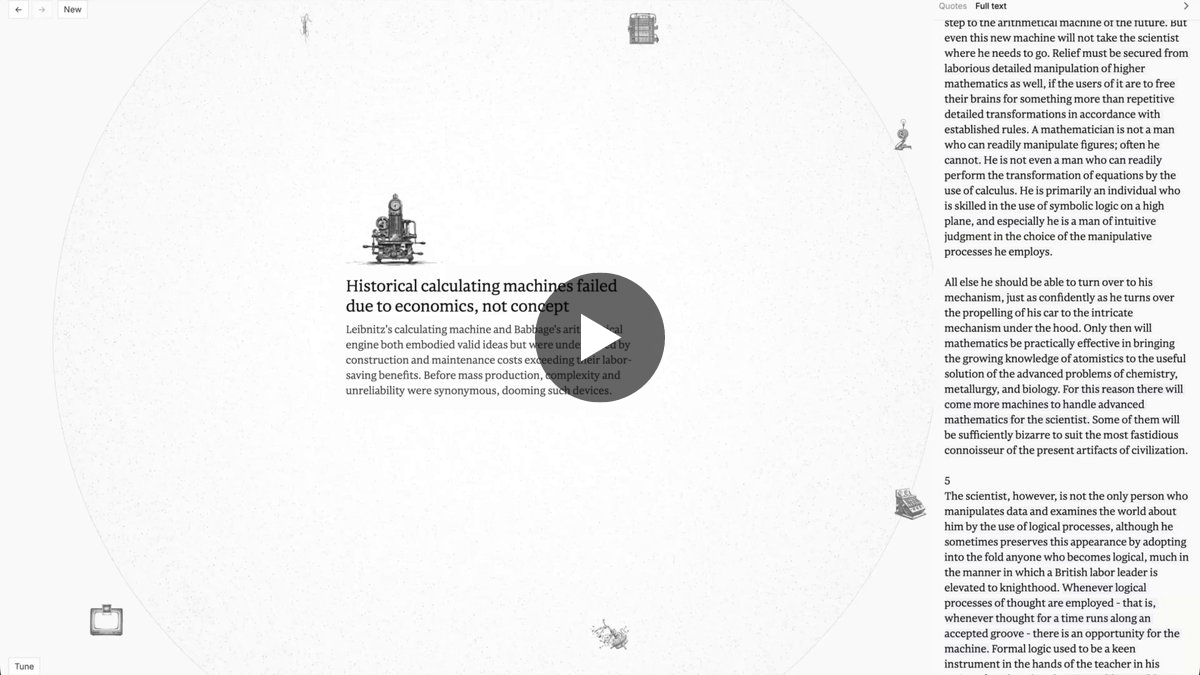
Reading augmentation systems increasingly help readers process text at scale. While these tools address real constraints of time and cognitive load, they often implicitly frame reading as...

poetic web: unfolding spiral
'poetic web: unfolding spiral' is a non-linear text I wrote as part of my bachelor thesis at the HFBK Hamburg. Driven by curiosity about the poetic web, the object of the text rather became the opening of a reflective space, where I could touch on the constraints and possibilities of language, words, worlds, and their artifacts, relation and meaning-making, smoothness, attention, and agency, and see how subtle shifts in understanding allowed for words to restructure and new meanings to grow.
How I Write Alt-Text - 12 Aug 2026 03:30 UTC
‘Alt-text’ is short for alternative text, and is used to convey the substance of visual content as text. It is important for people with visual disabilities, though is beneficial for a wide range of people. It is useful for low-speed connections where an image might not load, for searching for an image, for SEO/AIO/GEO, for cases where a link to an image is broken, for understanding context, and for a variety of other gains.

Creative Reading: Scaffolding Reading for Transformation
However, recent work on augmenting reading largely focuses on making reading more efficient, especially in knowledge-intensive contexts where people must rapidly make sense of research papers and other complex documents (Lo et al., 2024). These systems often aim to help readers skim, summarize, and synthesize large volumes of information in order to reduce cognitive effort and accelerate document- and corpus-level sensemaking at scale (Gu et al., 2025; Lo et al., 2024; Fok et al., 2023). At one extreme, the form of reading implicitly envisioned by these systems may resemble what we call “reading to discard”: extracting the essential, actionable informational core of a document as quickly and efficiently as possible, so that the rest can be swiftly tossed aside—much like we often process inbound mail. This motivates us to ask what scaffolding approaches might resist “reading to discard,” what alternative forms of reading we might scaffold, and what alternative views and values of reading might guide the conversation.
Sound & Vision
Explore the future of type with the Re:Vision 2025 typographic playground—an interactive showcase of emerging type trends. Dive in and shape the next wave of visual language.

Big AI is accelerating the metacrisis: What can we do?
The world is in the grip of ecological, meaning, and language crises that are converging into a metacrisis. Big AI is accelerating them all. LLM engineering sits at the core. Despite the public good motives of language engineers and the promise of LLMs, this work is being leveraged to create unprecedented wealth and power for a handful of individuals and corporations while causing existential harm to life on earth. As a profession, we urgently need to come together to explore alternatives and to design a life-affirming future for our field of natural language processing that is centered on human flourishing on a living planet.
A.I. Is Homogenizing Our Thoughts
Recent studies suggest that tools such as ChatGPT make our brains less active and our writing less original.