

</> htmx ~ Yes, and...
In this essay, Carson Gross discusses his advice to young people interested in computer science worried about the future given the advancements in AI.
The machines are fine. I'm worried about us.
On AI agents, grunt work, and the part of science that isn't replaceable.
Import AI 473: The US's superintelligence strategy; human brain in a mouse skull; and machine hermeneutics
Is the wall AI is hitting in the room with us right now?

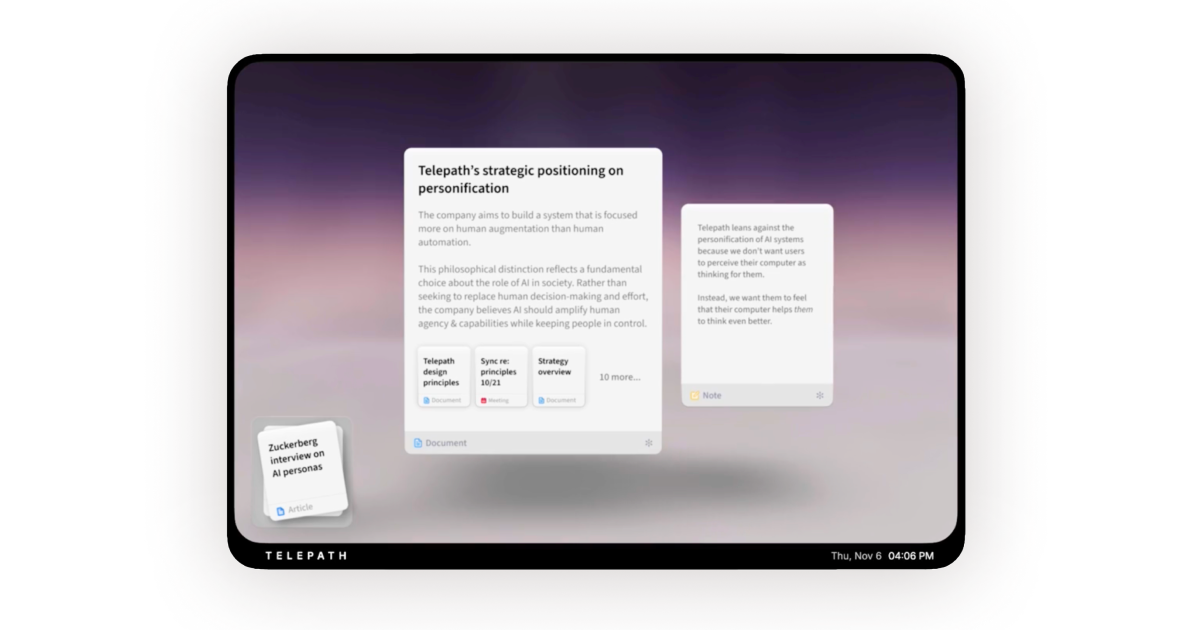
Demoing the AI computer that doesn't yet exist
A demo of what an AI-native personal computer could look like.
The contagion of fear | The Observation Deck
I have a difficult confession to make — a shameful incident that I have never spoken of, even to those closest to me. Late one night in my first year at university and having found computer science to be my life’s calling, I was in the back of the large computer science lab, talking with some fellow underclassmen. We were snidely decrying the lack of technological understanding in the broader population, with the kind of arrogance and hubris that youth and precociousness can uniquely summon. Somewhere in this discussion, a terrible idea was hatched: what if we went next door to the general computer lab, and told the humanities students there that a computer virus was spreading through their machines? Would they believe it?
Computer Says Kill: The AI Safety Circus w/ Heidy Khlaaf
Resource recs on AI catastrophic risk
If nothing magic is happening in the human brain, things could get weird

Synchron — Still you.
We build implantable Brain-Computer Interfaces to protect what makes you human.

Chinese room
The Chinese room argument holds that a computer executing a program cannot have a mind, understanding, or consciousness, regardless of how intelligently or human-like the program may make the computer behave. The argument was presented in a 1980 paper by the American philosopher John Searle, entitled "Minds, Brains, and Programs" and published in the journal Behavioral and Brain Sciences.[1] Similar arguments had been made previously by others, including Gottfried Wilhelm Leibniz, Peter Winch, and Anatoly Dneprov. Searle's version has been widely discussed in the years since.[2] The centerpiece of Searle's argument is a thought experiment known as the "Chinese room".[3]

Programming Still Sucks. — Writing
Sorry Peter. — I'm at a birthday party, and while most people here also work in tech, there's always a Guy with a Real Job. You know, a physical job, building some or other thing people need. And this Guy always asks some variant of the same question: aren't you worried AI is taking your job? I glance around and see a few faces turning around toward us, rolling their eyes ever so slightly before returning to their previous conversation. Yes, this question again.
Further Developments About Internal AI Models Hacking Things
If I had a nickel for every major leading AI lab that sheepishly admitted that the model it thought was sandboxed had, during a cybersecurity evaluation with its safeguards lowered, successfully hacked outside companies, I would have two nickels.

AI isn’t magic. It’s just weird
A new paper argues that AI should be treated as a ‘normal’ technology like electricity or the internet. But it’s far more unknowable

Close to the Metal — Real Life
The value of reintroducing friction into our interactions with computers

Rethinking security for the age of AI - The Official Microsoft Blog
Editor’s note: Updates with additional details on the model’s crash score. Why security needs a new cyber stack — Introducing Project Perception The physics of cybersecurity are changing. Autonomous systems can now reason, adapt and operate continuously. At the same time, the cost of offense is falling, while the volume, velocity and complexity of what...

Thinking about how computers can support intentional work. youtube.com/watch?v=Q7pbAW470qA

Attention architecture - thinking about todos, timeblocks, and calendars
www.youtube.com