


In its latest report the Intergovernmental Panel on Climate Change (IPCC) gave global greenhouse gas emissions a worldwide limit, know as the global
IEA reiterates ‘no new oil and gas needed’ if global warming is limited to 1.5C - Carbon Brief
The world would not need to invest in new oil and gas projects if demand for the fuels fell in line with the 1.5C limit on global warming, says the IEA

Carbon Removal Technologies | YC Request for Startups
Climate change presents an existential threat to humanity. We are already seeing the effects and they are showing up faster and stronger than anticipated. A report by United Nations' scientific panel on climate change released this month expects the atmosphere-on our current trajectory-to warm up by 1.5 degrees Celsius by 2040. Even the effects of a 0.5 degrees increase will have far-reaching consequences. This research indicates that we are already past the tipping point; even if we significantly reduced emissions, climate change would continue (Source IPCC summary C3 section). We believe there's still time to make a change if we look both to renewal energy and CO2 removal.

Carbon Captured
How the fossil fuel industry turned the plan to solve climate change into a plan to save itself

In Deep
The numbers are simply mind-blowing: up to £264 billion for a climate “solution” that will increase emissions. Has the government lost its mind?

Prime Minister Carney announces the largest clean energy investment in North American history
Canada is starting from a position of strength. We have what the world wants.

Reforming the products and processes of the IPCC to enhance its relevance
The Intergovernmental Panel on Climate Change (IPCC) assesses the scientific knowledge on climate change at five to seven year intervals. Exponential growth of the scientific literature has increased the workload for participants and the length of assessment reports. This paper proposes changes to the IPCC’s products and processes to enable it to better meet the needs of its audiences while reducing the growing burden imposed on authors and other participants.

Will Canada’s gas tax holiday drive up emissions and help the rich? | The Narwhal
The Carney government is keeping its tax off at gas pumps to help with the cost of living, but critics call it a subsidy for the oil and gas industry that won’t help those who need it most

Social Influence and Action — Jen Christiansen
I’m wary of climate solutions that are hyper focused on the action of individuals as opposed to systems and corporations. Do you experience carbon footprint guilt every time you board a plane to visit family too? Well, that whole schema was a product of the PR firm Ogilvy & Mather for British Petroleum. It was an effort to shift focus away from oil companies and onto individual responsibility to lower greenhouse gas emissions. For more, read “The carbon footprint sham” by Mark Kaufman for Mashable in 2021, and “Big oil coined ‘carbon footprints’ to blame us for their greed. Keep them on the hook” by Rebecca Solnit for The Guardian.

‘Anti-petroleum’ movement a growing security threat to Canada, RCMP say
Documents obtained by Greenpeace raise environmentalists’ fears they’ll be targets of surveillance and dirty tricks under Bill C-51
No new fossil fuel projects to reach net-zero: IEA
The International Energy Agency says in a new report that ending investment in new coal, oil and gas development is crucial to reaching ambitious climate targets by 2050.
‘The damage is done’: global oil crisis has changed fossil fuel industry for ever, IEA chief says
Exclusive: International Energy Agency’s Fatih Birol, the world’s leading energy economist, also says UK should largely forgo North Sea expansion

How Canada Became A Greenhouse Superpower
Canada, despite its cold weather, ships more fresh tomatoes, peppers and cucumbers to the U.S. than we send the other way. How? With the continent's largest cluster of greenhouses.

RETRACTED ARTICLE: The economic commitment of climate change
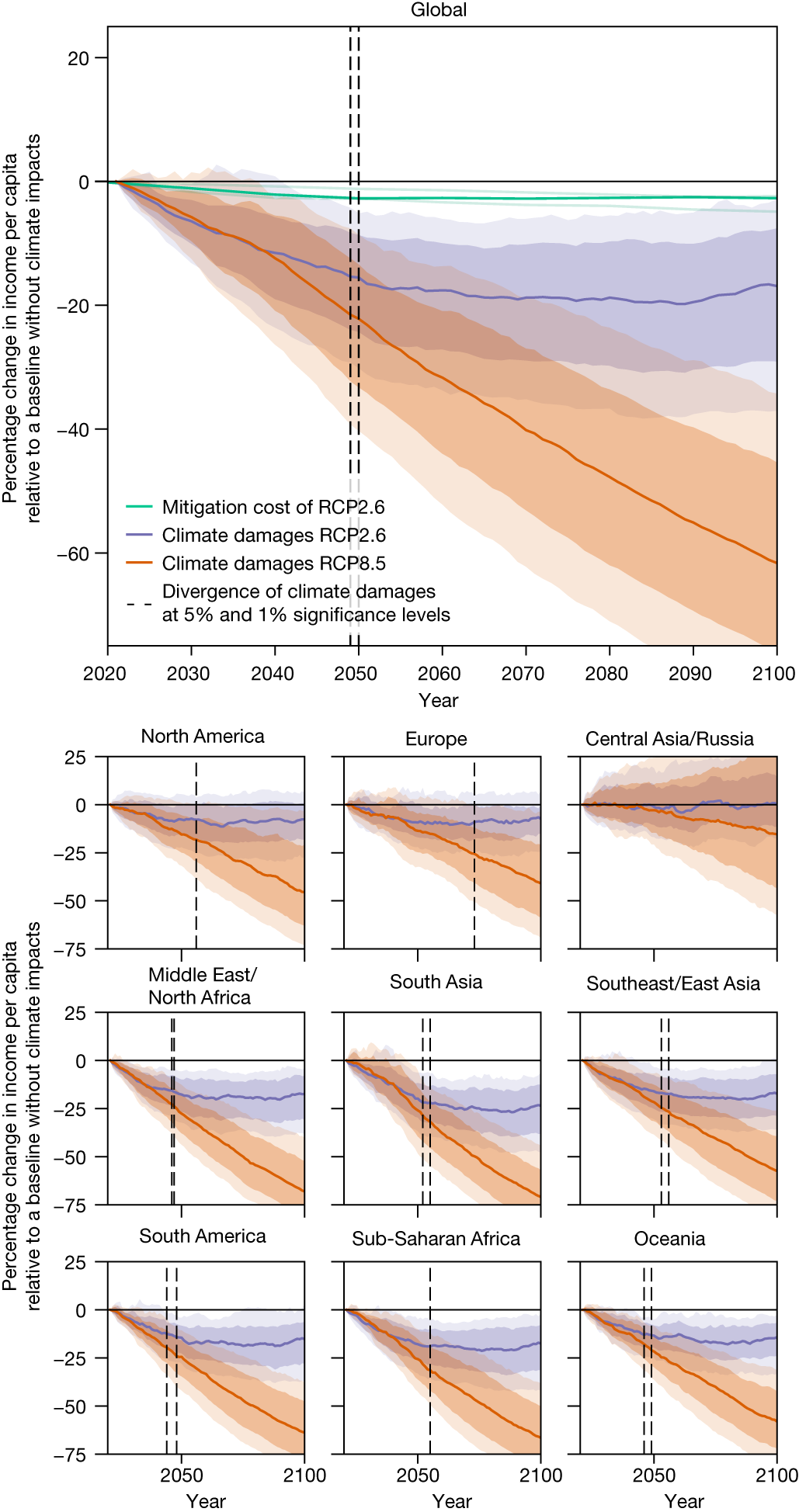
Global projections of macroeconomic climate-change damages typically consider impacts from average annual and national temperatures over long time horizons1–6. Here we use recent empirical findings from more than 1,600 regions worldwide over the past 40 years to project sub-national damages from temperature and precipitation, including daily variability and extremes7,8. Using an empirical approach that provides a robust lower bound on the persistence of impacts on economic growth, we find that the world economy is committed to an income reduction of 19% within the next 26 years independent of future emission choices (relative to a baseline without climate impacts, likely range of 11–29% accounting for physical climate and empirical uncertainty). These damages already outweigh the mitigation costs required to limit global warming to 2 °C by sixfold over this near-term time frame and thereafter diverge strongly dependent on emission choices. Committed damages arise predominantly through changes in average temperature, but accounting for further climatic components raises estimates by approximately 50% and leads to stronger regional heterogeneity. Committed losses are projected for all regions except those at very high latitudes, at which reductions in temperature variability bring benefits. The largest losses are committed at lower latitudes in regions with lower cumulative historical emissions and lower present-day income.
Why unilateral decarbonisation can pay for itself
Anthropogenic greenhouse gas emissions are rapidly warming our planet, with potentially severe economic, social, and health consequences. Conventional estimates of climate damages suggest that while coordinated global efforts are desirable, unilateral action is rarely cost-effective due to a classic free-rider problem. Why should a country bear the costs of reducing emissions when the benefits are shared globally? This column re-evaluates this view in light of new climate damage estimates based on global temperature variation, showing that the economic case for unilateral decarbonisation is far stronger than previously thought.

Key Principles for the Intergovernmental Science–Policy Panel on Chemicals and Waste
In 2021, the United Nations Environment Programme (UNEP) recognized chemical pollution as a planetary crisis tantamount to climate change and biodiversity

Assessing ExxonMobil’s global warming projections
Climate projections by the fossil fuel industry have never been assessed. On the basis of company records, we quantitatively evaluated all available global warming projections documented by—and in many cases modeled by—Exxon and ExxonMobil Corp scientists between 1977 and 2003. We find that most of their projections accurately forecast warming that is consistent with subsequent observations. Their projections were also consistent with, and at least as skillful as, those of independent academic and government models. Exxon and ExxonMobil Corp also correctly rejected the prospect of a coming ice age, accurately predicted when human-caused global warming would first be detected, and reasonably estimated the “carbon budget” for holding warming below 2°C. On each of these points, however, the company’s public statements about climate science contradicted its own scientific data. , Insider knowledge For decades, some members of the fossil fuel industry tried to convince the public that a causative link between fossil fuel use and climate warming could not be made because the models used to project warming were too uncertain. Supran et al . show that one of those fossil fuel companies, ExxonMobil, had their own internal models that projected warming trajectories consistent with those forecast by the independent academic and government models. What they understood about climate models thus contradicted what they led the public to believe. —HJS , ExxonMobil’s own climate models showed that fossil fuel use would cause climate warming. , BACKGROUND In 2015, investigative journalists discovered internal company memos indicating that Exxon oil company has known since the late 1970s that its fossil fuel products could lead to global warming with “dramatic environmental effects before the year 2050.” Additional documents then emerged showing that the US oil and gas industry’s largest trade association had likewise known since at least the 1950s, as had the coal industry since at least the 1960s, and electric utilities, Total oil company, and GM and Ford motor companies since at least the 1970s. Scholars and journalists have analyzed the texts contained in these documents, providing qualitative accounts of fossil fuel interests’ knowledge of climate science and its implications. In 2017, for instance, we demonstrated that Exxon’s internal documents, as well as peer-reviewed studies published by Exxon and ExxonMobil Corp scientists, overwhelmingly acknowledged that climate change is real and human-caused. By contrast, the majority of Mobil and ExxonMobil Corp’s public communications promoted doubt on the matter. ADVANCES Many of the uncovered fossil fuel industry documents include explicit projections of the amount of warming expected to occur over time in response to rising atmospheric greenhouse gas concentrations. Yet, these numerical and graphical data have received little attention. Indeed, no one has systematically reviewed climate modeling projections by any fossil fuel interest. What exactly did oil and gas companies know, and how accurate did their knowledge prove to be? Here, we address these questions by reporting and analyzing all known global warming projections documented by—and in many cases modeled by—Exxon and ExxonMobil Corp scientists between 1977 and 2003. Our results show that in private and academic circles since the late 1970s and early 1980s, ExxonMobil predicted global warming correctly and skillfully. Using established statistical techniques, we find that 63 to 83% of the climate projections reported by ExxonMobil scientists were accurate in predicting subsequent global warming. ExxonMobil’s average projected warming was 0.20° ± 0.04°C per decade, which is, within uncertainty, the same as that of independent academic and government projections published between 1970 and 2007. The average “skill score” and level of uncertainty of ExxonMobil’s climate models (67 to 75% and ±21%, respectively) were also similar to those of the independent models. Moreover, we show that ExxonMobil scientists correctly dismissed the possibility of a coming ice age in favor of a “carbon dioxide induced ‘super-interglacial’”; accurately predicted that human-caused global warming would first be detectable in the year 2000 ± 5; and reasonably estimated how much CO 2 would lead to dangerous warming. OUTLOOK Today, dozens of cities, counties, and states are suing oil and gas companies for their “longstanding internal scientific knowledge of the causes and consequences of climate change and public deception campaigns.” The European Parliament and the US Congress have held hearings, US President Joe Biden has committed to holding fossil fuel companies accountable, and a grassroots social movement has arisen under the moniker #ExxonKnew. Our findings demonstrate that ExxonMobil didn’t just know “something” about global warming decades ago—they knew as much as academic and government scientists knew. But whereas those scientists worked to communicate what they knew, ExxonMobil worked to deny it—including overemphasizing uncertainties, denigrating climate models, mythologizing global cooling, feigning ignorance about the discernibility of human-caused warming, and staying silent about the possibility of stranded fossil fuel assets in a carbon-constrained world. Historically observed temperature change (red) and atmospheric carbon dioxide concentration (blue) over time, compared against global warming projections reported by ExxonMobil scientists. ( A ) “Proprietary” 1982 Exxon-modeled projections. ( B ) Summary of projections in seven internal company memos and five peer-reviewed publications between 1977 and 2003 (gray lines). ( C ) A 1977 internally reported graph of the global warming “effect of CO 2 on an interglacial scale.” (A) and (B) display averaged historical temperature observations, whereas the historical temperature record in (C) is a smoothed Earth system model simulation of the last 150,000 years.
