


I have long been sympathetic to the concept of long cycles in capitalist production and accumulation. This is the idea that capitalist production moves in cycles, not just in booms and slumps every…
Capital in the Twenty First Century
What are the grand dynamics that drive the accumulation…

Exocapitalism: economies with absolutely no limits
There is a touch of destiny with this one. We have real…

The Fallacy of Endless Economic Growth
What economists around the world get wrong about the future.
Capital Cycles and AI
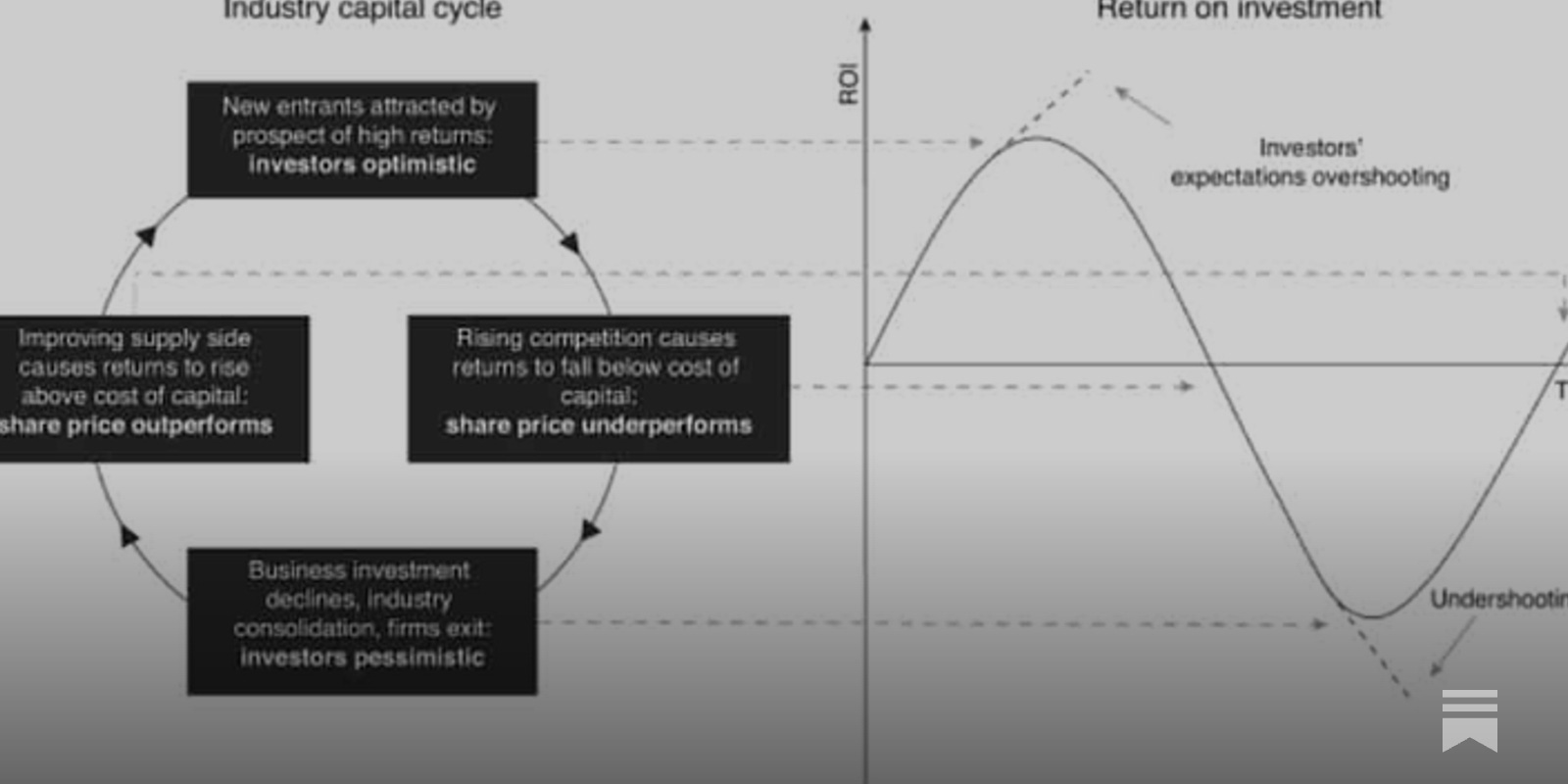
What is a capital cycle and why AI is building the mother of all capital cycles
Pluralistic: America and “national capitalism” (18 Feb 2025) – Pluralistic: Daily links from Cory Doctorow
Thomas Piketty's 2013 unexpected bestseller (a 750 page economics book translated from French!) Capital in the 21st Century, offers a very convincing explanation of our political decay, and it continues to serve this purpose as the decay undergoes alarming acceleration:
Cyber-Marx: Cycles and Circuits of Struggle in High Technology Capitalism
Cycles and Circuits of Struggle in High Technology Capitalism
Brett Scott (@brettscott)
A lot of economists want to claim that economic growth is, at some deep level, driven by human greed. In this worldview, we always desire more and more, and so collectively seek to endlessly boost production I don’t buy this worldview at all I think economic growth is driven - at a deep level - by fear. It stems from the extreme insecurity of life in a capitalist market system, where you’re always on the verge of being cut out of society, and so need to over-secure your position through any means possible One of the most compelling pieces of evidence for this is the history of colonial beliefs around laziness. In many colonial regions, colonizers would complain about tribal people being lazy - in other words, not seeking to increase production when they could. The reason for this, however, was that such people had access to subsistence farming and secure social structures that did not require endless competition. Secure people are, by definition, ‘lazier’, in the sense that they do not perceive a visceral need to fight for survival The colonial mission then, was the cut them off from older means of survival, make them dependent on insecure market structures, and thereby boost production as they all turn up at the mines to elbow each other out of the way as they compete for jobs. Security, in other words, is the enemy of economic growth

Cyber-Marx: Cycles and circuits of struggle in high technology capitalism - Nick Dyer-Witheford
The complete text of Nick Dyer-Witheford's 1999 book, which provides an analysis of information-age capitalism and the movements currently dissolving it. In PDF format.

Capitalism in Crisis Amid Slow Growth and Growing Inequality
Six years after the Lehman disaster, the industrialized world is suffering from Japan Syndrome. Growth is minimal, another crash may be brewing and the gulf between rich and poor continues to widen. Can the global economy reinvent itself?

Capitalism and the Death Drive
What we call growth today is in fact a tumorous growth,…

The ‘wicked trinity’ of late capitalism: Governing in an era of stagnation, surplus humanity, and environmental breakdown
Scholars within the fields of political ecology, environmental political theory, and international political economy tend to evaluate the prospects of state-led environmental transitions in general terms – enquiring as to the capitalist state’s inherent properties and their environmental implications. Less attention has been paid to how the state’s green capacities are conditioned by contemporary evolutions in the form and pace of capital accumulation. Capitalism’s directional pattern of historical development poses unique challenges for green state projects. Its drive to raise labour productivity metabolises nature on a growing scale, while generating conditions of overproduction and rendering a progressively larger portion of the population superfluous to the production process.Thus, the question is not simply whether the state can rise to the challenge of climate change, but rather how states are scrambling to govern the intersecting crises of climate catastrophe, economic stagnation, and surplus humanity. This ‘wicked trinity’ compounds the tensions at the heart of the capitalist state, resulting in an increasing inability to perform its role while sustaining its liberal form. This governance trilemma is illustrated by the case of the solar photovoltaic boom, where the spectacular increase in the productivity and scale of solar panel manufacturing have generated oversupply and falling profitability. States have reacted by indefinitely providing subsidies, financing automation technologies thatexacerbate labour superfluity, and relocating solar panel manufacturing to places with authoritarian labour regimes. The case of photovoltaics is a microcosm of the general predicament faced by states as they struggle to govern capitalism’s secular developmental tendencies.
Capitalism and Its Critics: A History
A Financial Times Most Anticipated Book of 2025A sweeping, dramatic history of capitalism as seen through the eyes of its fiercest critics. At a time when artificial intelligence, climate change, and inequality are raising fundamental questions about the economic system, Capitalism and Its Critics provides a kaleidoscopic history of global capitalism, from the East India Company and Industrial Revolution to the di...
Why Capitalism Requires Expanded Reproduction
A friend Nick wants to know why capitalism can only exist as expanded reproduction. In Volume II of “Capital,” Marx developed the diagrams for both simple and expanded reproduction. Why…

Capitalism Without Humans
As new technologies (not immigrants) replace human labor, "machine breaking" as a tactic of rebellion is taking on a renewed vitality.
IDS Annual Lecture 2026 with Jason Hickel
IDS Annual Lecture 2026 with Jason Hickel