

Conceptualizing functions as infinite-dimensional vectors lets us apply the tools of linear algebra to a vast landscape of new problems, from image and geometry processing to curve fitting and machine learning.
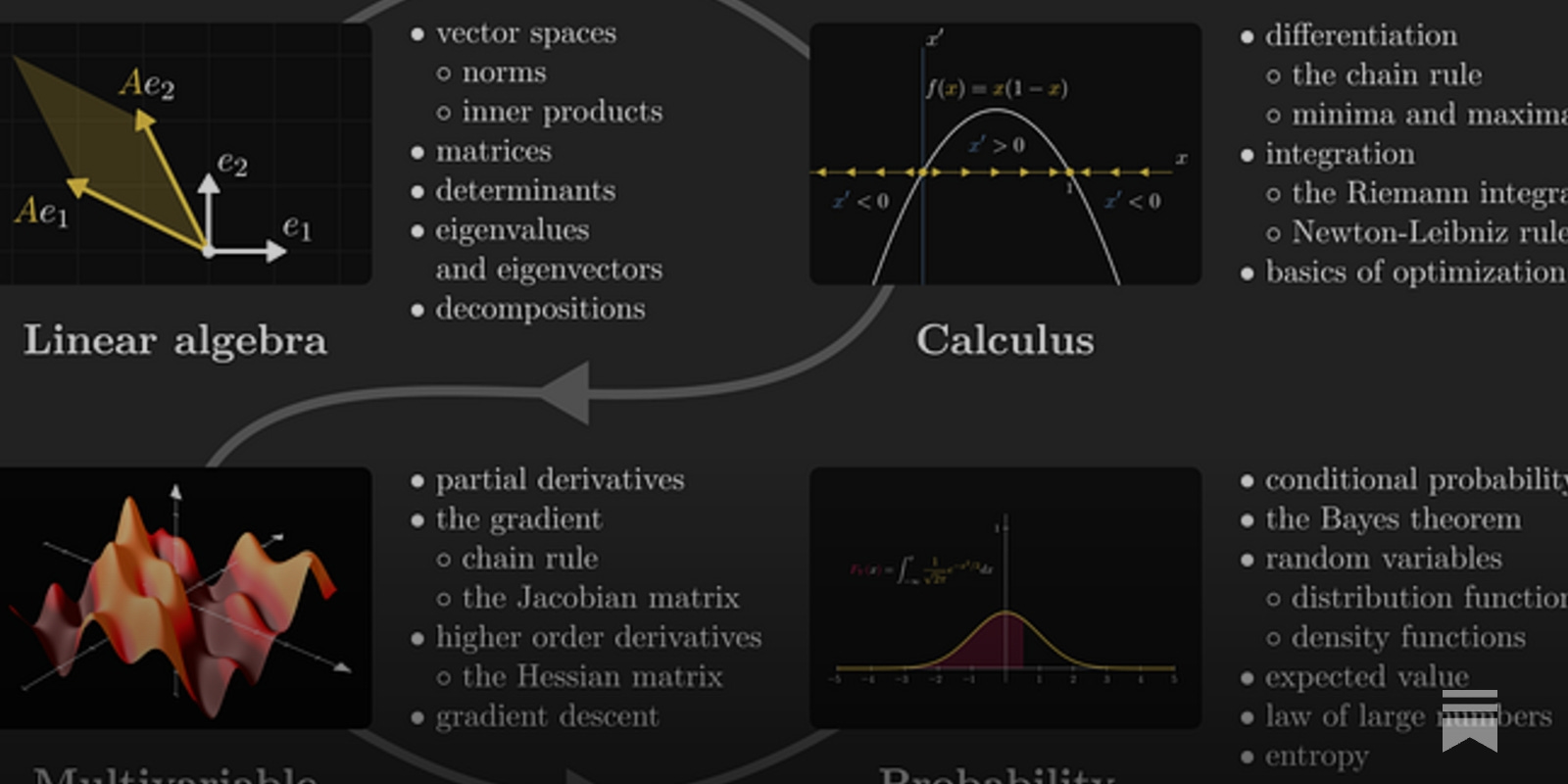
The Roadmap of Mathematics for Machine Learning
A complete guide to linear algebra, calculus, and probability theory
Higher Dimensional Syntax - Eric Finster

AI and Folk Cartesianism - Part 1: Defining the Problem
Why I'm scared of linear algebra

Tensor
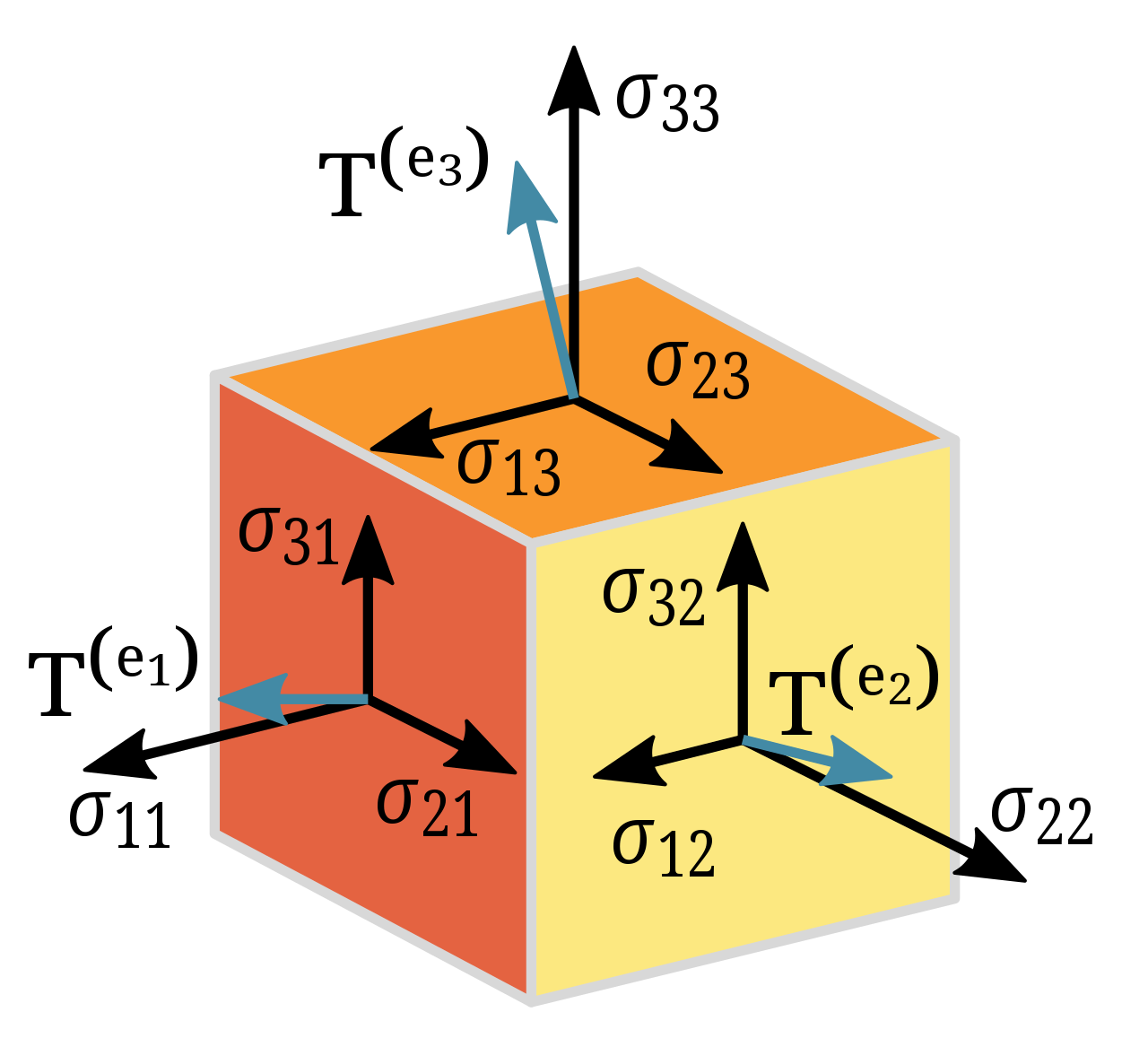
In mathematics, a tensor is an algebraic object that describes a multilinear relationship between sets of algebraic objects associated with a vector space. Tensors may map between different objects such as vectors, scalars, and even other tensors. There are many types of tensors, including scalars and vectors, dual vectors, multilinear maps between vector spaces, and even some operations such as the dot product. Tensors are defined independent of any basis, although they are often referred to by their components in a basis related to a particular coordinate system; those components form an array, which can be thought of as a high-dimensional matrix.
Machine Learning Algorithms, Applications: Key Methods, Real-World Uses
Key Takeaways Traditional algorithms such as regression, decision trees, boosting, clustering, and PCA remain highly useful for practical ML problems.Neural net

Infinity Category Theory Offers a Bird's-Eye View of Mathematics
Mathematicians have expanded category theory into infinite dimensions, revealing new connections among mathematical concepts
Mathematics in the age of AI
An essay, based on a public lecture delivered at the 2026 International Congress of Mathematicians, on how the mathematical community might respond to the arrival of artificial intelligence tools that are capable of performing research-level mathematical tasks. Rather than debating the capabilities of such tools, we condition on the hypothesis that these capabilities will arrive, and examine instead a question that is orthogonal to it: what the goals and values of mathematical research actually are. The problem-solving component of mathematics is used as a case study.

Functions as Objects - Part 1 | Daryl Ducharme | Offprint
This was originally posted on Jan. 15, 2007 and is being posted here for historical reasons

Gradient descent
Gradient descent is a method for unconstrained mathematical optimization. It is a first-order iterative algorithm for minimizing a differentiable multivariate function.

Manifold hypothesis
The manifold hypothesis posits that many high-dimensional data sets that occur in the real world actually lie along low-dimensional latent manifolds inside that high-dimensional space.[1][2][3][4] As a consequence of the manifold hypothesis, many data sets that appear to initially require many variables to describe, can actually be described by a comparatively small number of variables, linked to the local coordinate system of the underlying manifold. It is suggested that this principle underpins the effectiveness of machine learning algorithms in describing high-dimensional data sets by considering a few common features.
The lost art of mathematical modelling
We provide a critique of mathematical biology in light of rapid developments in modern machine learning. We argue that out of the three modelling activities – (1) formulating models; (2) analysing models; and (3) fitting or comparing models to data – inherent to mathematical biology, researchers currently focus too much on activity (2) at the cost of (1). This trend, we propose, can be reversed by realising that any given biological phenomenon can be modelled in an infinite number of different ways, through the adoption of a pluralistic approach, where we view a system from multiple, different points of view. We explain this pluralistic approach using fish locomotion as a case study and illustrate some of the pitfalls – universalism, creating models of models, etc. – that hinder mathematical biology. We then ask how we might rediscover a lost art: that of creative mathematical modelling.
Making Programming Visual, Spatial, and Learnable
What's wrong with linear, static programming mediums and how might we improve them?
Vector Theory: Epistemology, Political Economy, and Probabilistic Computation
This article introduces vector theory as a critical approach for understanding the shift from symbolic to probabilistic computation in contemporary AI systems. The paper argues that the digital turn organised meaning through discrete bits, Boolean logic, and hierarchical structures, in contrast large language models (LLMs) and diffusion architectures operate through high-dimensional vector spaces, cosine similarity, and probability manifolds. The three sections of the article examine the geometry of meaning, the dynamics of stochastic flow, and the political economy of the vector turn. These sections connect concepts such as vectors, tokenisation and generative AI to critical traditions from Marx through the Frankfurt School to contemporary media theory. Drawing on and expanding Kittler’s media materialism, Stiegler’s grammatisation, and Deleuze’s notion of smooth space, the article argues that existing approaches, developed under the paradigm of discrete digitality and symbolic logic, generate too many explanatory anomalies. The vector paradigm represents a new stage in the real subsumption of cognitive and linguistic labour, where capital reconstitutes language as geometry within proprietary vector space. The article connects this to notions of cognitive anaesthesia and the systematic “smoothing” of social friction, arguing that this potentially threatens the tacit dimension of critical thought, the very faculties required to diagnose the computational regime that produces it.

Kernel (linear algebra)
In mathematics, the kernel of a linear map, also known as the null space or nullspace, is the part of the domain which is mapped to the zero vector of the co-domain; the kernel is always a linear subspace of the domain. That is, given a linear map L : V → W between two vector spaces V and W, the kernel of L is the vector space of all elements v of V such that L(v) = 0, where 0 denotes the zero vector in W, or more symbolically:
