Chip away at blocks of stone to make grains of sand for harnessing the power of time!
Claude Design is a "clock time" solution for a "calendar time" problem
Orgs are betting that they can substitute sense-making with faster artifact delivery. Users are paying the price.
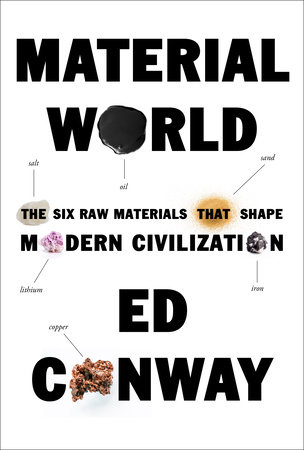
Material World by Ed Conway | Penguin Random House Canada
THE NEW YORK TIMES BOOK REVIEW EDITORS' CHOICE • AN ECONOMIST BEST BOOK OF THE YEAR • Sand, salt, iron, copper, oil, and lithium. These fundamental materials have created empires, razed civilizations, and fed our ingenuity and greed for thousands of years. Without them, our modern world would not exist, and the battle to control them will determine our future. • Finalist for the Financial Times and Schroders Business Book of the Year Award
Thinking with Sand: A Talk Series Exploring New Software Tools for Creative Exploration and Augmented Thinking At the MIT Media Lab
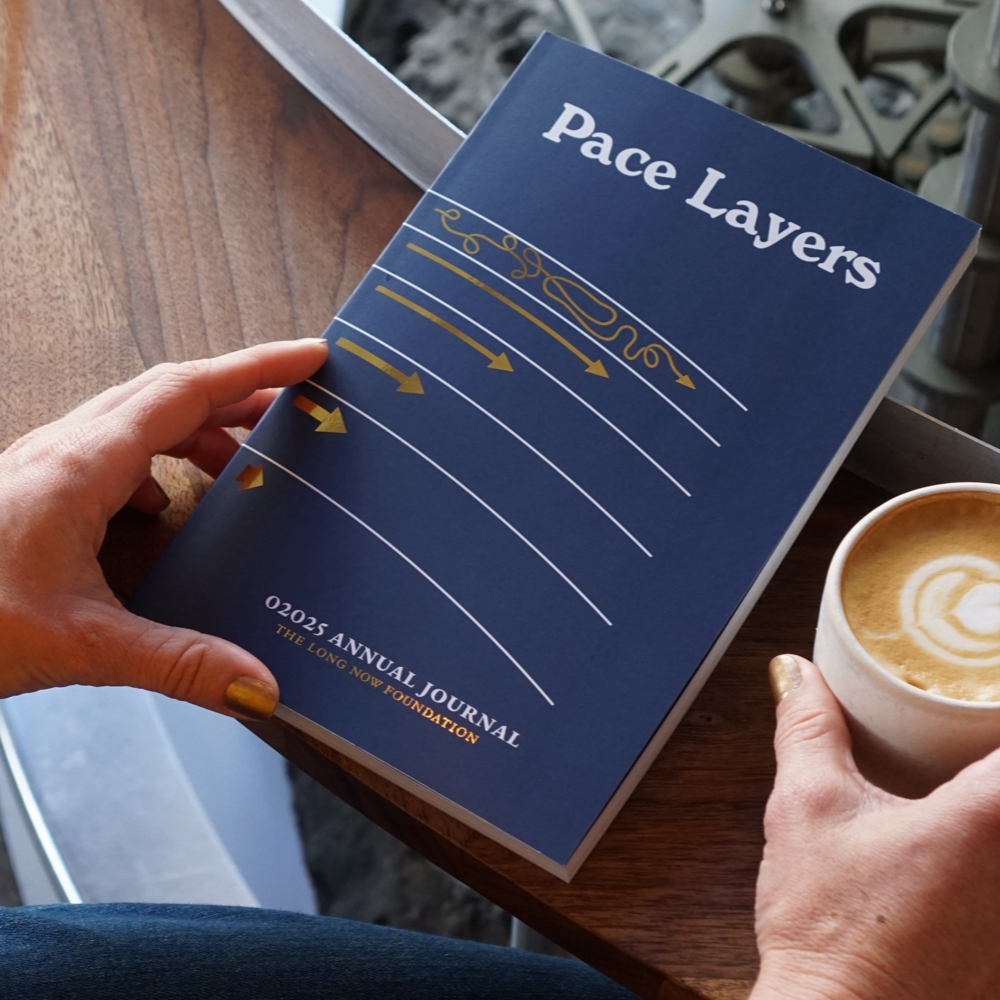
Pace Layers 02025 Annual Journal
Long Now’s annual print journal explores the ancient past and distant future of the present moment through essays, interviews, fiction, poetry, and visual art. The journal takes its name and shape from Long Now cofounder Stewart Brand’s pace layers framework — a tool for thinking about how civilizations work. [Learn more about Pace Layers](https://longnow.org/pacelayers/)
Meet Pebble Index 01 - External Memory For Your Brain
Catch your best ideas before they slip through your fingers Do you ever have flashes of insight or an idea worth remembering? This happens to me 5 10 times e...

Mending Wall
Something there is that does n’t love a wall, That sends the frozen-ground-swell under it, And spills the upper boulders in the sun; And makes gaps even…

The Regenerative Grain - The Phoenix Architecture
In 2014 I gave a talk called Tiny (keep things small enough to understand) In 2026, small means something different. Small means safe to delete. New in the Phoenix Architecture series: The Regenerative GrainI

Time-lock puzzle
A time-lock puzzle, or time-released cryptography, encrypts a message that cannot be decrypted until a specified amount of time has passed. The concept was first described by Timothy C. May,[1] and a solution first introduced by Ron Rivest, Adi Shamir, and David A. Wagner in 1996.[2] Time-lock puzzle are useful in cases where confidentiality of information is determined by time, such as a diarist who does not want their views released until 50 years after their death, an auction where bids are sealed until the bidding period is closed, electronic voting, and contract signing.[1][3] They can additionally be used in creating further cryptographic primitives, such as verifiable delay functions and zero knowledge proofs.[3]
The Daily Planet #123: Deep Time Impermanence - The Daily Planet
Living with two clocks
Staying with unbearable thoughts, and searching for a politics that’s equal to these times.