

How civil society and Danish foundations can support digital democracy
Civil Society Statement on Democratic Digital Infrastructure
Civil society statement in support of the creation of a European Public Digital Infrastructure fund, in alignment with the 2022 European Declaration on Digital Rights and Principles for the Digital Decade.
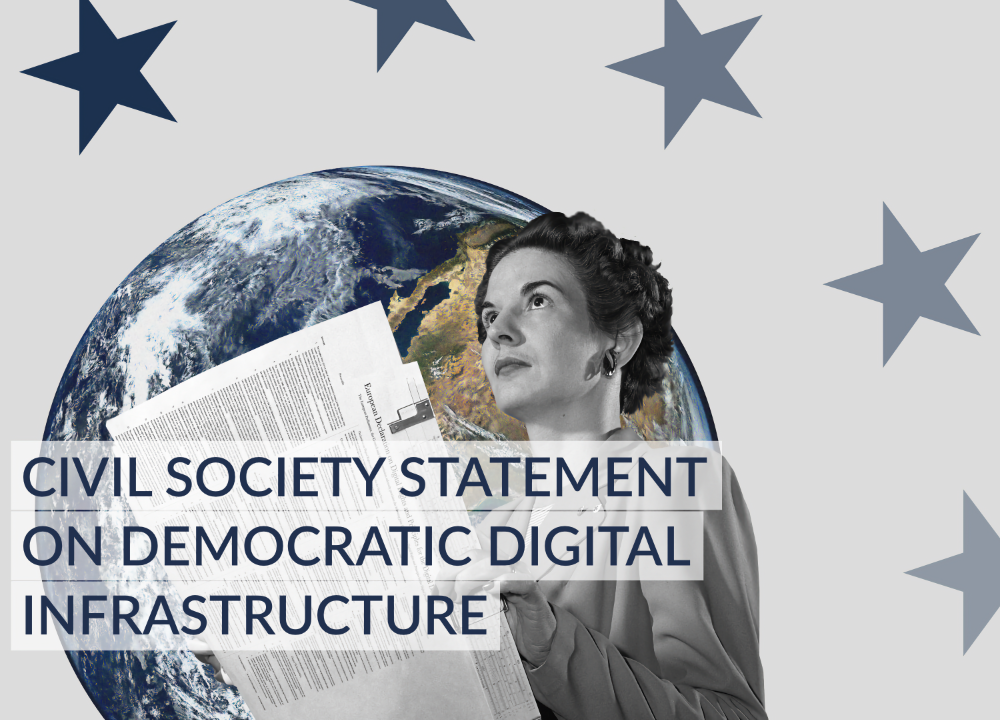
A Call for Democratic Digital Infrastructure
Today, together with over 40 civil society organizations, trade unions, and research centers, we pub

Public Service Social Media as a Democratic Safeguard | TechPolicy.Press
Christine Galvagna proposes an EU fund to support decentralized, public service focused social media networks to protect digital rights and democracy.

Commons Network
Digital Commons are not only about digital technology, but also about the economy, how it is organised and who it benefits. Digital Commons represent a democratic practice, with shared ownership, thus initiating a shift away from centralised (private or state) management of technology and towards democratisation of digital infrastructure. In this way Digital Commons help guard and reinforce such public values as democracy, self-determination and sovereignty. In the first explainer we put forward how this shift offers numerous opportunities for the Netherlands, or any country that takes Digital Commons seriously. Read the explainer

Scoping report: Future challenges to democracy | CoP CC on Participatory and Deliberative Democracy
The report from the European Commission identifies 10 key challenges and emerging trends impacting European democratic systems and suggests future policy options. These challenges are structured across three interconnected levels: citizens and societal dynamics, the information and knowledge environment, and institutions and the democratic system. This framework aims to provide a comprehensive and integrated view of democracy as a connected ecosystem, emphasising how challenges in one area can affect the entire system.

Interoperable Sovereignty: The Democratic Alternative to Digital Authoritarianism
A Democratic Architecture for the Digital Age Digital sovereignty has become a central concern for governments worldwide, yet its meaning remains contested. Too often it is framed as...

The Infrastructure Shock
The explosion of digital infrastructure systems over the past thirty years may be the biggest but least recognised shock delivered by the internet. We need to develop the governance capacity to manage it and force it out of hands of the democracy-hostile corporations that control it today.

European Declaration on Digital Rights and Principles
Read the Declaration on Digital Rights and Principles in full to find out about the EU’s commitment to a secure, safe and sustainable digital transformation.
Data-owning Democracy or Digital Socialism?
This article contrasts two reform proposals articulated in recent debates about how to democratize the digital economy: data-owning democracy and digital socialism. A data-owning democracy is a political-economic regime character-ized by the
Funding Open Source for Digital Sovereignty
"Open Source alone won't deliver digital sovereignty. Europe must fix procurement and fund those who actually build it."

European Public Digital Infrastructure Fund White Paper · Open Future
This white paper identifies the need for a European Public Digital Infrastructure Fund as an instrument for building out Digital Public Spaces in Europe.

Fractured reality - Publications Office of the EU
The report examines the evolving impact of digital technologies on European democracy. In an era of a global struggle to control the information space, this report offers critical insights into the fracturing of perceived realities, the rise of the ‘fantasy-industrial complex’, and the systemic risks posed by the attention economy. It exposes how platforms algorithmically prioritise engagement over accuracy, reinforcing ideological echo chambers and amplifying mis- and disinformation that erode democratic resilience. The report highlights how structural incentives and foreign control of the most important players in the information space undermine information integrity, collective knowledge and civic discourse. In response, the report presents a number of recommendations from fostering alternative public spaces and crowd-sourced knowledge systems to reforming business models, restoring user agency, and advancing EU digital sovereignty through decentralised infrastructure
Fractured reality
The report examines the evolving impact of digital technologies on European democracy. In an era of a global struggle to control the information space, this report offers critical insights into the fracturing of perceived realities, the rise of the ”fantasy-industrial complex,” and the systemic risks posed by the attention economy. It exposes how platforms algorithmically prioritise engagement over accuracy, reinforcing ideological echo chambers and amplifying mis- and disinformation that erode democratic resilience. The report highlights how structural incentives and foreign control of the most important players in the information space undermine information integrity, collective knowledge and civic discourse. In response, the report presents a number of recommendations from fostering alternative public spaces and crowd-sourced knowledge systems to reforming business models, restoring user agency, and advancing EU digital sovereignty through decentralised infrastructure.
Fractured reality
The report examines the evolving impact of digital technologies on European democracy. In an era of a global struggle to control the information space, this report offers critical insights into the fracturing of perceived realities, the rise of the ‘fantasy-industrial complex’, and the systemic risks posed by the attention economy. It exposes how platforms algorithmically prioritise engagement over accuracy, reinforcing ideological echo chambers and amplifying mis- and disinformation that erode democratic resilience. The report highlights how structural incentives and foreign control of the most important players in the information space undermine information integrity, collective knowledge and civic discourse. In response, the report presents a number of recommendations from fostering alternative public spaces and crowd-sourced knowledge systems to reforming business models, restoring user agency, and advancing EU digital sovereignty through decentralised infrastructure
Why Online Democracies Fail - Eclectic Corvine Muses
A compendium to my upcoming proposal for community infrastructure within the AT Protocol