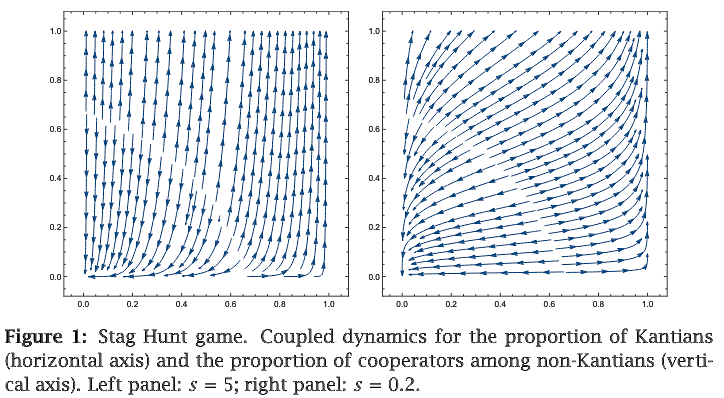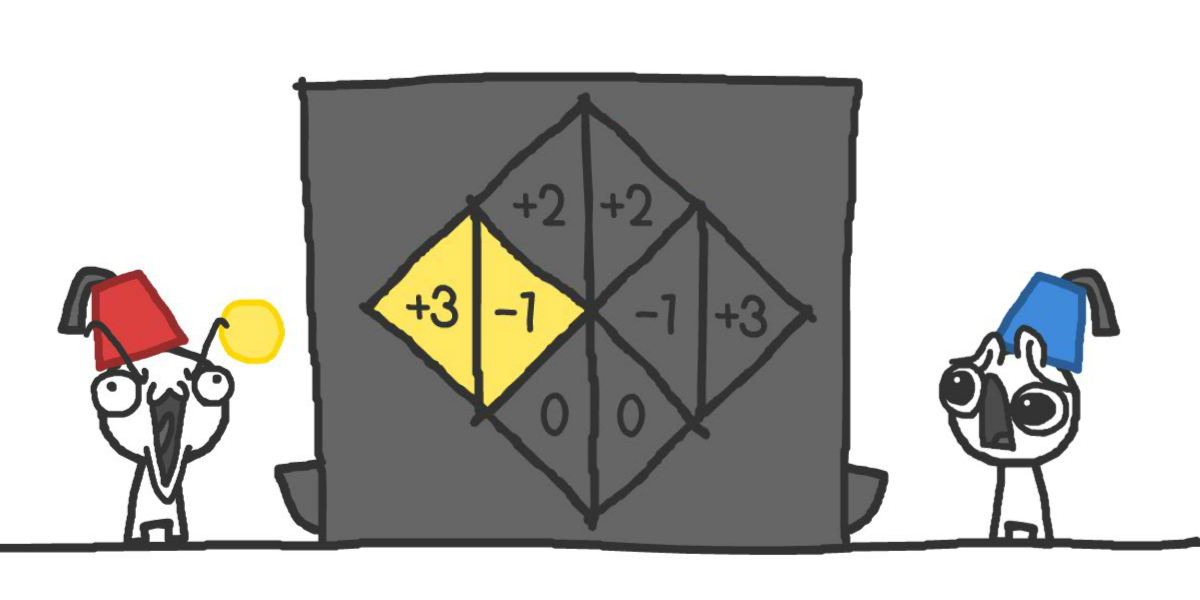


The view from Evolutionary Game Theory
17. A Value for n-Person Games
17. A Value for n-Person Games was published in Contributions to the Theory of Games, Volume II on page 307.
Mohrta
Mohrta is a nonlinear FPS adventure through the strange and otherworldly. Explore a vast selection of unique environments, slay an enormous cast of bizarre creatures, and upgrade your arsenal of multifaceted weapons.

Mote: An Interactive Ecosystem Simulation — Peter Whidden
The hidden ‘rules of the game’ that dictate how we navigate the world | Psyche Videos
How free are we really, if human behaviour embodies the complex, intertwined webs of society and history?

Strategy in four worlds
Different environments require different survival strategies

🌿 Foraging in High-Dimensional Data
My talk from the Diverse Intelligences Summer Institute 2025 on how we can draw from thinking in complex systems science and game design to heal our relationship to the Web.
The emergence of consensus: a primer
The origin of population-scale coordination has puzzled philosophers and scientists for centuries. Recently, game theory, evolutionary approaches and complex systems science have provided quantitative insights on the mechanisms of social consensus. However, the literature is vast and widely scattered across fields, making it hard for the single researcher to navigate it. This short review aims to provide a compact overview of the main dimensions over which the debate has unfolded and to discuss some representative examples. It focuses on those situations in which consensus emerges ‘spontaneously’ in the absence of centralized institutions and covers topics that include the macroscopic consequences of the different microscopic rules of behavioural contagion, the role of social networks and the mechanisms that prevent the formation of a consensus or alter it after it has emerged. Special attention is devoted to the recent wave of experiments on the emergence of consensus in social systems.

Maximum power in evolution, ecology and economics
Ludwig Boltzmann suggested that natural selection was fundamentally a struggle among organisms for available energy. Alfred Lotka argued that organisms that capture and use more energy than their competition will have a selective advantage in the evolutionary process, i.e. the Darwinian notion of evolution was based on a fundamental, generalized energy principle. He extended this general principle from the energetics of a single organism or species to the energetics of entire energy pathways through ecosystems. Howard Odum and Richard Pinkerton, building on Lotka, extended this concept to ‘The maximum power principle’ and applied it to many biological and physical systems including human economies. We examine this history and how these ideas relate to concepts from other disciplines including philosophy. But there has been considerable confusion in understanding and applying these concepts which we attempt to resolve while providing various examples from routine life and discussing some unresolved issues. This article is part of the theme issue ‘Thermodynamics 2.0: Bridging the natural and social sciences (Part 2)’.


The Law of Conservation of Information: Search Processes Only Redistribute Existing Information
Conservation of information sparked scientific interest once a recurring pattern was noticed in the evolutionary computing literature. In grappling with the creation of information through evolutionary algorithms, this literature consistently revealed that the information outputted by such algorithms always needed first to be programmed into them. Thus, the primary goal of this literature—to uncover how information could be created from scratch or de novo —was shown to be misconceived: the information was not created but instead shuffled around or smuggled in, implying that it already existed in some form or other. Information output in these situations therefore always presupposed a counterbalancing input of prior information. Once this pattern was seen, the next logical step was to quantify the amount of information inputted and outputted, demonstrating a consistent mathematical relation between the two. This led to the proof of a number of theorems about search. In these theorems, a baseline search with probability p of success gave way to an improved search with probability q of success. Typically p would be very small and close to zero, implying a practically impossible search (like searching for a needle in a haystack). By contrast, q would be much larger and close to one, implying an eminently doable search. The punchline of these theorems was that, as the improved search became itself the subject of a search (a search for a search , or S4S), the probability of finding it could not exceed p / q , rendering success of the improved search no more probable than success of the original baseline search, in effect filling one hole by digging another. Such conservation-of-information theorems, as they came to be called, were search-space specific, adapted to different kinds of search across a range of search spaces. There was a measure-theoretic theorem in which probability measures guided search. There were also function-theoretic and fitness-theoretic theorems where mappings into the search space as well as fitness functions on the search space respectively guided search. The key insight of this paper is that all these conservation-of-information theorems are special cases of a simple probabilistic relation based on elementary probability theory. This paper identifies the underlying rationale that makes all the previous conservation-of-information theorems work. In so doing, it provides a straightforward proof and general formulation of what may rightly be called the Law of Conservation of Information.
Frameworks v0.2
FRAMEWORKS v0.2 Many of the thoughts in this document draw on and synthesize concepts from economics, math, physics, chemistry, biology, and psychology. Here are a handful of core concepts that are often relied on as inputs: Activation energy Behavioral economics Cognitive biases Darwinism En...
The Multiple Paths to Multiple Life
We argue for multiple forms of life realized through multiple different historical pathways. From this perspective, there have been multiple origins of life on Earth—life is not a universal homology. By broadening the class of originations, we significantly expand the data set for searching for life. Through a computational analogy, the origin of life describes both the origin of hardware (physical substrate) and software (evolved function). Like all information-processing systems, adaptive systems possess a nested hierarchy of levels, a level of function optimization (e.g., fitness maximization), a level of constraints (e.g., energy requirements), and a level of materials (e.g., DNA or RNA genome and cells). The functions essential to life are realized by different substrates with different efficiencies. The functional level allows us to identify multiple origins of life by searching for key principles of optimization in different material form, including the prebiotic origin of proto-cells, the emergence of culture, economic, and legal institutions, and the reproduction of software agents.

A Strategy and Wardley Mapping Primer
If you're doing strategic work, think in terms of evolutionary flow — and learn to draw fast-and-dirty Wardley maps.

The wild rise and fall of Flappy Bird | Version History