

At its core, the Gender Binary–as well as Trans/Misogynistic-Bias–exists to create an oppressed class. This oppressed class is what we recognize as Women, and its oppression is facilitated by the logic of misogynistic-bias, which asserts that women are inherently lesser than those outside of the oppressed class (Women < Men = TRUE). The creation of an oppressed class carries with it the creation of a non-oppressed class, consisting of those who are not women. This non-oppressed class is what we recognize as Men. The classes of Women and Men are defined by the phenomena of femininity and masculinity. The traits which make up these phenomena differ between cultures, but they can be found in both the physical, such as shape and sound, and the abstract, such as behavior & thought. Trans/Misogynistic-Bias superimposes the classes of Women and Men over these phenomena, so that when traits which evoke femininity or masculinity are identified, the individuals who embody these traits are then classified as either Women or Men. Due to this superimposition, femininity and Women are synonymous within Gendered Reality. As such, traits associated with femininity are subject to the logic of misogynistic-bias. This leads to value neutral qualities such as softness or emotionalism–traits often associated with femininity–to be recognized as lesser. To embody these traits is to embody weakness itself. Conversely, traits which evoke masculinity become synonymous with strength and power. Further, since Trans/Misogynistic-Bias is perpetually looping in on itself, so too does this conditioning. Just as femininity is associated with weakness, weakness is associated with femininity. This leads to traits such as helplessness or naivety being viewed as aspects of femininity, while traits which evoke power, such as intelligence and wealth, become aspects of masculinity. Through this process, Trans/Misogynistic-Bias perpetuates the positioning of Women as being less than Men in every aspect.
Social Constructs (or, 'What is A Woman, Really?')
You can't "masculinity" your way out of oppression
Who's Afraid of Gender? (A Guide to Judith Butler)
Who's Afraid of Gender? (A Guide to Judith Butler)
THIS IS GENDERED – The feminist encyclopedia
THIS IS GENDERED is a feminist encyclopedia. We believe everything is gendered. The entries in this encyclopedia demonstrate just this. Use the search bar to read up on the gender dimension of a topic of your interest.
Sex Redefined: The Idea of 2 Sexes Is Overly Simplistic
Biologists now think there is a larger spectrum than just binary female and male
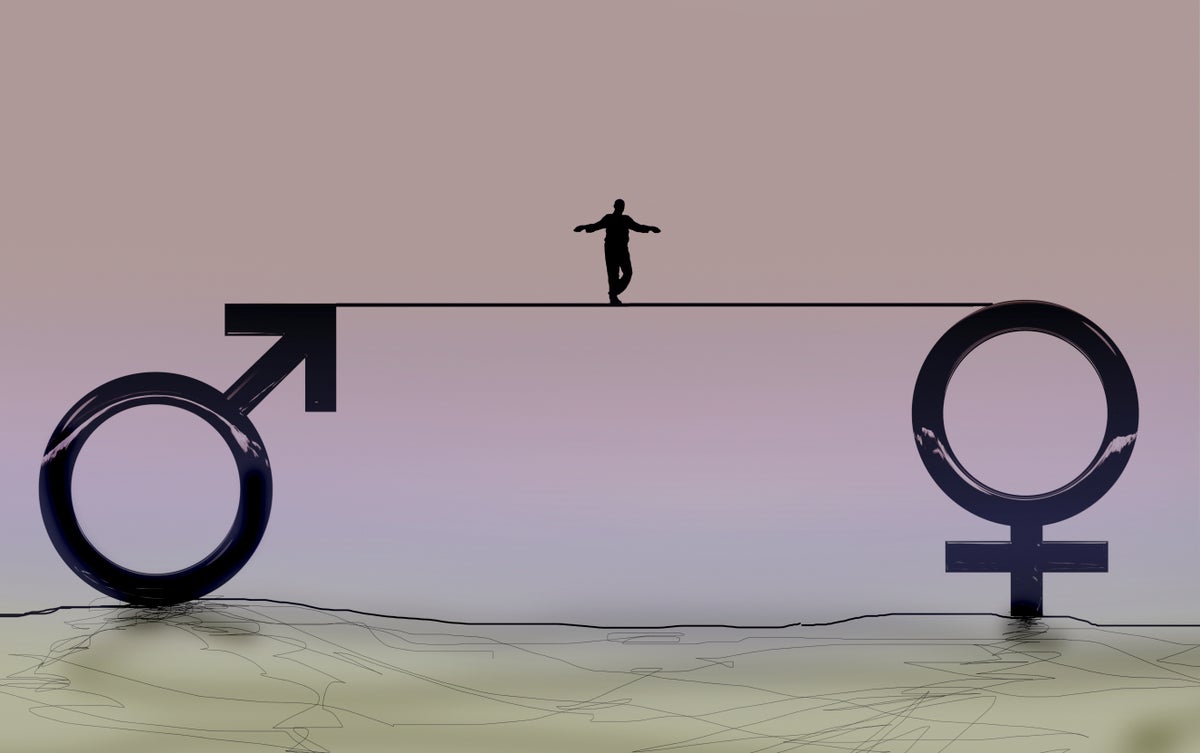
The idea that oppressions are subconscious scares me - Lemmy
In order to understand oppression as a subconscious thing, let’s take a couple of examples. Many women complain that they express an idea that is immediately dismissed, only for a man to be cheered for saying the exact same thing, minutes later. I have witnessed time and again a woman pointing to the correct explanation or solution for a bug and a man just ignoring her repeatedly, only to exhaust all other solutions before arriving to the same conclusion and solution. There is a ton of lab research to show this goes beyond anecdotal evidence. Some researchers recently showed that for the same length of speech, women speakers were judged as being overtaking the dialog. In fact, the balance that the average listener gauged as fair was 70% male speech vs 30% female speech. Don’t get me started about bias of doctors, not only against women and transgender people, but, let’s face the elephant in the room, black people. A recent study had found that doctors hold outdated racist tropes, for instance, that black people are more resistant to pain. Doctors are also more likely to discount complains from any marginalized group, and send them home with a “have less stress” tap on the back, when in reality they do have something serious. The list goes on and on. There is a whole book, called “Dying of Whiteness”, which shows that white people are opposed to welfare measures, when they think that black people will benefit from welfare too. The number of leftist and anarchist people who maintain some blatant form of medicalized cisgenderism is astonishing. And this is not about transphobia only. The track record of many collectives with sexism is harrowing. Someone recently wrote “Why I am not giving to your mutual aid project”, TL;DR because every collective has a couple of skeletons of sexual abuse in their closet. Haven’t we all seen the silent machismo and the solidarity between male authority figures in these spaces? Whenever a story like this pops up, the whole repertoire of discount tropes for sexual abuse allegations is taken out from the secret place it is kept for emergencies like this. This is consequential for broader organization as well, not only gendered and racialized oppression. In a strict Bakunian sense, the informality of a circle of buddies pulling the strings on any topic of field of activity is a form of State. A kyriarchy, or oppression. And there are more oppressions that we don’t even know, in jobs, universities, hobbies, and more. Some of them can be traced back to sexism, like the hard-science superiority complex has sexist undertones, but wherever there is inequality, there is oppression. It seems that people have a predisposition to form groups and make rules that reify social categories, for instance when some universities are considered elite and others shitholes, or some squat is seen as true hardcore anarchists and the others as alternative lifestyle hippies. ALL of this operates subconsciously. For quite some time I thought that the channels of anarchist organization would remedy human predisposition towards inequality, oppression, and bias. I now realize that this can not happen automatically, but a serious component of self-reflection to transcend internalized kyriarchies must be necessary. But we now see the prevail of the most vulgar and raw inequality instincts, enabled by systemic capitalist indoctrination and consent manufacturing campaigning. And we know that this seed is also present in leftists and anarchists. I believe that something horrible is about to happen the following five to ten years. We will then reflect, as we did in the aftermath of the two first world wars, on human predisposition to outgroup, other, dehumanize and eliminate. We might as well reinvent the science of the human psychology of obedience, conformity, prejudice, oppression and kyriarchy. And anarchists might have to reinvent the principles of political organization, this time to include the understanding of subconscious oppression, and embrace procedures to address and transcend all kyriarchies. That would stay truth to the spirit of complete abolition of all State, including internalized states of mind. (The pun is not intended.) In fact, I finally tend to agree with some anarchist pedagogists, that preparing people to be active members in an equal society, free of oppressions, the work must start in childhood, to eradicate the instincts of property, selfishness, power and supremacy. So, although it might seem there could not be a bleakest time to raise such issues, that in fact the struggle for visibility, for the normalization of queer lives, for the subversion of verbal sexism, and so on and so forth, all were important and integral to the anarchist cause. The white male racist kleprocratists might shed ours and many of our siblings’ blood over the next ten years. But 2030’s anarchism will re-discover the procedures that engender these demands and bake the relentless struggle for complete equality right into the channels of anarchist social organization and generational reproduction.
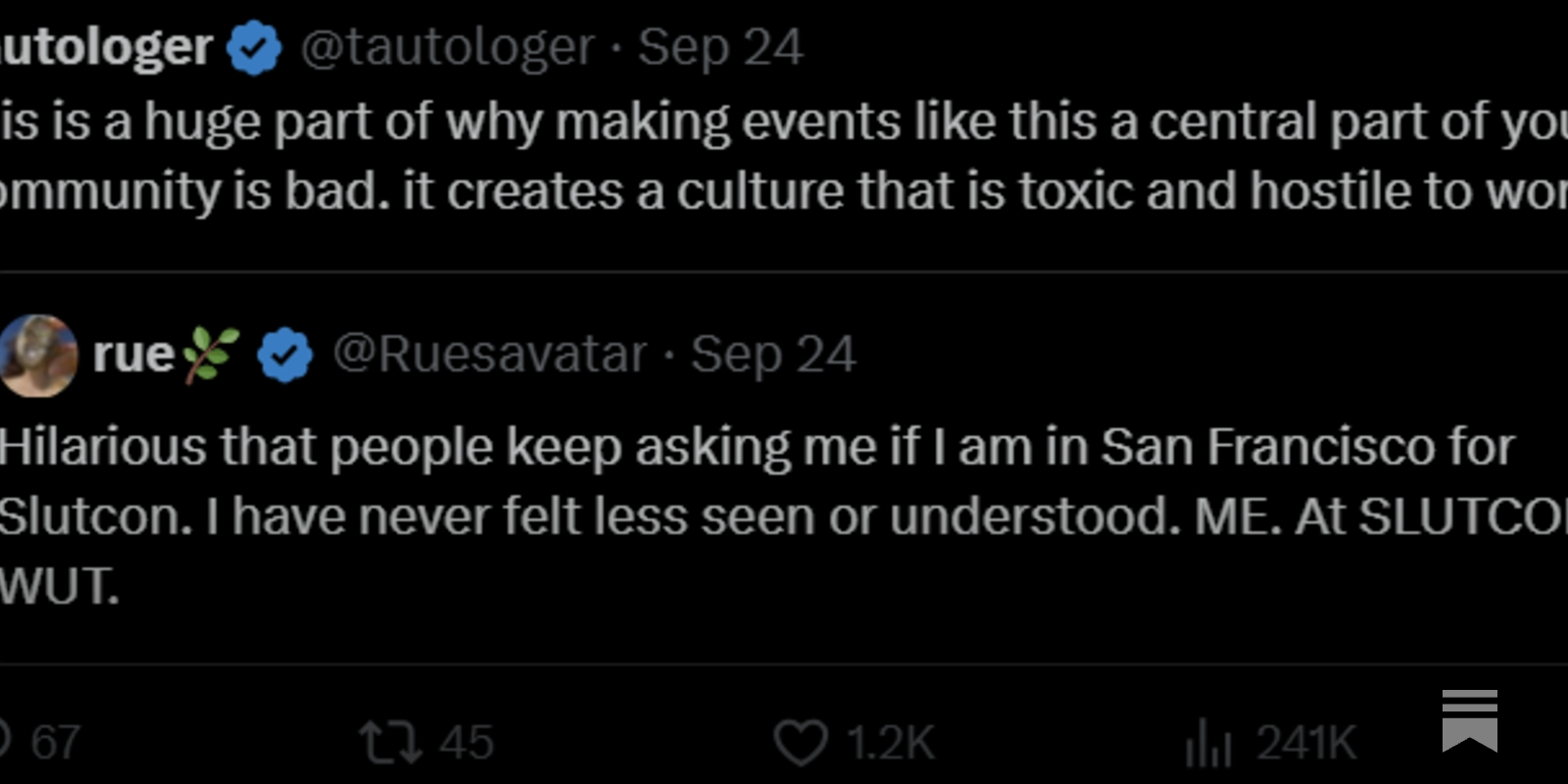
Male-dominated subcultures and why they stay that way
Slutcon, high school debate, EAs, rationalists, and you, the person reading this.
Dear young men: The old stereotypes of what it is to be a 'man' are a load of rubbish
Whether you want it or not, you’ve inherited the responsibility of creating a new answer to the ancient question of what it means to be a man

AI, gender bias and development
Generative AI is quietly reinforcing harmful gender stereotypes, shaping how we see the world and ourselves. How can we ensure it doesn't affect our development work in a biased way?

Out-group homogeneity
The out-group homogeneity effect is the perception of out-group members as more similar to one another than are in-group members, i.e. "they are alike; we are diverse".[1] Perceivers tend to have impressions about the diversity or variability of group members around those central tendencies or typical attributes of those group members. Thus, outgroup stereotypicality judgments are overestimated, supporting the view that out-group stereotypes are overgeneralizations.[2] The term "outgroup homogeneity effect", "outgroup homogeneity bias" or "relative outgroup homogeneity" have been explicitly contrasted with "outgroup homogeneity" in general,[3] the latter referring to perceived outgroup variability unrelated to perceptions of the ingroup.
Gender Trouble: Feminism and the Subversion of Identity
One of the most talked-about scholarly works of the past fifty years, Judith Butler’s Gender Trouble is as celebrated as it is controversial.Arguing that traditional feminism is wrong to look to a natural, 'essential' notion of the female, or indeed of sex or gender, Butler starts by questioning the category 'woman' and continues in this vein with examinations of 'the masculine' and 'the feminine'. Best known however, but also most often misinterpreted, is Butler's concept of gender as a reiterated social performance rather than the expression of a prior reality.Thrilling and provocative, few other academic works have roused passions to the same extent.


The problem isn’t that the women are unattractive.
Misogyny masquerading as social critique.
Stability of Transgender Identity in Adolescents Seen in Multidisciplinary Specialized Gender Centers: A Multicenter Study in Canada
To determine the proportions of adolescents continuing with their gender identity after referral to specialized gender clinics, the proportion continuing with gender-affirming hormones, and the proportion who detransition.
