A brief introduction to how one might start to think about deploying AI agents into mission-critical applications.
How to Deploy AI Agents for Safety

AI agent runs amok in Fedora and elsewhere
Agentic AI systems can be used to do a variety of things autonomously on behalf of a human user [...]
trycua/acu
A curated list of resources about AI agents for Computer Use, including research papers, projects, frameworks, and tools.
What is Agentic AI? Examples, Use Cases, and Platforms [wcyear]
Everything you need to know about agentic AI solutions, including real-life examples of use cases, workflows, and frameworks.

OWASP GenAI Security Project Releases Top 10 Risks and Mitigations for Agentic AI Security
Culmination of over 100 industry leaders’ input and extensive published resources to deliver critical guidance to address Agentic AI Security risks WILMINGTON, Del. — Dec. 10, 2025 — The OWASP GenAI Security Project (genai.owasp.org), a leading global open-source and expert community dedicated to delivering practical guidance and tools for securing generative and agentic AI, […]

Agentic AI Governance: A Strategic Framework for Autonomous Systems
Agentic AI is moving from chat to action. Learn how to govern autonomous systems using the "Digital Contractor" framework and the 3-Tiered Guardrail system.

Introduction to Agents
Discover what actually works in AI. Join millions of builders, researchers, and labs evaluating agents, models, and frontier technology through crowdsourced benchmarks, competitions, and hackathons.

agentOS - Everything Agents Need to Run and Operate - Rivet
The complete platform for production AI agents. Stateful runtime, universal agent interface, and secure code execution. One SDK, one platform, deploy anywhere.

Project Think: building the next generation of AI agents on Cloudflare
Announcing a preview of the next edition of the Agents SDK — from lightweight primitives to a batteries-included platform for AI agents that think, act, and persist.

Humanitarian aid turns to AI as crises outpace capacity
Purpose-designed AI agents with a focus on safety can provide critical assistance to vulnerable populations.

Agentic Engineering Management
To what extent AI is OK to use in software development might be debated, but in general, the idea is not a controversial one anymore. The debate rather moved on from code completion and simple PR summarizations to Agentic Engineering, where an execution loop allows an AI Agent to function

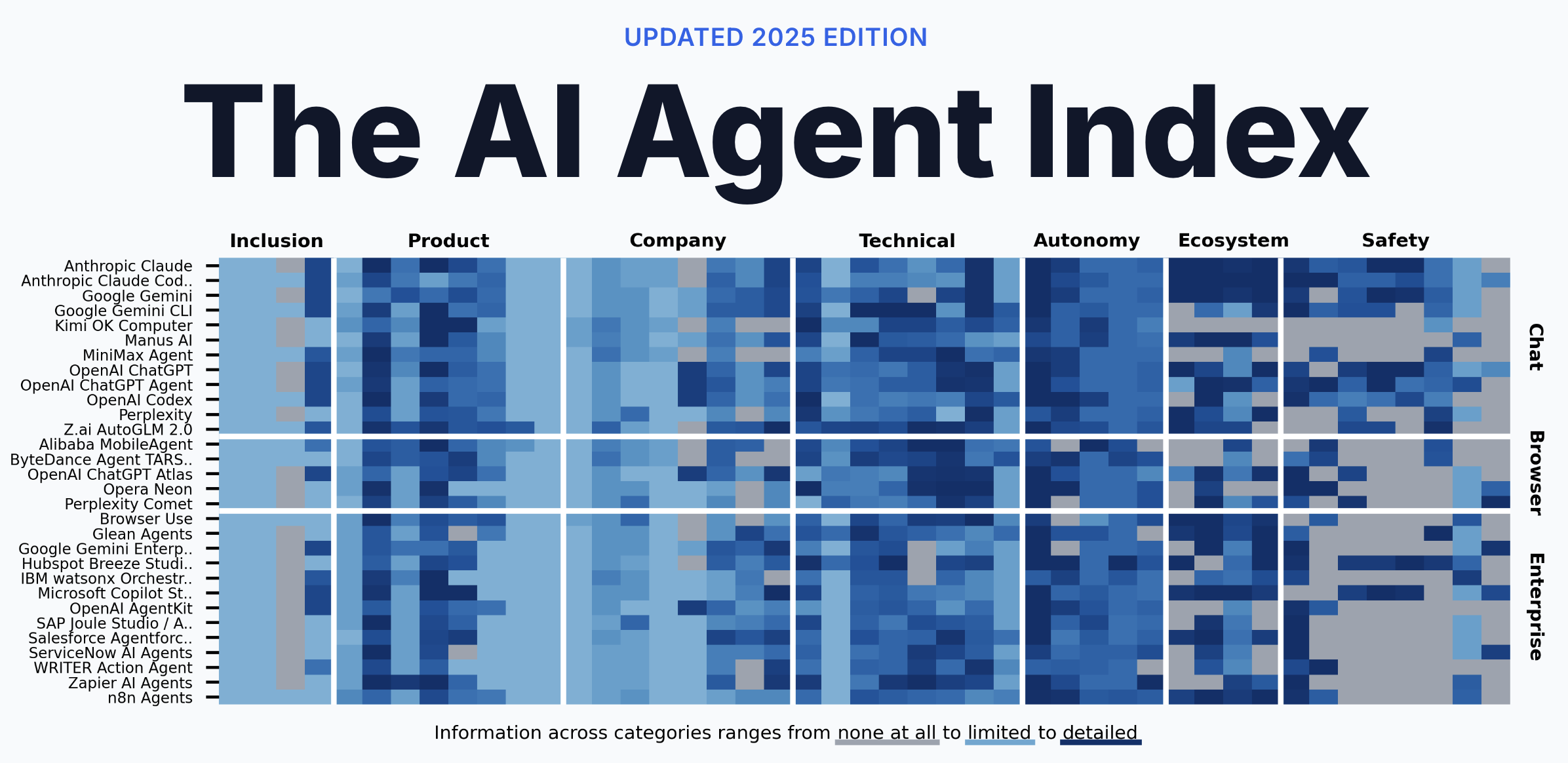
The 2025 AI Agent Index Documenting Technical and Safety Features of Deployed Agentic AI Systems
Agentic AI systems are increasingly capable of performing professional and personal tasks with limited human involvement. However, tracking these developments is difficult because the AI agent ecosystem is complex, rapidly evolving, and inconsistently documented, posing obstacles to both researchers and policymakers. To address these challenges, this paper presents the 2025 AI Agent Index. The Index documents information regarding the origins, design, capabilities, ecosystem, and safety features of 30 state-of-the-art AI agents based on publicly available information and email correspondence with developers. In addition to documenting information about individual agents, the Index illuminates broader trends in the development of agents, their capabilities, and the level of transparency of developers. Notably, we find different transparency levels among agent developers and observe that most developers share little information about safety, evaluations, and societal impacts. The 2025 AI Agent Index is available online at https://aiagentindex.mit.edu.
The 2025 AI Agent Index: Documenting Technical and Safety Features of Deployed Agentic AI Systems
Agentic AI systems are increasingly capable of performing professional and personal tasks with limited human involvement. However, tracking these developments is difficult because the AI agent ecosystem is complex, rapidly evolving, and inconsistently documented, posing obstacles to both researchers and policymakers. To address these challenges, this paper presents the 2025 AI Agent Index. The Index documents information regarding the origins, design, capabilities, ecosystem, and safety features of 30 state-of-the-art AI agents based on publicly available information and email correspondence with developers. In addition to documenting information about individual agents, the Index illuminates broader trends in the development of agents, their capabilities, and the level of transparency of developers. Notably, we find different transparency levels among agent developers and observe that most developers share little information about safety, evaluations, and societal impacts. The 2025 AI Agent Index is available online at https://aiagentindex.mit.edu

The 2025 AI Agent Index: Documenting Technical and Safety Features of Deployed Agentic AI Systems
Agentic AI systems are increasingly capable of performing professional and personal tasks with limited human involvement. However, tracking these developments is difficult because the AI agent ecosystem is complex, rapidly evolving, and inconsistently documented, posing obstacles to both researchers and policymakers. To address these challenges, this paper presents the 2025 AI Agent Index. The Index documents information regarding the origins, design, capabilities, ecosystem, and safety features of 30 state-of-the-art AI agents based on publicly available information and email correspondence with developers. In addition to documenting information about individual agents, the Index illuminates broader trends in the development of agents, their capabilities, and the level of transparency of developers. Notably, we find different transparency levels among agent developers and observe that most developers share little information about safety, evaluations, and societal impacts. The 2025 AI Agent Index is available online at https://aiagentindex.mit.edu
MI9: An Integrated Runtime Governance Framework for Agentic AI
Agentic AI systems capable of reasoning, planning, and executing actions present fundamentally distinct governance challenges compared to traditional AI models. Unlike conventional AI, these systems exhibit emergent and unexpected behaviors during runtime, introducing novel agent-related risks that cannot be fully anticipated through pre-deployment governance alone. To address this critical gap, we introduce MI9, the first fully integrated runtime governance framework designed specifically for safety and alignment of agentic AI systems. MI9 introduces real-time controls through six integrated components: agency-risk index, agent-semantic telemetry capture, continuous authorization monitoring, Finite-State-Machine (FSM)-based conformance engines, goal-conditioned drift detection, and graduated containment strategies. Operating transparently across heterogeneous agent architectures, MI9 enables the systematic, safe, and responsible deployment of agentic systems in production environments where conventional governance approaches fall short, providing the foundational infrastructure for safe agentic AI deployment at scale. Detailed analysis through a diverse set of scenarios demonstrates MI9's systematic coverage of governance challenges that existing approaches fail to address, establishing the technical foundation for comprehensive agentic AI oversight.
The 2025 AI Agent Index
Agentic AI systems are increasingly capable of performing complex tasks with limited human involvement. The 2025 AI Agent Index documents the origins, design, capabilities, ecosystem, and safety features of 30 prominent AI agents based on publicly available information and correspondence with developers.