Time-boxed moderation lists: sort your blocks into T-7/T-30/T-90 lists and get reminded when time is up.
nettime: The #Refresh Action Manifesto
[Date Prev] [Date Next] [Thread Prev] [Thread Next] [Date Index] [Thread Index]
I'm begging you to manage your time
Life Cycle - Track Your Time App - App Store
Download Life Cycle - Track Your Time by Sleep Cycle AB on the App Store. See screenshots, ratings and reviews, user tips, and more apps like Life Cycle - Track…

Temporal: The 9-Year Journey to Fix Time in JavaScript
JavaScript's Date object has been a source of bugs for three decades. Temporal, which just reached Stage 4, is a modern replacement with immutable types, first-class time zone and calendar support, and nanosecond precision. This is the story of how Bloomberg, Igalia, and the TC39 community spent nine years turning an idea into a shipping standard.

An update on leap seconds – Tony Finch
It has been a couple of years since my previous blog post about leap seconds, though I have been tweeting on the topic fairly frequently: see my page on date, time, and leap seconds for an index of threads. But Twitter now seems a lot less likely to stick around, so I’ll aim to collect more of my thinking-out-loud here on my blog.
The Problem with Time & Timezones - Computerphile : Computerphile
A web app that works out how many seconds ago something happened. How hard can coding that be? Tom Scott explains how time twists and turns like a twisty-turny...

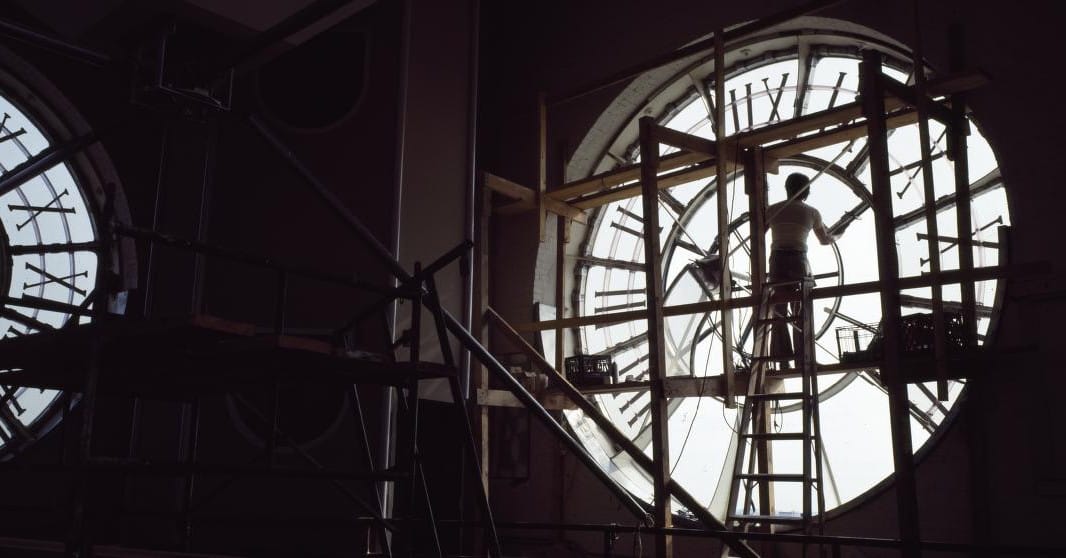
I Built a Device to Never Miss the Subway
Timeful is now completely free | Timeful
No more ads. No more premium tier. No more event limits. Every feature in Timeful is now free for everyone.
SLIME MOLD TIME MOLD on Twitter / X
we'd love to make this happen! happy to discuss and brainstorm any time :) we even wrote a little bit about it in the past, check out this old post:https://t.co/krgMioxZtb— SLIME MOLD TIME MOLD (@mold_time) September 15, 2025
Time-Duration Asymmetries in Consumer Decision-Making
Abstract Consumers routinely make decisions about short time periods, such as waiting for a table or deciding whether to pay for faster delivery. Such periods are often expressed by either a duration or a clock time (e.g., if it is 6:00 PM now, “Your table will be ready in 30 minutes” vs. “Your table will be ready at 6:30 PM”). Eight experiments (N = 16,604) show that these logically equivalent frames change how long a period feels, with downstream consequences for consumer decisions. Relatively short time periods feel longer when framed by duration rather than by start and end time (i.e., clock times or calendar dates), but this pattern reverses as periods get longer. We refer to this phenomenon as time-duration asymmetry: framing an interval by its start and end time versus its duration changes how long it feels, with the direction of the effect depending on the interval’s length. We propose that this occurs because duration frames evoke compressive scalar representations shaped by diminishing sensitivity, whereas start-end frames situate time within structured categorical systems that attenuate compression. This research offers a unified framework for understanding how subtle differences in temporal framing shape perceptions of time and subsequent decisions.

Toggl Track: Time Tracking Software for Any Workflow
The world's best time tracking software. Track employee time, send beautiful client reports, and calculate profitability. Free and paid plans to save you time.
FOSDEM 2026 - Schedule
Every year, FOSDEM hosts a wide variety of activities. This page gives an overview with links to further information about scheduled events. All times CET (UTC+1).