
Tinfoil Containers lets you deploy your application backend, your training pipeline, or your proprietary model on Tinfoil and build end-to-end verifiably private AI services.

Tinfoil - Private AI
AI that keeps your data private at all times. Fast, powerful, and verifiable, thanks to secure hardware enclaves.
Tinfoil Private Chat
Private AI chat application supporting open source models through Tinfoil
Backend infrastructure - Tinfoil Documentation
This page provides a description of the different components that make up our backend infrastructure. It also describes how Tinfoil guarantees code auditability and data confidentiality using these components.

How Tinfoil Proves Exactly What Model Is Running
How we cryptographically guarantee that we are serving specific, untampered model weights that clients can verify on each request.

Safety Without Compromising on Privacy
Our approach to safeguards in Tinfoil Chat that keeps your conversations private: model evaluations before hosting, plus safeguard models that run exclusively inside secure enclaves.

AI proxy: fostering a more open ecosystem - Blog - Braintrust
Introducing Braintrust's latest feature: an AI proxy that lets you use open source models like LLaMa 2 and Mistral, as well as all of OpenAI's and Anthropic's models, behind a single interface with caching, security, and API key management built in.
Containers From Scratch • Liz Rice • GOTO 2018
Quantifying Frontier LLM Capabilities for Container Sandbox Escape
AI agents are demonstrating rapid improvement in capabilities: the length of some tasks that frontier models can complete autonomously—measured in human-equivalent time—has been doubling approximately every seven months (METR, 2025; AI Security Institute, 2025a). In cybersecurity, current models achieve non-trivial success (Zhang et al., 2025) on professional-level Capture the Flag challenges, and recent evaluations report 13% success rates on exploiting real-world web application vulnerabilities (Zhu et al., 2025b). These results indicate that modern models can already perform multi-step vulnerability discovery and exploitation.
Docker Blog | Docker
The 2026 Stack Overflow Developer Survey shows only 7% of developers trust AI output for important decisions. Here’s what that means for running agents safely.

Docker Blog | Docker
The 2026 Stack Overflow Developer Survey shows only 7% of developers trust AI output for important decisions. Here’s what that means for running agents safely.
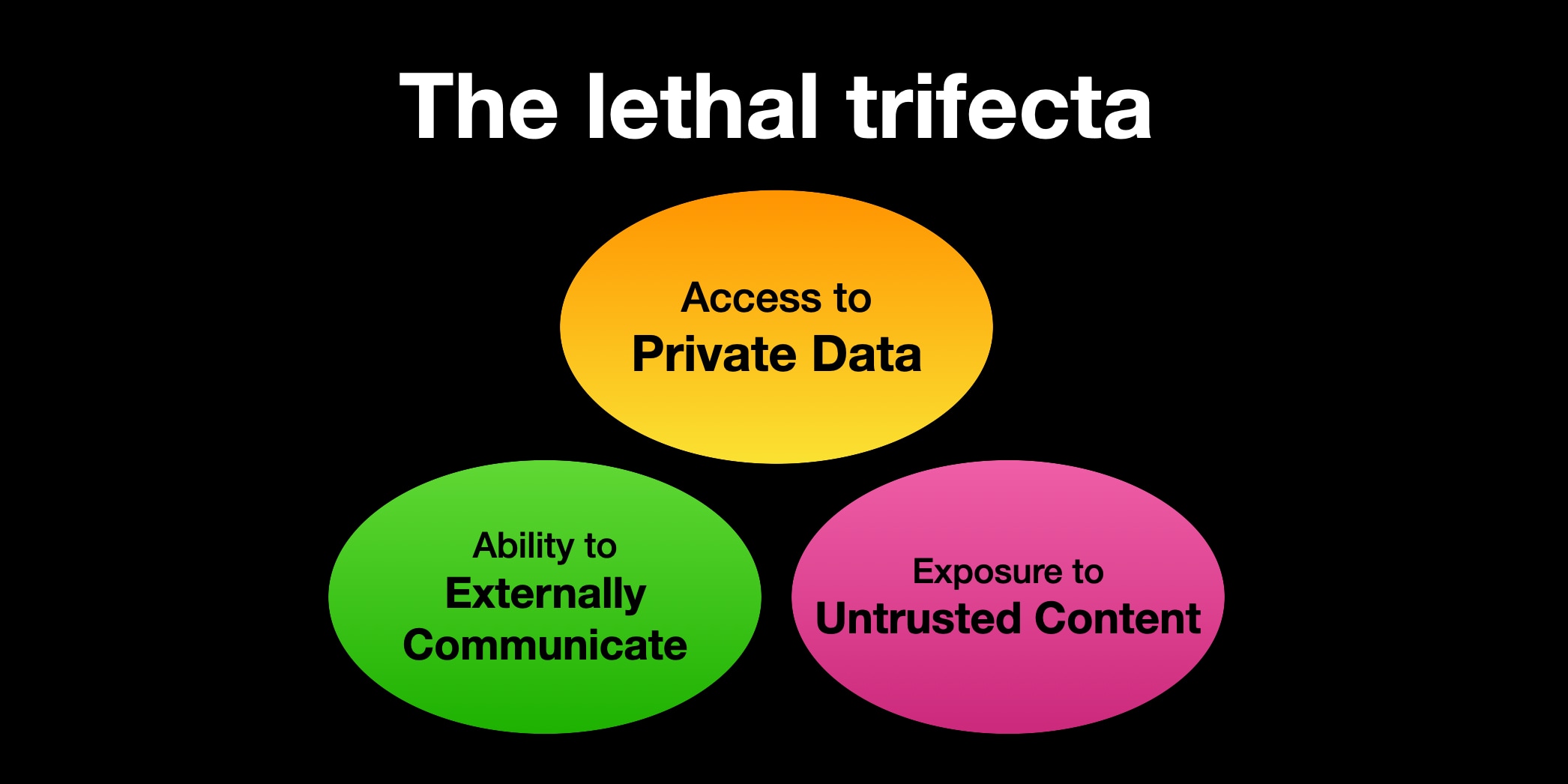
The lethal trifecta for AI agents: private data, untrusted content, and external communication
If you are a user of LLM systems that use tools (you can call them “AI agents” if you like) it is critically important that you understand the risk of …
AI Agents Enable Adaptive Computer Worms
A computer worm is malware that spreads on a network by replicating itself from one machine to another. Traditional worms, like WannaCry, exploited predetermined vulnerabilities, and their spread can be halted by patching those vulnerabilities. Here we show that artificial intelligence (AI) agents enable a fundamentally new threat: a worm that generates tailored attack strategies to each target it encounters. The worm parasitically uses compromised machines to run open-weight large language models (LLMs) to sustain its reasoning, or extend its reach for further attacks. Deployed on a network of machines spanning Linux, Windows, and IoT (Internet of Things) devices, the worm propagated by exploiting common, real-world corporate network vulnerabilities. Since the worm is powered by stolen compute, the attacker's marginal cost per new infection is zero. This creates a destabilizing economic asymmetry between attackers and defenders. Moreover, because the worm requires no commercial AI platform, centralized safety controls, such as service refusals or rate limiting, are structurally irrelevant. Our results demonstrate that self-sustaining AI-driven cyber-threats are no longer theoretical. We must prepare for autonomous generative adversaries: malware systems that propagate without human operators and are defined not by fixed exploit code, but by the capacity to reason about targets, adapt to observations, and synthesize attack logic in real time.

US Law Enforcement Warns of ‘Anti-Tech Extremism’ as AI Hatred Grows
As Americans stew over the looming risk of job-stealing AI and data centers in their back yards, the feds are raising the alarm about a new category of threat, documents obtained by WIRED show.

Titan in depth: Security in plaintext | Google Cloud Blog
While there are no absolutes in computer security, we design, build and operate Google Cloud Platform (GCP) with the goal to protect customers' code and data. We harden our architecture at multiple layers, with components that include Google-designed hardware, a Google-controlled firmware stack, Google-curated OS images, a Google-hardened hypervisor, as well as data center physical security and services.
A Strategy for Protecting Content from AI
Because that’s the world we live in these days.