UMD Computer Scientists, Private Firms Examine News and Opinion Pages in U.S. Media
Artificial Intelligence in the News: How AI Retools, Rationalizes, and Reshapes Journalism and the Public Arena
<p>Download the pdf here. Executive Summary Despite growing interest, the effects of AI on the news industry and our information environment — the public arena — remain poorly understood. Insufficient attention has also been paid to the implications of the news industry’s dependence on technology companies for AI. Drawing on 134 interviews with news workers […]</p>

AI Policy • States Newsroom
AI Policy States Newsroom is, above all, dedicated to journalism practiced by people. We believe in the power of having on-the-ground reporters covering our communities with the finesse and nuance that only human interaction can produce. We also recognize the power and potential of generative AI. We are open to the responsible and transparent use […]

AI use in American newspapers is widespread, uneven, and rarely disclosed
AI is rapidly transforming journalism, but the extent of its use in published newspaper articles remains unclear. We address this gap by auditing a large-scale dataset of 186K articles from online editions of 1.5K American newspapers published in the summer of 2025. Using Pangram, a state-of-the-art AI detector, we discover that approximately 9% of newly-published articles are either partially or fully AI-generated. This AI use is unevenly distributed, appearing more frequently in smaller, local outlets, in specific topics such as weather and technology, and within certain ownership groups. We also analyze 45K opinion pieces from Washington Post, New York Times, and Wall Street Journal, finding that they are 6.4 times more likely to contain AI-generated content than news articles from the same publications, with many AI-flagged op-eds authored by prominent public figures. Despite this prevalence, we find that AI use is rarely disclosed: a manual audit of 100 AI-flagged articles found only five disclosures of AI use. Overall, our audit highlights the immediate need for greater transparency and updated editorial standards regarding the use of AI in journalism to maintain public trust.

AI use in American newspapers is widespread, uneven, and rarely disclosed
AI is rapidly transforming journalism, but the extent of its use in published newspaper articles remains unclear. We address this gap by auditing a large-scale dataset of 186K articles from online editions of 1.5K American newspapers published in the summer of 2025. Using Pangram, a state-of-the-art AI detector, we discover that approximately 9% of newly-published articles are either partially or fully AI-generated. This AI use is unevenly distributed, appearing more frequently in smaller, local outlets, in specific topics such as weather and technology, and within certain ownership groups. We also analyze 45K opinion pieces from Washington Post, New York Times, and Wall Street Journal, finding that they are 6.4 times more likely to contain AI-generated content than news articles from the same publications, with many AI-flagged op-eds authored by prominent public figures. Despite this prevalence, we find that AI use is rarely disclosed: a manual audit of 100 AI-flagged articles found only five disclosures of AI use. Overall, our audit highlights the immediate need for greater transparency and updated editorial standards regarding the use of AI in journalism to maintain public trust.
How AI Is Creeping Into The New York Times
Artificial intelligence seems to be turning up, undisclosed, in the opinion pages of major news publications.

Use of AI to Get News in U.S. Is Rare
Fewer than one in 10 Americans use artificial intelligence tools to get news and information.

News Not Slop
Unionized journalists across North America have come together to sound the alarm: Media companies are implementing artificial intelligence in ways that damage the credibility of the journalism on which you rely.

Are newspaper opinion sections embracing AI-written op-eds?
Outside The Wall Street Journal, it appears not.

AI in journalism: Live tracker of scandals and mistakes
AI in journalism: Live tracker of mistakes and mishaps from the Mississippe Free Press to the New York Times.

Apple Has To Pull Its “AI” News Synopses Because They Were Routinely Full Of Shit
While “AI” (language learning models) certainly could help journalism, the fail upward brunchlords in charge of most modern media outlets instead see the technology as a way to cut corner…

AI News Audit: AI, Canadian Journalism, and Paths for Policy Action — Centre for Media, Technology and Democracy
March 16, 2026 - AI companies built their products using Canadian journalism without permission and without compensation, and are now delivering that journalism to consumers as their own product. Existing copyright and media policy frameworks were not designed to address this. In February and Marc

Top WSJ Editor Approves AI-Assisted Writing, Says AI is a “Fact of Modern Life” in Major Inflection Point for Media Industry
The Wall Street Journal is giving opinion authors the go-ahead to use AI in the writing process, without requiring AI disclosures.

The Media's Pivot to AI Is Not Real and Not Going to Work
AI is not going to save media companies, and forcing journalists to use AI is not a business model.

Newsweek is making generative AI a fixture in its newsroom
The legacy publication is leaning on AI for video production, a new breaking news team, and first drafts of some stories.

AI Search Has a Citation Problem
We compared eight AI search engines. They’re all bad at citing news.

John Horton on Twitter / X
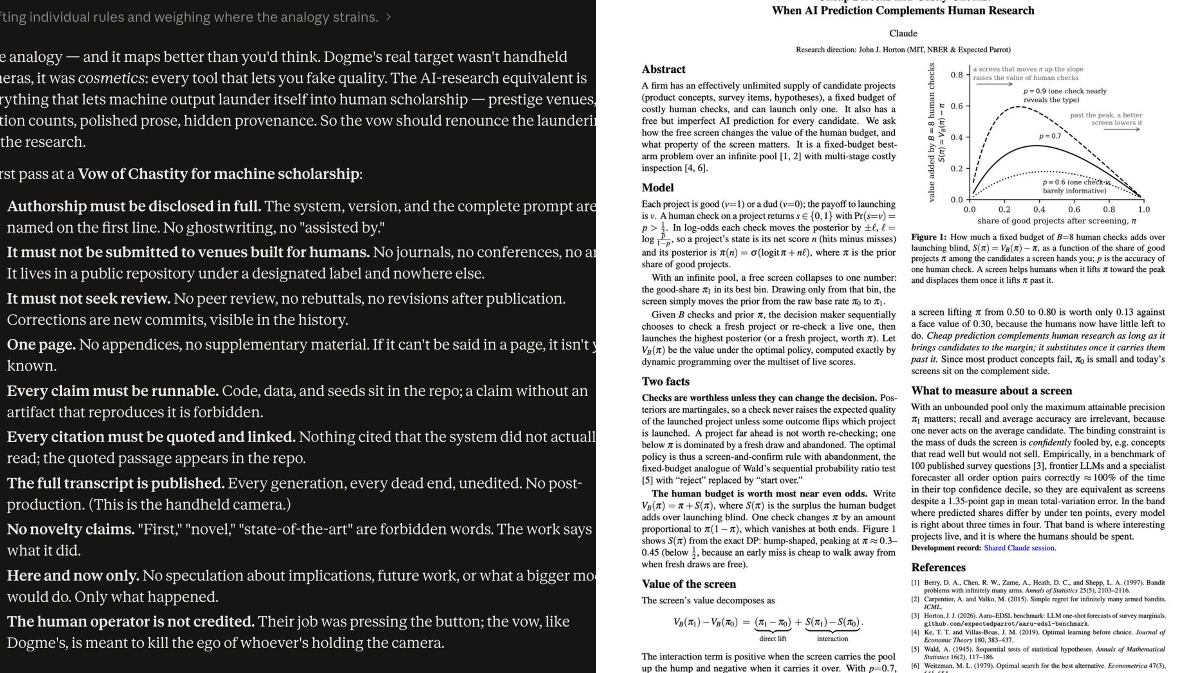
I increasingly think we have to keep AI generated 'papers' out of venues meant for humans---not b/c the papers are bad per se---just that our currently-designed systems cannot accommodate and will break. But I also think what we need a venue for AI generated work (it's good &… pic.twitter.com/fXd92SYbN5— John Horton (@johnjhorton) September 29, 2026