

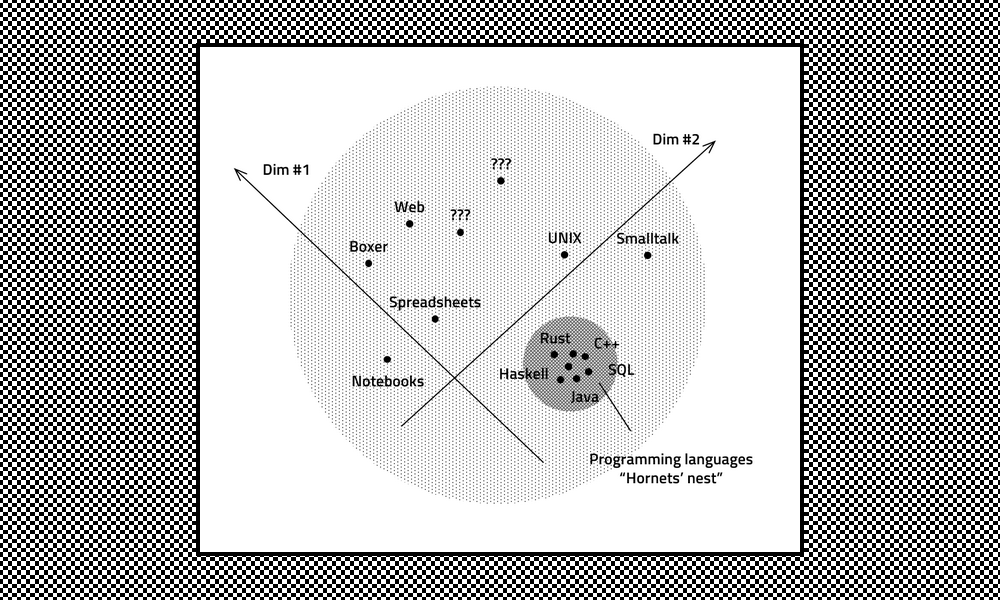
Framework that captures the characteristics of programming systems, makes it possible to compare and better understand them and find interesting new points in their design space.
Practical Foundations for Programming Languages
A Philosophy of Software Design
This book addresses the topic of software design: how to decompose complex software systems into modules (such as classes and methods) that can be implemented relatively independently. The book first introduces the fundamental problem in software design, which is managing complexity. It then d...

Convivial design heuristics for software systems
The theme of this workshop is the proliferation of ideas about calling into question the cultural roots of our current programming languages, and the search for alternative paradigms with other cultural bases.
Software Design is Knowledge Building
The product of software development is not code but a mental model, a theory: a specific way of explaining the world.

GATlab: Modeling and Programming with Generalized Algebraic Theories
Categories and categorical structures are increasingly recognized as useful abstractions for modeling in science and engineering. To uniformly implement category-theoretic mathematical models in software, we introduce GATlab, a domain-specific language for algebraic specification embedded in a technical programming language. GATlab is based on generalized algebraic theories (GATs), a logical system extending algebraic theories with dependent types so as to encompass category theory. Using GATlab, the programmer can specify generalized algebraic theories and their models, including both free models, based on symbolic expressions, and computational models, defined by arbitrary code in the host language. Moreover, the programmer can define maps between theories and use them to declaratively migrate models of one theory to models of another. In short, GATlab aims to provide a unified environment for both computer algebra and software interface design with generalized algebraic theories. In this paper, we describe the design, implementation, and applications of GATlab.

Exotic Programming Ideas, Part 1 (Module Systems) - Stephen Diehl
Personal blog of Stephen Diehl - Software engineer writing about technology, programming, and the future
Foundations of Algebraic Specification and Formal Software Development
This book provides foundations for software specification and formal software development from the perspective of work on algebraic specification, concentrating on developing basic concepts and studying their fundamental properties. These foundations are built on a solid mathematical basis, using elements of universal algebra, category theory and logic, and this mathematical toolbox provides a convenient language for precisely formulating the concepts involved in software specification and development. Once formally defined, these notions become subject to mathematical investigation, and this interplay between mathematics and software engineering yields results that are mathematically interesting, conceptually revealing, and practically useful. The theory presented by the authors has its origins in work on algebraic specifications that started in the early 1970s, and their treatment is comprehensive. This book contains five kinds of material: the requisite mathematicalfoundations; traditional algebraic specifications; elements of the theory of institutions; formal specification and development; and proof methods. While the book is self-contained, mathematical maturity and familiarity with the problems of software engineering is required; and in the examples that directly relate to programming, the authors assume acquaintance with the concepts of functional programming. The book will be of value to researchers and advanced graduate students in the areas of programming and theoretical computer science.
Seeing Like a Programmer (LambdaConf 2024) — Sympolymathesy, by Chris Krycho
How do we make good software, and indeed, what makes software good: both as software, and in terms of its place in the world?

Factor programming language
The Factor programming language is a concatenative, stack-based programming language with high-level features including dynamic types, extensible syntax, macros, and garbage collection. On a practical side, Factor has a full-featured library, supports many different platforms, and has been extensively documented.
Coeffects: Context-aware programming languages
Interactive essay that explains theory of coeffects and lets you type-check and run sample programs.
Modular: The Claude C Compiler: What It Reveals About the Future of Software
Compilers occupy a special place in computer science. They're a canonical course in computer science education. Building one is a rite of passage. It forces you to confront how software actually works, by examining languages, abstractions, hardware, and the boundary between human intent and machine execution.

Platform as a Runtime - the Next Step in Platform Engineering
As systems become larger and more complex we need to take the concepts of platform engineering to a higher level – to the code level – by creating platforms and abstractions that will reduce cognitive load, help simplify and accelerate software development, and allow for easy maintenance and upgrades to the platform. Let’s move from “platform” to “Platform as a Runtime”.

Its Time for a New Programming Language
Today, when compared to any other point in programming history, we find ourselves spoiled for choice when it comes to programming…
Types and Programming Languages
A type system is a syntactic method for automatically checking the absence of certain erroneous behaviors by classifying program phrases according to the kinds of values they compute. The study of type systems--and of programming languages from a type-theoretic perspective -- -has important applications in software engineering, language design, high-performance compilers, and security. This text provides a comprehensive introduction both to type systems in computer science and to the basic theory of programming languages. The approach is pragmatic and operational; each new concept is motivated by programming examples and the more theoretical sections are driven by the needs of implementations. Each chapter is accompanied by numerous exercises and solutions, as well as a running implementation, available via the Web. Dependencies between chapters are explicitly identified, allowing readers to choose a variety of paths through the material. The core topics include the untyped lambda-calculus, simple type systems, type reconstruction, universal and existential polymorphism, subtyping, bounded quantification, recursive types, kinds, and type operators. Extended case studies develop a variety of approaches to modeling the features of object-oriented languages.
Programming Language Foundations in Agda – Table of Contents
This book is an introduction to programming language theory using the proof assistant Agda.