

Have you ever argued with someone who is seriously good at debating? I have. It sucks. You’re constantly thrown off-balance, responding to a point you didn’t expect to. You find yourself defending the weak edges of your argument, while the main thrust gets left behind in the back-and-forth, and you end up losing momentum, confidence, and ultimately, the argument. One of my close friends won international debate competitions for fun while we were at university (he’s now a successful criminal barrister), and he told me that the only trick in the book, once you boil it all down, is to make sure the conversation is framed in your terms. Once that happens, it’s all over bar the shouting.
Beginner's Guide to Arguing Constructively
How to turn arguments from vicious battles into productive dialogues.
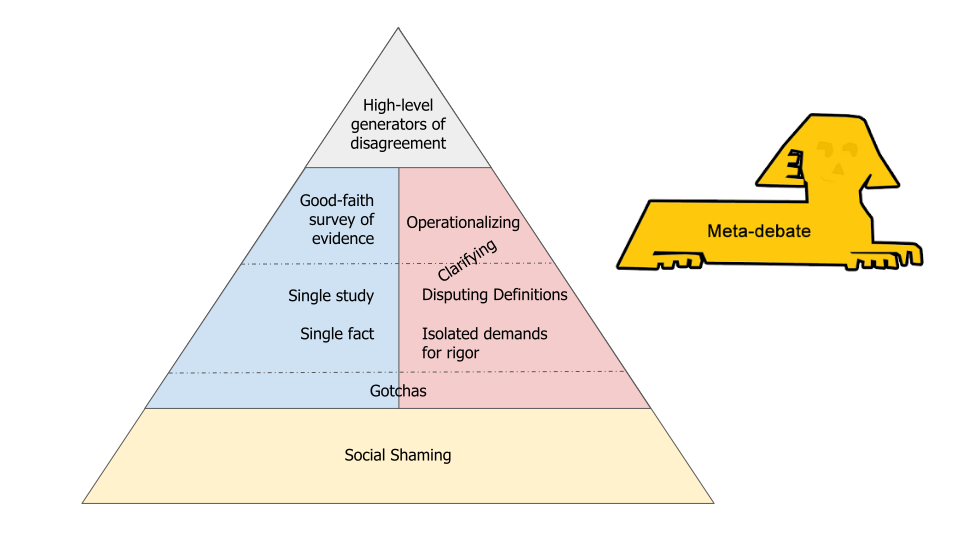
How to Stop Endless Discussions
When we find ourselves in endless debates where everyone defends their idea, we don't know how to handle the situation. We eventually find a way out, but what we need is an excellent system.

Argumentation theory | Communication and Mass Media | Research Starters | EBSCO Research
<p>Argumentation theory explores the processes and methods of reasoning and debate used by individuals in both formal and informal contexts. The theory has roots in ancient philosophical discourse, particularly from figures like Aristotle, and has evolved through the contributions of modern philosophers such as Chaïm Perelman and Stephen Toulmin. It highlights how arguments are structured, identifying key components such as claims, grounds (or data), and warrants, which collectively help participants make their case. </p> <p>Additionally, arguments can be categorized into three main types: factual claims, which are verifiable; judgment or value claims, which are subjective; and policy claims, which pertain to proposed courses of action. This framework acknowledges the influence of personal biases, often shaping the reasoning process, and emphasizes the importance of logical support, backing, qualifiers, and rebuttals in strengthening arguments. In academic contexts, the theory suggests that creating valid topics should focus on policy arguments, while also addressing counterarguments to foster a comprehensive debate. Overall, argumentation theory serves as a critical tool for understanding how reasoning and persuasive communication function in various scenarios.</p>

How to win an argument with a toddler
You can’t. That’s because toddlers don’t understand what an argument is and aren’t interesting in having one. Toddlers (which includes defensive bureaucrats, bullies, flat e…
The Honest Case for the Humanities
Or: Why I’m Tired of My Colleagues Making Arguments That Only Work on Us

Misplaced Divides? Discussing Political Disagreement With Strangers Can Be Unexpectedly Positive
Differences of opinion between people are common in everyday life, but discussing those differences openly in conversation may be unnecessarily rare. We report three experiments ( N = 1,264 U.S.-based adults) demonstrating that people’s interest in discussing important but potentially divisive topics is guided by their expectations about how positively the conversation will unfold, leaving them more interested in having a conversation with someone who agrees versus disagrees with them. People’s expectations about their conversations, however, were systematically miscalibrated such that people underestimated how positive these conversations would be—especially in cases of disagreement. Miscalibrated expectations stemmed from underestimating the degree of common ground that would emerge in conversation and from failing to appreciate the power of social forces in conversation that create social connection. Misunderstanding the outcomes of conversation could lead people to avoid discussing disagreements more often, creating a misplaced barrier to learning, social connection, free inquiry, and free expression.

Argument from authority
Some consider it a practical and sound way of obtaining knowledge that is generally likely to be correct when the authority is real, pertinent, and universally accepted,[1][4][5][6][7][8][9] while others consider it to be a very weak defeasible argument or an outright fallacy.[10][11][12][13][14]
A Decline in the Quality of Debate? The Evolution of Cognitive Complexity in Swiss Parliamentary Debates on Immigration (1968–2014)
Abstract This article explores the evolution of debate quality in the Swiss parliament. Focusing on immigration debates, we employ a psychological construct—cognitive complexity (CC)—which captures both epistemic and accommodative dimensions of political argumentation. We find a decrease in CC in parliamentary immigration debates over time, but this decrease was driven by the rise of the SVP (Swiss People's Party). However, there was almost no “spillover” of this new communication style to other parties. Moreover, we also find a constant difference between the Ständerat and the Nationalrat, with the former scoring higher on CC and thus asserting its role as a “chambre de réflexion” in immigration debates. Our diachronic focus on the quality of political debate takes a novel perspective on the dynamics of consensus democracy as well as on elite political culture. While our results indicate that the rise of the SVP has transformed the traditional consensual and deliberative pattern of Swiss policy‐making style into one which is geared towards less accommodation and a higher simplicity of political talk, there is still remarkable resilience against this new style of political interaction.

A Decline in the Quality of Debate? The Evolution of Cognitive Complexity in Swiss Parliamentary Debates on Immigration (1968–2014)
Abstract This article explores the evolution of debate quality in the Swiss parliament. Focusing on immigration debates, we employ a psychological construct—cognitive complexity (CC)—which captures both epistemic and accommodative dimensions of political argumentation. We find a decrease in CC in parliamentary immigration debates over time, but this decrease was driven by the rise of the SVP (Swiss People's Party). However, there was almost no “spillover” of this new communication style to other parties. Moreover, we also find a constant difference between the Ständerat and the Nationalrat, with the former scoring higher on CC and thus asserting its role as a “chambre de réflexion” in immigration debates. Our diachronic focus on the quality of political debate takes a novel perspective on the dynamics of consensus democracy as well as on elite political culture. While our results indicate that the rise of the SVP has transformed the traditional consensual and deliberative pattern of Swiss policy‐making style into one which is geared towards less accommodation and a higher simplicity of political talk, there is still remarkable resilience against this new style of political interaction.

We argue badly, and nothing accumulates. How could we do better? | Reason Commons — Issue Trees & Logical Thinking Process
Millions of people argue every day about the things that matter most — climate change, what to do about AI, how we might build a better world. Some of it is sharp, even insightful. And almost none of it accumulates.
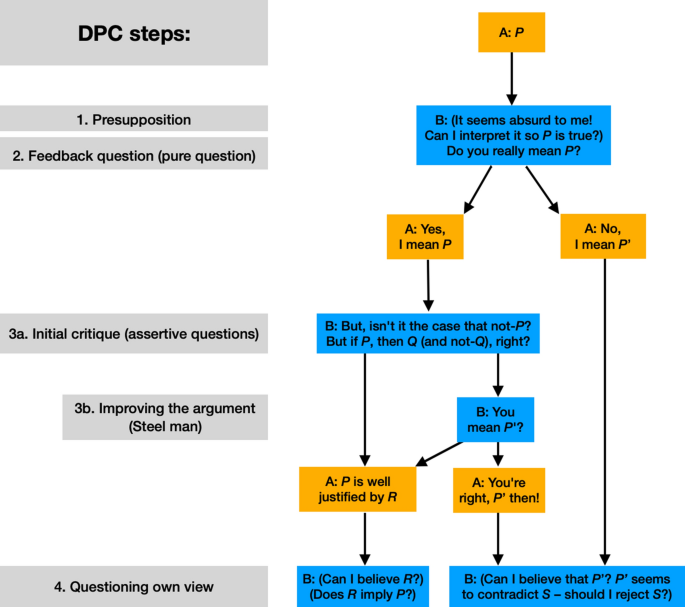
The Dialectical Principle of Charity: A Procedure for a Critical Discussion
This paper aims to discuss a well-known concept from argumentation theory, namely the principle of charity. It will show that this principle, especially in its contemporary version as formulated by Donald Davidson, meets with some serious problems. Since we need the principle of charity in any kind of critical discussion, we propose the way of modifying it according to the presupponendum—the rule written in the sixteenth century by Ignatius Loyola. While also corresponding with pragma-dialectical rules, it also provides additional content. This will be termed the dialectical principle of charity, and it offers a few steps to be performed during an argument in order to make sure that the participants understand each other well and are not deceived by any cognitive bias. The meaning of these results could be of great significance for argumentation theory, pragma-dialectics and the practice of public discourse as it enhances the principle of charity and makes it easier to apply in argumentation.
fenc.es — be wrong on the internet, productively
Trace the map of reasonable disagreement. Break arguments into statements, rate confidence and importance, and find the crux.

AI can help humans find common ground in democratic deliberation
Finding agreement through a free exchange of views is often difficult. Collective deliberation can be slow, difficult to scale, and unequally attentive to different voices. In this study, we trained an artificial intelligence (AI) to mediate human deliberation. Using participants’ personal opinions and critiques, the AI mediator iteratively generates and refines statements that express common ground among the group on social or political issues. Participants ( N = 5734) preferred AI-generated statements to those written by human mediators, rating them as more informative, clear, and unbiased. Discussants often updated their views after the deliberation, converging on a shared perspective. Text embeddings revealed that successful group statements incorporated dissenting voices while respecting the majority position. These findings were replicated in a virtual citizens’ assembly involving a demographically representative sample of the UK population. , Editor’s summary To act collectively, groups must reach agreement; however, this can be challenging when discussants present very different but valid opinions. Tessler et al . investigated whether artificial intelligence (AI) can help groups reach a consensus during democratic debate (see the Policy Forum by Nyhan and Titiunik). The authors trained a large language model called the Habermas Machine to serve as an AI mediator that helped small UK groups find common ground while discussing divisive political issues such as Brexit, immigration, the minimum wage, climate change, and universal childcare. Compared with human mediators, AI mediators produced more palatable statements that generated wide agreement and left groups less divided. The AI’s statements were more clear, logical, and informative without alienating minority perspectives. This work carries policy implications for AI’s potential to unify deeply divided groups. —Ekeoma Uzogara , INTRODUCTION Democracy, at its best, rests upon the free and equal exchange of views among people with diverse perspectives. Collective deliberation can be effectively supported by structured events, such as citizens’ assemblies, but such events are expensive, are difficult to scale, and can result in voices being heard unequally. This study investigates the potential of artificial intelligence (AI) to overcome these limitations, using AI mediation to help people find common ground on complex social and political issues. RATIONALE We asked whether an AI system based on large language models (LLMs) could successfully capture the underlying shared perspectives of a group of human discussants by writing a “group statement” that the discussants would collectively endorse. Inspired by Jürgen Habermas’s theory of communicative action, we designed the “Habermas Machine” to iteratively generate group statements that were based on the personal opinions and critiques from individual users, with the goal of maximizing group approval ratings. Through successive rounds of human data collection, we used supervised fine-tuning and reward modeling to progressively enhance the Habermas Machine’s ability to capture shared perspectives. To evaluate the efficacy of AI-mediated deliberation, we conducted a series of experiments with over 5000 participants from the United Kingdom. These experiments investigated the impact of AI mediation on finding common ground, how the views of discussants changed across the process, the balance between minority and majority perspectives in group statements, and potential biases present in those statements. Lastly, we used the Habermas Machine for a virtual citizens’ assembly, assessing its ability to support deliberation on controversial issues within a demographically representative sample of UK residents. RESULTS Group opinion statements generated by the Habermas Machine were consistently preferred by group members over those written by human mediators and received higher ratings from external judges for quality, clarity, informativeness, and perceived fairness. AI-mediated deliberation also reduced division within groups, with participants’ reported stances converging toward a common position on the issue after deliberation; this result did not occur when discussants directly exchanged views, unmediated. Although support for the majority position increased after deliberation, the Habermas Machine demonstrably incorporated minority critiques into revised statements. We replicated these results in a virtual citizens’ assembly, additionally finding that during AI-mediated deliberation, the views of groups of discussants tended to move in a similar direction on controversial issues. These shifts were not attributable to biases in the AI, suggesting that the deliberation process genuinely aided the emergence of shared perspectives on potentially polarizing social and political issues. CONCLUSION This research demonstrates the potential of AI to enhance collective deliberation by finding common ground among discussants with diverse views. The AI-mediated approach is time-efficient, fair, scalable, and outperforms human mediators on key dimensions. Rather than simply appealing to the majority, the Habermas Machine prominently incorporated dissenting voices into the group statements. AI-assisted deliberation is not without its risks, however; to ensure fair and inclusive debate, steps must be taken to ensure users are representative of the target population and are prepared to contribute in good faith. Under such conditions, AI may be leveraged to improve collective decision-making across various domains, from contract negotiations and conflict resolution to political discussions and citizens’ assemblies. The Habermas Machine offers a promising tool for finding agreement and promoting collective action in an increasingly divided world. AI helps people find common ground in collective deliberation. (Left) The AI mediator uses participants’ opinions to generate group statements and iteratively refines those statements through participants’ critiques. (Middle) Statements from the AI mediator (purple) garner stronger endorsement than those written by a human mediator (orange). (Right) AI mediation leaves groups less divided after deliberation, whereas simply sharing opinions with others does not.

Reflexive discourse analysis: A methodology for the practice of reflexivity
How to implement reflexivity in practice? Can the knowledge we produce be emancipatory when our discourses recursively originate in the world we aim to challenge? Critical International Relations (IR) scholars have successfully put reflexivity on the agenda based on the theoretical premise that discourse and knowledge play a socio-political role. However, academics often find themselves at a loss when it comes to implementing reflexivity due to the lack of adapted methodological and pedagogical material. This article shifts reflexivity from meta-reflections on the situatedness of research into a distinctive practice of research and writing that can be learned and taught alongside other research practices. To do so, I develop a methodology based on discourse: reflexive discourse analysis (RDA). Based on the discourse analysis of our own discourse and self-resocialisation, RDA aims to reflexively assess and transform our socio-discursive engagement with the world, so as to render it consistent with our intentional socio-political objectives. RDA builds upon a theoretical framework integrating discourse theory to Bourdieu’s conceptual apparatus for reflexivity and practices illustrated in the works of Comte and La Boétie. To illustrate this methodology, I used this very article as a recursive performance. I show how RDA enabled me to identify implicit discriminative mechanisms within my discourse and transform them into an alternative based on love, to produce an article more in line with my socio-political objectives. Overall, this article turns reflexivity into a critical methodology for social change and demonstrates how to integrate criticality methodologically into research and writing.
Since some seem determined not to get it: Arguing science shouldn’t be political is like arguing that ducks shouldn’t be waterfowl. Sure, whatever floats your boat, but they wouldn’t be ducks then would they? Science is a collective human effort at sensemaking—the very definition of political.

Carl T. Bergstrom
When I was 5, I loved science, which I took to be planets and magnets and chemicals and shit. Soon I realized science was a collective human activity, and these were just the objects of its attention. Anyway, whenever I read an OpEd on how science isn't political, I think "Are you 5 years old?"