

Z-Image: A powerful and efficient 6B-parameter image generation model with support for bilingual instructions and fast inference.
Diffusion Models: A Comprehensive Survey of Methods and Applications
Diffusion models have emerged as a powerful new family of deep generative models with record-breaking performance in many applications, including image synthesis, video generation, and molecule...

Complete guide to samplers in Stable Diffusion
Dive into the world of Stable Diffusion samplers and unlock the potential of image generation.

The Curse of Recursion: Training on Generated Data Makes Models Forget
Stable Diffusion revolutionised image creation from descriptive text. GPT-2, GPT-3(.5) and GPT-4 demonstrated astonishing performance across a variety of language tasks. ChatGPT introduced such...
Discontinuity-Aware 2D Neural Fields
Neural image representations offer the possibility of high fidelity, compact storage, and resolution-independent accuracy, providing an attractive alternative to traditional pixel- and grid-based representations. However, coordinate neural networks fail to capture discontinuities present in the image and tend to blur across them; we aim to address this challenge. In many cases, such as rendered images, vector graphics, diffusion curves, or solutions to partial differential equations, the locations of the discontinuities are known. We take those locations as input, represented as linear, quadratic, or cubic \bez curves, and construct a feature field that is discontinuous across these locations and smooth everywhere else. Finally, we use a shallow multi-layer perceptron to decode the features into the signal value. To construct the feature field, we develop a new data structure based on a curved triangular mesh, with features stored on the vertices and on a subset of the edges that are marked as discontinuous. We show that our method can be used to compress a 100,000^2-pixel rendered image into a 25MB file; can be used as a new diffusion-curve solver by combining with Monte-Carlo-based methods or directly supervised by the diffusion-curve energy; or can be used for compressing 2D physics simulation data.
LAION-5B: An open large-scale dataset for training next generation image-text models
Groundbreaking language-vision architectures like CLIP and DALL-E proved the utility of training on large amounts of noisy image-text data, without relying on expensive accurate labels used in standard vision unimodal supervised learning. The resulting models showed capabilities of strong text-guided image generation and transfer to downstream tasks, while performing remarkably at zero-shot classification with noteworthy out-of-distribution robustness. Since then, large-scale language-vision models like ALIGN, BASIC, GLIDE, Flamingo and Imagen made further improvements. Studying the training and capabilities of such models requires datasets containing billions of image-text pairs. Until now, no datasets of this size have been made openly available for the broader research community. To address this problem and democratize research on large-scale multi-modal models, we present LAION-5B - a dataset consisting of 5.85 billion CLIP-filtered image-text pairs, of which 2.32B contain English language. We show successful replication and fine-tuning of foundational models like CLIP, GLIDE and Stable Diffusion using the dataset, and discuss further experiments enabled with an openly available dataset of this scale. Additionally we provide several nearest neighbor indices, an improved web-interface for dataset exploration and subset generation, and detection scores for watermark, NSFW, and toxic content detection.
DiffusionGemma Technical Report
We introduce DiffusionGemma, an experimental open-weight language model that uses discrete diffusion to generate text at exceptionally high speed. Rather than decoding one token at a time, DiffusionGemma iteratively refines blocks of 256 tokens in parallel, avoiding the sequential decoding bottleneck of conventional autoregressive (AR) large language models. Instead of training from scratch, we obtain DiffusionGemma by fine-tuning the mixture-of-experts Gemma 4 model with 3.8B activated and 25.2B total parameters. Our compute-efficient two-stage training pipeline uses fewer than 10% of the starting AR model's total training token budget. The first stage uses supervised fine-tuning to teach bidirectional denoising, while the second stage combines reinforcement learning with sampler distillation to jointly improve generation quality and inference efficiency. DiffusionGemma establishes a new Pareto frontier for the trade-off between generation speed and model capability. Averaged across our full evaluation suite, it generates around 20 tokens per forward pass and achieves roughly 1,500 output tokens per second on a single NVIDIA H100 GPU, which is substantially faster than AR models even with state-of-the-art speculative decoding. DiffusionGemma also retains the starting model's support for thinking mode, multimodal inputs, and long contexts. Despite diffusion fine-tuning, it remains capable of AR generation with only minor performance degradation, suggesting a path toward hybrid diffusion-AR decoding.
AImages
The HackerNoon AI Image Gallery is powered by human prompts entered into the most cutting edge AI image generation models, like Stable Diffusion, Midjourney, Dall-e, and more
Introducing ChatGPT Images 2.0
ChatGPT Images 2.0 introduces a state-of-the-art image generation model with improved text rendering, multilingual support, and advanced visual reasoning.

Image generation | OpenAI API
Learn how to generate or edit images with the OpenAI API and image generation models.

Stanford CS25: V5 I Transformers in Diffusion Models for Image Generation and Beyond
How Text-to-Image AI Works, What AI Image Generators Can Create
Overview Text prompts can be transformed into photographs, artwork, concepts, characters and creative visuals.Many modern generators progressively remove noise

ChangeBridge: Spatiotemporal Image Generation with Multimodal Controls for Remote Sensing
Spatiotemporal image generation is a highly meaningful task, which can generate future scenes conditioned on given observations. However, existing change generation methods can only handle event-driven changes (e.g., new buildings) and fail to model cross-temporal variations (e.g., seasonal shifts). In this work, we propose ChangeBridge, a conditional spatiotemporal image generation model for remote sensing. Given pre-event images and multimodal event controls, ChangeBridge generates post-event scenes that are both spatially and temporally coherent. The core idea is a drift-asynchronous diffusion bridge. Specifically, it consists of three main modules: a) Composed Bridge Initialization, which replaces noise initialization. It starts the diffusion from a composed pre-event state, modeling a diffusion bridge process. b) Asynchronous Drift Diffusion, which uses a pixel-wise drift map, assigning different drift magnitudes to event and temporal evolution. This enables differentiated generation during the pre-to-post transition. c) Drift-Aware Denoising, which embeds the drift map into the denoising network, guiding drift-aware reconstruction. Experiments show that ChangeBridge can generate better cross-spatiotemporal aligned scenarios compared to state-of-the-art methods. Additionally, ChangeBridge shows great potential for land-use planning and as a data generation engine for a series of change detection tasks. Code is available at https://github.com/zhenghuizhao/ChangeBridge
Towards Understanding Text Hallucination of Diffusion Models via Local Generation Bias
Score-based diffusion models have achieved incredible performance in generating realistic images, audio, and video data. While these models produce high-quality samples with impressive details, they often introduce unrealistic artifacts, such as distorted fingers or hallucinated texts with no meaning. This paper focuses on textual hallucinations, where diffusion models correctly generate individual symbols but assemble them in a nonsensical manner. Through experimental probing, we consistently observe that such phenomenon is attributed it to the network's local generation bias. Denoising networks tend to produce outputs that rely heavily on highly correlated local regions, particularly when different dimensions of the data distribution are nearly pairwise independent. This behavior leads to a generation process that decomposes the global distribution into separate, independent distributions for each symbol, ultimately failing to capture the global structure, including underlying grammar. Intriguingly, this bias persists across various denoising network architectures including MLP and transformers which have the structure to model global dependency. These findings also provide insights into understanding other types of hallucinations, extending beyond text, as a result of implicit biases in the denoising models. Additionally, we theoretically analyze the training dynamics for a specific case involving a two-layer MLP learning parity points on a hypercube, offering an explanation of its underlying mechanism.
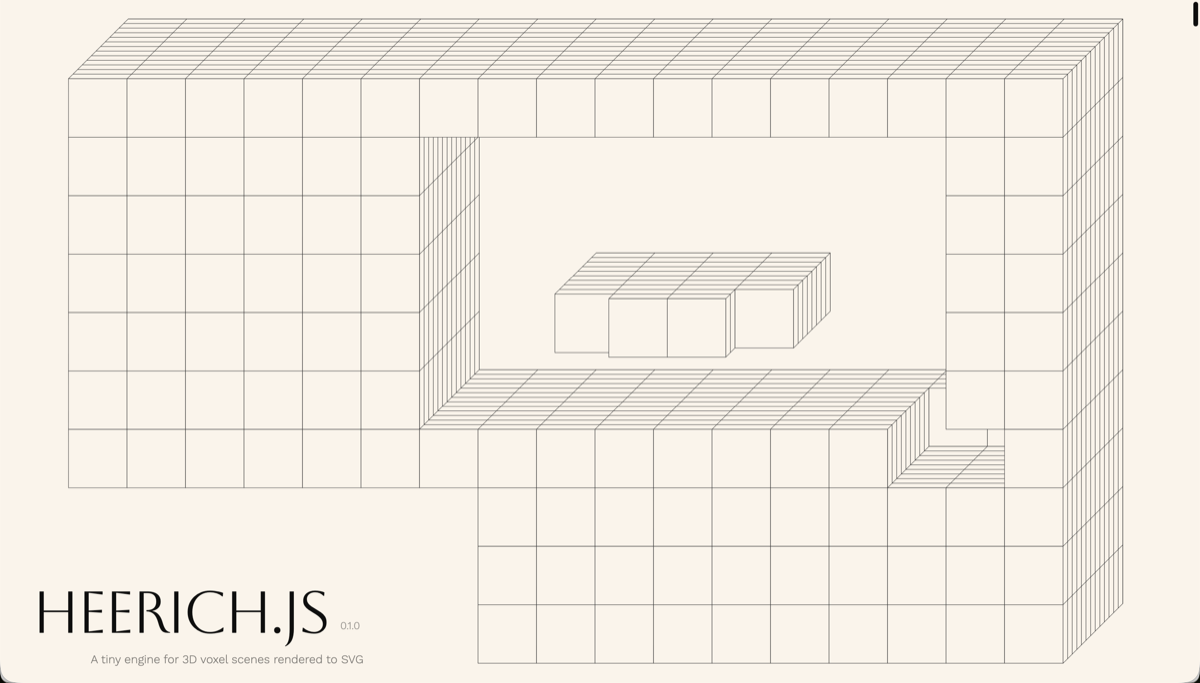
heerich.js
Tiny engine for 3D voxel scenes rendered to SVG — boolean ops, oblique/perspective cameras, zero dependencies.
ascorbic/og-edge
Generate Open Graph images with Deno and Netlify Edge Functions, no framework needed.