

Applying human ergonomics and design principles to syntax highlighting
Our CSS isn't opinionated enough - Craig Abbott
Why styling on semantics and roles could make accessibility harder to skip
Our CSS isn't opinionated enough - Craig Abbott
Why styling on semantics and roles could make accessibility harder to skip
Addressing Accessibility Barriers in Programming for People with Visual Impairments: A Literature Review
Accessibility issues with programming languages and programming environments pose a major barrier for students with visual impairments to participate in computing related courses as well as threatens the productivity of professional programmers with visual impairments. To remedy this, the past two decades have witnessed an increase in accessibility research designed to investigate and address the challenges faced by people with visual impairments while programming or learning how to program. We conducted a literature review of accessibility research in this domain. The aim was to identify, aggregate, and highlight known accessibility barriers to programming faced by professional programmers and students with visual impairments learning how to code as well as to identify all solutions that have been proposed to address these barriers. We selected and analyzed 70 papers reporting on accessibility of programming and programming environments for people with visual impairments. Numerous barriers to programming by people with visual impairments have been identified in the literature. Some of these barriers are understudied and present opportunities for future work. A lot of studies have also proposed tools and new accessible programming languages to address the accessibility issues of current programming languages and programming environments.

Lexicon Embeds Overview
There’s an excellent discussion and thread about syntax highlighting of code blocks happening today: I think most notably there’s some alignment around using a lexicon to represent code blocks (say Tangled’s strings) and embedding those, rather than just doing syntax highlighting w/in the constraints of a bsky post. This seems like a good place to hammer a bunch of things out.

Font with Built-In Syntax Highlighting
An experiment in javascript-free syntax highlighting, made possible by opentype contextual alternates and COLR table

Lumis - Syntax Highlighter
Syntax highlighting powered by Tree-sitter and Neovim themes. One API across CLI, Rust, Elixir, JavaScript / TypeScript, browsers, and Java.
Syntax - Web Development Podcast
Full Stack Web Developers Wes Bos and Scott Tolinski dive deep into web development, CSS, JavaScript, Frameworks, Typescript, Servers and more. Listen in 2 times a week!
Accessible Color Choices Are About So Much More Than Just Contrast - Sheri Byrne-Haber's Blog
Learn more about disability and accessibility in the business and educational settings from the expert in the field - Sheri Byrne Haber.

#10: "Bad at CSS" by Keith Cirkel
twinkleplop — plop some twinkle in your code
A syntax highlighter and code authoring toolkit. Small, fast, customisable.
Accessibility of low-code approaches: A systematic literature review
Context: Model-driven approaches are increasingly used in different domains, such as education, finance and app development, in order to involve non-developers in the software development process. Such tools are hugely dependent on visual elements and thus might not be accessible for users with specific challenges, e.g., visual impairments. Objectives: To locate and analyse existing literature on the accessibility of low-code approaches, their strengths and weaknesses and key directions for future research. Methods: We carried out a systematic literature review and searched through five leading databases for primary studies. We used both quantitative and qualitative methods for data synthesis. Results: After reviewing and filtering 918 located studies, and conducting both backward and forward snowballing, we identified 38 primary studies that were included in our analysis. We found most papers focusing on accessibility of visual languages and block-based programming. Conclusion: Limited work has been done on improving low code programming environment accessibility. The findings of this systematic literature review will assist researchers and developers in understanding the accessibility issues in low-code approaches and what has been done so far to develop accessible approaches.
A Simple Web Developer’s Color Guide — Smashing Magazine
Laura Elizabeth never found color theory useful when trying to use color in her projects. Somewhat ironically, she’s been finding that the better she got at choosing and using color, the better she became in the theory behind it. In this article, Laura shares a simple color workflow that you can use in your next web project.
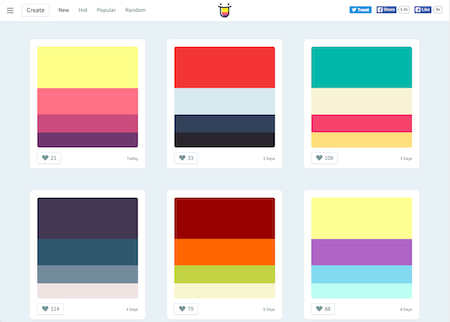
Designing for Colour-Blindness
As always, I’ve been tinkering with the site over the last few weeks. One of the adjustments I made was to remove the underlines from links, which I felt mad...

Introducing the Accessible Components Library - TetraLogical
We've open-sourced our Accessible Components Library, and, as you might expect, this includes the HTML, CSS, and JavaScript code. But, we thought, "Why stop there?" So, we've also published our documentation, including the accessibility requirements, test scenarios, and even the working automated tests which validate each one.
This is SO INCREDIBLY EXTREMELY valuable! Writing policy is really difficult, whether it's designed for humans or machines.

Dave Willner
At TrustCon this year I talked about a technique we’ve developed for automatically optimizing content-moderation policies, using an inversion of the binocular labeling approach Zentropi had already pioneered. Today we're shipping the tool that technique became. blog.zentropi.ai/optimizing-our-policy-optimiz…
