Beyond basic graph retrieval: six production-oriented architectures for combining semantic search, knowledge graphs, and LLM reasoning.
Discover the Power of Knowledge Graphs with this n8n InfraNodus Node
Triple Pattern Fragments: a Low-cost Knowledge Graph Interface for the Web
Does this article spark your interest? Then we should work together!
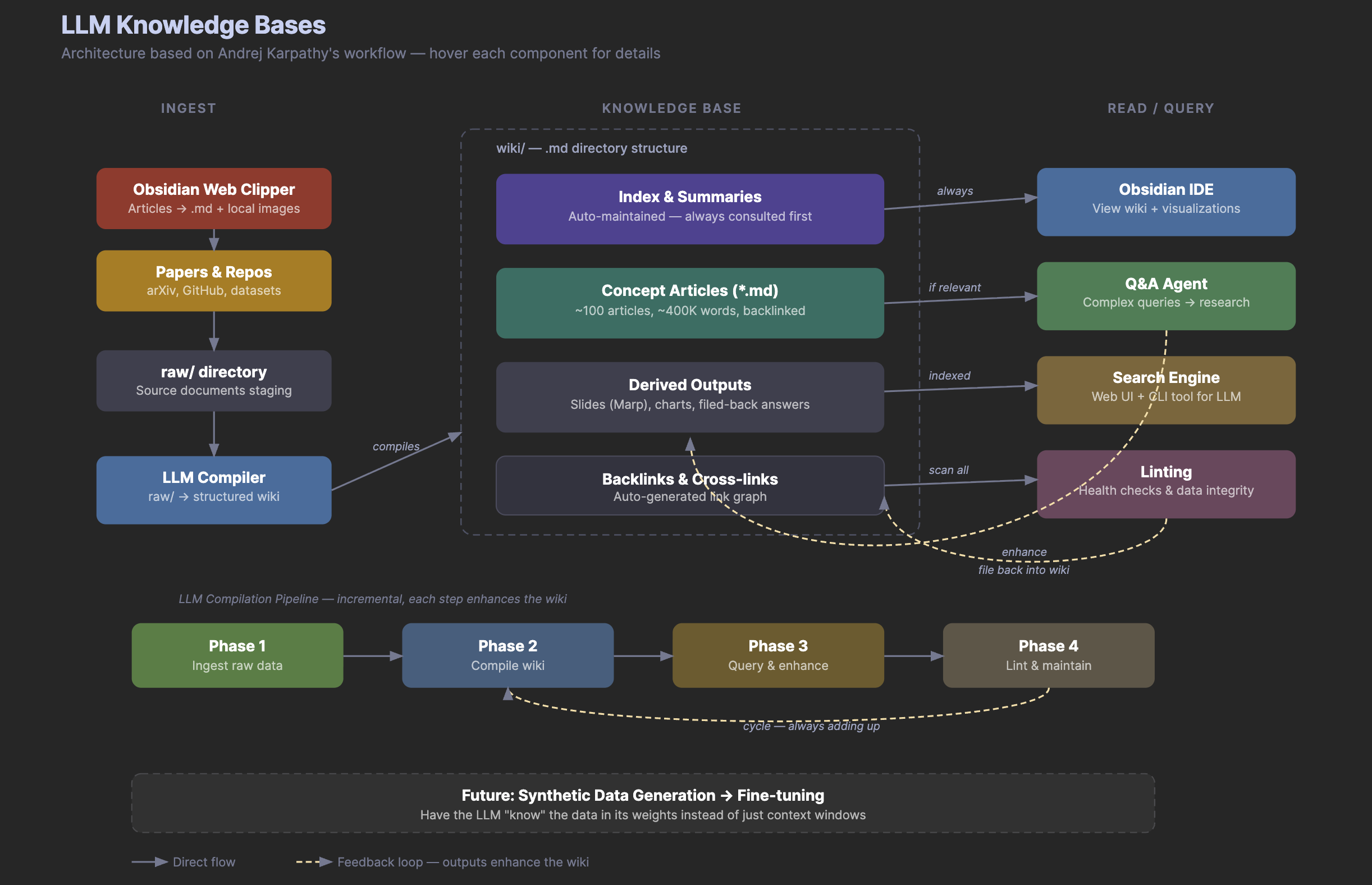
LLM Knowledge Bases
A visual breakdown of Andrej Karpathy's approach to building personal knowledge bases powered by LLMs. Learn the 4-phase pipeline: ingest, compile, query, and maintain - with an interactive architecture diagram.
Semantic Data Modeling, Graph Query, and SQL, Together at Last?
Our teams advance the state of the art through research, systems engineering, and collaboration across Google.

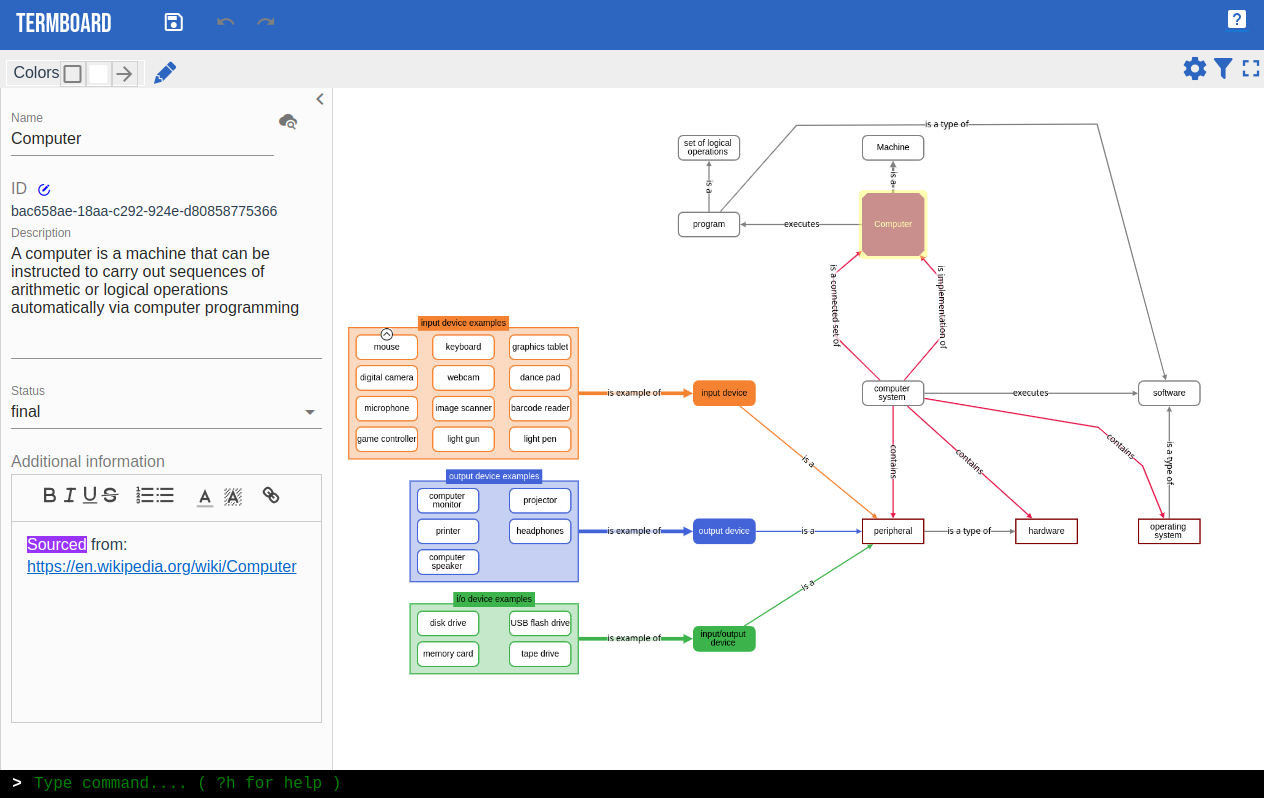
Knowledge Graphs
In this article, we provide a comprehensive introduction to knowledge graphs, which have recently garnered significant attention from both industry and academia in scenarios that require exploiting diverse, dynamic, large-scale collections of data. After some opening remarks, we motivate and contrast various graph-based data models, as well as languages used to query and validate knowledge graphs. We explain how knowledge can be represented and extracted using a combination of deductive and inductive techniques. We conclude with high-level future research directions for knowledge graphs.
An LLM's Perspective: What It's Actually Like to Receive These Instructions | Notion
graph TB subgraph

Introducing the Knowledge Graph: things, not strings
We hope this will give you a more complete picture of your interest, provide smarter search results, and pique your curiosity.

LLM Architecture Gallery
A gallery that collects architecture figures from The Big LLM Architecture Comparison and related articles, with fact sheets and links back to the original s...

How to Build an LLM Knowledge Base
A hands-on guide to building a simple LLM knowledge base with raw markdown sources, a compiled wiki, reusable prompts, and an agent that keeps improving the knowledge base over time.
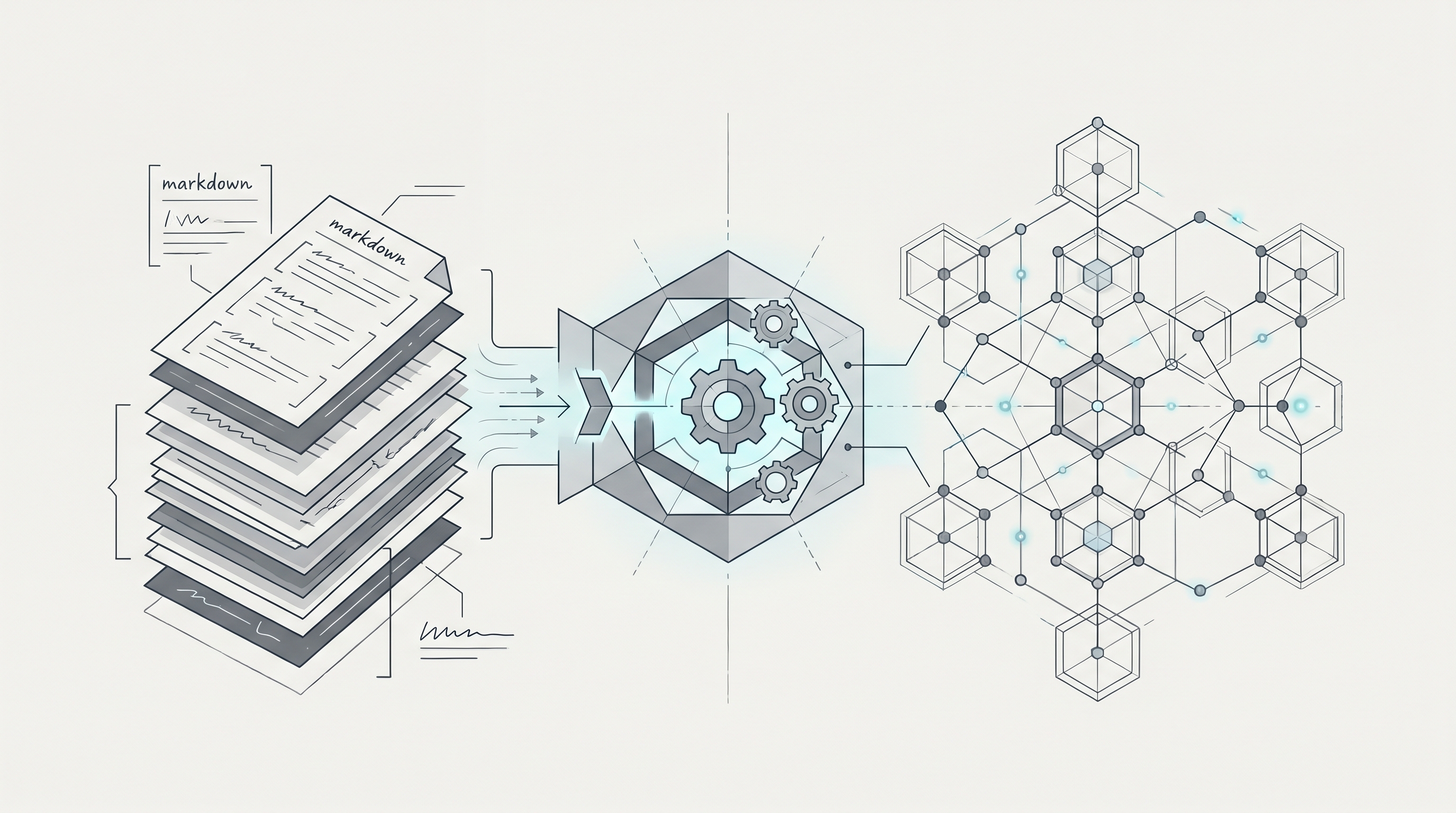
Retrieval as Reasoning: Self-Evolving Agent-Native Retrieval via LLM-Wiki
LLM agents require retrieval to behave less like one-shot context fetching and more like reasoning: searching, reading, traversing, and deciding when evidence is sufficient. Yet current Retrieval-Augmented Generation (RAG) systems organize external knowledge as flat chunks retrieved by embedding similarity, exposing a retrieval-as-lookup interface ill-suited to iterative reasoning agents. We propose LLM-Wiki, an agent-native retrieval system that operationalizes the Retrieval-as-Reasoning paradigm by treating external knowledge as a compilable, composable, and self-evolving structure rather than a static retrieval index. LLM-Wiki compiles documents into structured Wiki pages with bidirectional links, exposes search, read, and link-following operations through standard tool-calling interfaces, and introduces an Error Book for persistent structural and semantic self-correction. LLM-Wiki achieves state-of-the-art results on HotpotQA, MuSiQue, and 2WikiMultiHopQA, outperforming HippoRAG 2, LightRAG, and GraphRAG by 2.0-8.1 F1 points. On AuthTrace, LLM-Wiki achieves the best overall accuracy, with especially strong gains on multi-document structured queries, confirming that compilation-based retrieval generalizes beyond chain-style multi-hop reasoning.

Home - GRAPHIA
Through the creation of the first comprehensive SSH Knowledge Graph enriched with AI and LLM applications, GRAPHIA will transform SSH data.

AutoSchemaKG: Autonomous Knowledge Graph Construction through Dynamic Schema Induction from Web-Scale Corpora
In the current era of information abundance, transforming vast amounts of unstructured data into structured, machine-readable knowledge remains one of the most significant challenges in artificial intelligence. Knowledge Graphs (KGs) have emerged as the cornerstone technology for this transformation Zhao et al. (2024), providing the semantic backbone for applications ranging from search engines and question answering Wu et al. (2024); Chen et al. (2024c); Zong et al. (2024); Sun et al. (2024b) to recommendation systems Lyu et al. (2024) and complex reasoning tasks Li et al. (2024b). Yet despite their critical importance, current KG construction approaches remain hampered by an inherent paradox: they require predefined schemas created by domain experts, which fundamentally limits their scalability, adaptability, and domain coverage.
Specification of graph translators with triple graph grammars
Data integration is a key issue for any integrated set of software tools. A typical CASE environment, for instance, offers tools for the manipulation of requirements and software design documents, and it provides more or less sophisticated assistance for keeping these documents in a consistent state. Up to now, almost all data consistency observing or preserving integration tools are hand-crafted due to the lack of generic implementation frameworks and the absence of adequate specification formalisms. Triple graph grammars are intended to fill this gap and to support the specification of interdependencies between graph-like data structures on a very high level. Furthermore, they are the fundamentals of a new machinery for the production of batch-oriented as well as incrementally working data integration tools.

How NASA is Using Graph Technology and LLMs to Build a People Knowledge Graph
Missed NASA’s People Graph webinar? Catch the recap and see how graph technology and AI are shaping the future of workforce intelligence.