


We investigate the internal mechanisms used by Claude 3.5 Haiku — Anthropic's lightweight production model — in a variety of contexts, using our circuit tracing methodology.
Circuit Tracing: Revealing Computational Graphs in Language Models
We describe an approach to tracing the “step-by-step” computation involved when a model responds to a single prompt.

Tracing the thoughts of a large language model
Anthropic's latest interpretability research: a new microscope to understand Claude's internal mechanisms
Models overview
Claude is a family of state-of-the-art large language models developed by Anthropic. This guide introduces the available models and compares their performance.
Mapping the Mind of a Large Language Model
We have identified how millions of concepts are represented inside Claude Sonnet, one of our deployed large language models. This is the first ever detailed look inside a modern, production-grade large language model.
GEMOT: Towards Mechanistic World Models for Biology
Scientific discovery seeks mechanisms that explain observations and predict beyond the measurements that produced them. Whereas large language models (LLMs) encode knowledge implicitly, mechanistic world models organise it as a parsimonious set of explicit, modular, reusable mechanisms whose predictions can be scored against data.
How Large Language Models Actually Work
Large language models are cultural technologies. What might that mean?
Four different perspectives

Aaron Steven White
computational semanticist. into modular synths and rum. https://aaronstevenwhite.io
The evolution of syntactic communication
Animal communication is typically non-syntactic, which means that signals refer to whole situations1,2,3,4,5,6,7. Human language is syntactic, and signals consist of discrete components that have their own meaning8. Syntax is a prerequisite for taking advantage of combinatorics, that is, “making infinite use of finite means”9,10,11. The vast expressive power of human language would be impossible without syntax, and the transition from non-syntactic to syntactic communication was an essential step in the evolution of human language12,13,14,15,16. We aim to understand the evolutionary dynamics of this transition and to analyse how natural selection can guide it. Here we present a model for the population dynamics of language evolution, define the basic reproductive ratio of words and calculate the maximum size of a lexicon. Syntax allows larger repertoires and the possibility to formulate messages that have not been learned beforehand. Nevertheless, according to our model natural selection can only favour the emergence of syntax if the number of required signals exceeds a threshold value. This result might explain why only humans evolved syntactic communication and hence complex language.

Hypothesis generation and updating in large language models
Large language models (LLMs) increasingly help people solve problems, from debugging code to repairing machinery. This process requires generating plausible hypotheses from partial descriptions,...

haiku.garden devlog
Build log for haiku.garden, a personal-data-server home for the Naviar Haiku community on ATProto.
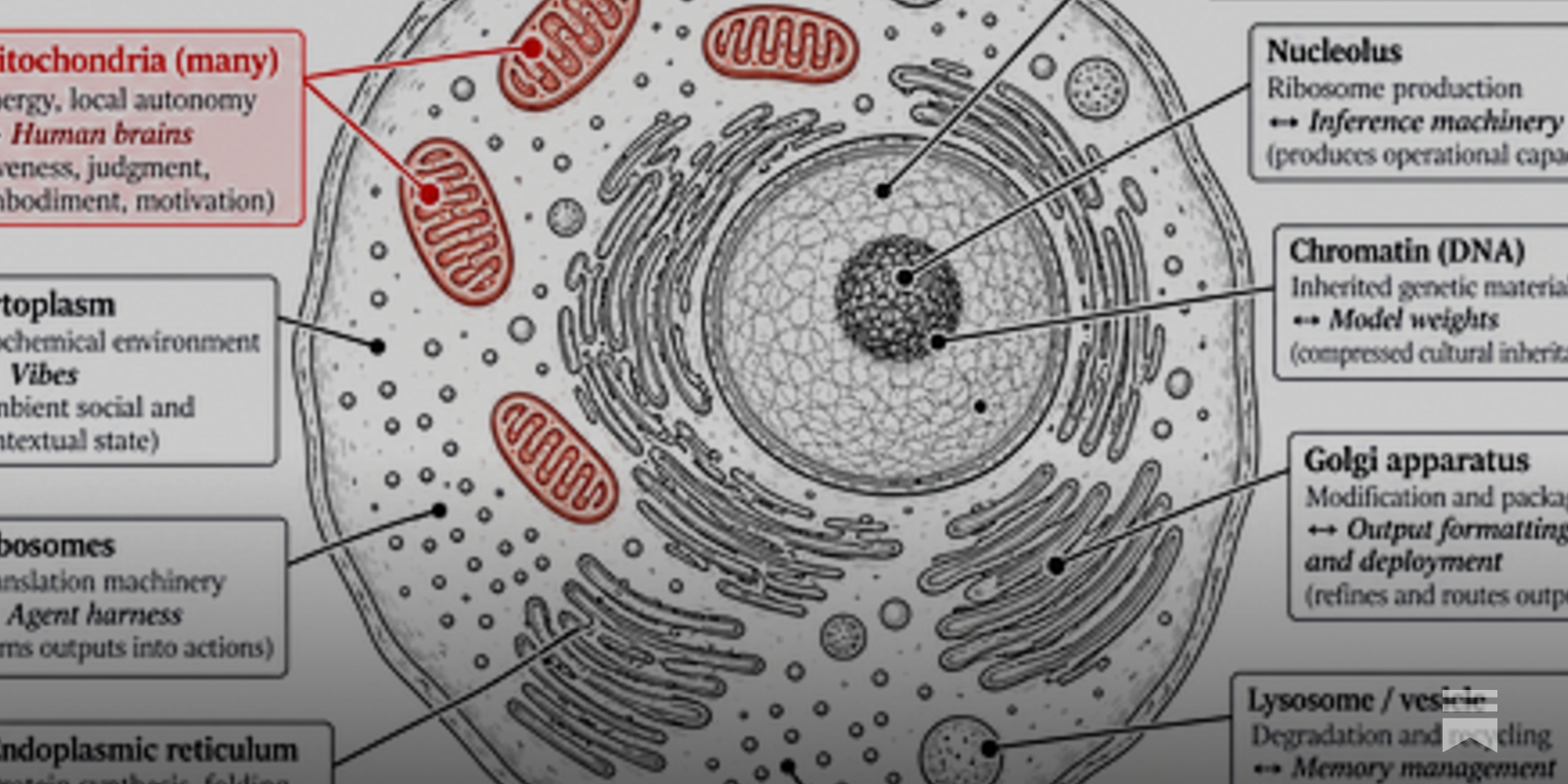
Our Eukaryotic Moment
Counterprogramming premature ontological closure in conceptualizing AI
Empirical evidence of Large Language Model's influence on human spoken communication
From the printing press to social media, innovations in communication technology have repeatedly reshaped how ideas spread through human culture. Chatbots powered by generative artificial intelligence constitute a new medium, encoding cultural patterns in their neural representations and disseminating them in conversations with hundreds of millions of people. Whether these patterns transmit into human language, and ultimately shape human culture, is a fundamental question. While fully quantifying the causal impact of a chatbot like ChatGPT on human culture is challenging, lexical shifts in human spoken communication may offer an early indicator. Here we show that words preferentially generated by ChatGPT, such as delve, showcase, boast, intricacies and meticulous, increased abruptly in spontaneous human speech. A synthetic-control analysis of 737,083 hours of conversation from 824,634 podcast episodes, screened for unscripted speech, causally links this shift to ChatGPT's release. The measurable influence on spontaneous speech suggests that humans internalize the lexical choices of large language models (LLMs). A preregistered experiment (N = 496) confirms they do, as a brief chatbot interaction led participants to adopt its words as their own, persisting past a distractor task and confirmed in forced lexical choice, indicating entrenchment in the active vocabulary. Together these results show that machines trained on human data now feed their own traits back into human language, integrating LLMs into the ongoing processes of cultural evolution.. This coupling raises concerns about linguistic homogenization and the capacity of a few major AI providers for latent cultural influence at scale.
Language Machines
How generative AI systems capture a core function of language Looking at the emergence of generative AI, Language Machines presents a new theory of meaning i...
elvis on Twitter / X
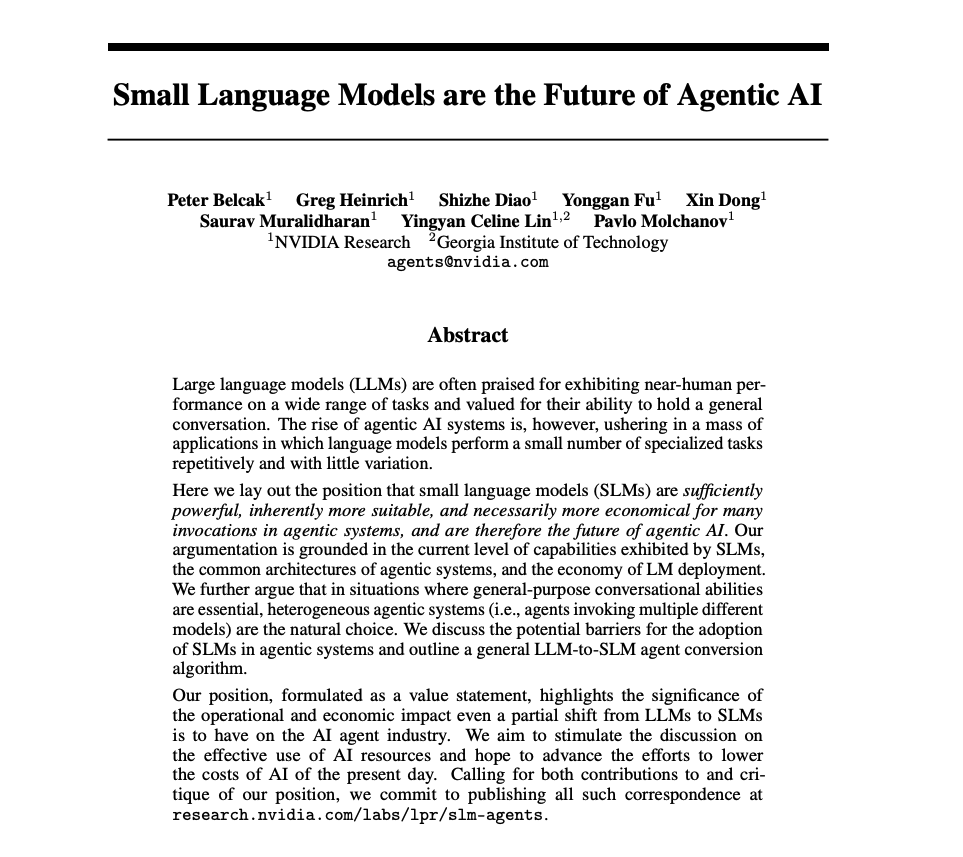
Small Language Models are the Future of Agentic AILots to gain from building agentic systems with small language models.Capabilities are increasing rapidly!AI devs should be exploring SLMs.Here are my notes: pic.twitter.com/7dhmz9V2jB— elvis (@omarsar0) July 1, 2025
Position: Stop Anthropomorphizing Intermediate Tokens as Reasoning/Thinking Traces!
Intermediate token generation (ITG), where a model produces output before the solution, has become a standard method to improve the performance of language models on reasoning tasks. These intermediate tokens have been called \say{reasoning traces} or even \say{thinking traces} -- implicitly anthropomorphizing the traces, and implying that these traces resemble steps a human might take when solving a challenging problem, and as such can provide an interpretable window into the operation of the model's thinking process to the end user. In this position paper, we present evidence that this anthropomorphization isn't a harmless metaphor, and instead is quite dangerous -- it confuses the nature of these models and how to use them effectively, and leads to questionable research. We call on the community to avoid such anthropomorphization of intermediate tokens.