

A new geopolitics is shaping the development of AI and the energy transition.
AI’s Imperial Agenda
“Empire of AI” author Karen Hao on how Silicon Valley’s young AI companies parallel colonial empires of old.

A Real Political Economy of Technology - The Ideas Letter
Two technological futures are competing for political and material priority: generative AI and the green transition. Benanav argues that while AI is marketed as a world-reordering breakthrough, its productivity gains…

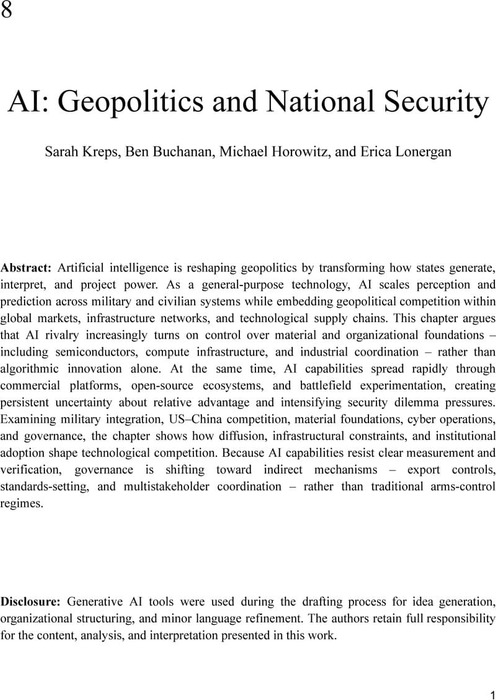
AI, Geopolitics, and National Security (Chapter 8)
Artificial intelligence is reshaping geopolitics by transforming how states generate, interpret, and project power. Rather than producing a single new weapon, AI operates as a general-purpose technology that scales perception, prediction, and decision-making across military, civilian, and informational domains. This chapter argues that AI rivalry increasingly depends on control over material and organizational foundations, including semiconductors, compute infrastructure, data centers, industrial coordination, and institutional adoption. It examines battlefield integration, U.S.–China competition, semiconductor statecraft, cyber operations, information power, and governance. The chapter shows that AI capabilities diffuse rapidly through commercial platforms, open-source ecosystems, and wartime experimentation, while frontier development remains constrained by infrastructure and supply-chain chokepoints. Because AI capability is difficult to measure or verify, governance is shifting away from traditional arms-control models toward export controls, standards, voluntary commitments, and multistakeholder coordination.
Apocalypse Now and Then • EQUATOR
Artificial intelligence is capitalism’s final destination

The Moat or the Commons — Warman Notes
American capital financed AI on the assumption it would be the next great monopoly. Open-weight models are commoditizing the capability that monopoly was supposed to protect. The collision between the two now defines the direction of the U.S. AI industry — and the country.
OpenAI Calls for New Industrial Policy as AI Reshapes Economy and Governance
OpenAI’s policy paper argues that governments must adopt a new industrial policy to manage AI’s economic disruption.

Import AI 452: Scaling laws for cyberwar; rising tides of AI automation; and a puzzle over gDP forecasting
How much could AI revolutionize the economy?


The New Geopolitics Of The Green Transition
The only path forward for tackling the climate crisis hinges on cooperative industrial strategies to coordinate clean energy investment and infrastructure development.
EU-AI | Igor L.
The geopolitical landscape is shifting from physical borders to digital infrastructure. Here is a factual breakdown of how a $500 billion investment in "Sovereign AI" is changing global power dynamics. The Shift: From Land to "Substrate" Historically, a nation’s power was defined by its territory and legal systems (the Westphalian model). Today, power is increasingly tied to the compute substrate—the physical hardware and energy required to run AI. 1. Infrastructural Enclosure The "Sovereign Compute Coalition" (SCC) represents a massive consolidation of power. Major private entities are acquiring the three pillars of modern national strength: * Hardware: High-end AI chips (e.g., Nvidia). * Energy: The massive power grids needed to fuel them. * Data Centers: The physical "brains" of the digital economy. 2. The Rise of Technocracy As private companies own these essential tools, governments may find themselves in a position where they effectively "rent" their ability to govern. This moves decision-making power away from elected officials and toward those who control AI infrastructure. 3. Europe’s Strategic Response Europe is launching several initiatives to avoid becoming a "client state" of foreign tech providers. The strategy focuses on four main channels: * 8ra Initiative: Building a decentralized, multi-provider cloud-edge architecture to ensure data remains under European control and interoperable across borders. * ReArm Europe: A strategic defense package (presented in March 2025) aimed at boosting industrial competitiveness and reducing strategic dependencies in technology and defense. * Sovereign LLMs: Developing domestic models, such as Mistral, that are designed to align with European data privacy standards and cultural values. * Energy & Procurement: Using public procurement and new regulatory frameworks to create demand for homegrown, sustainable energy-efficient compute solutions. The goal of these moves is #DigitalSovereignty : the ability for a region to control its own digital destiny without relying exclusively on transnational monopolies. Data tells the real story. Are you following it? Follow #datanomics

Building Political Superintelligence
Amidst fears of dystopia, a blueprint for how we use AI to reinvent the way we govern ourselves

Inside the Dirty, Dystopian World of AI Data Centers
The race to power AI is already remaking the physical world.
The Next Great Divergence: How AI could split the world again if we don’t intervene | Brookings
Michael Muthukrishna and Philip Schellekens argue that AI, like past general-purpose technologies, could drive a new global divergence unless deliberate action ensures its benefits are broadly shared rather than geographically concentrated.

A Thesis on the History of the 21st Century: Technocracy, AI, and the End of the World
Reviewing a trio of books by a sextet of ruling-class ideologues, Mathias Fuelling finds an ambient anxiety hanging over a perceived crisis in American capitalism, with visions of bolstering a Silicon Valley-led technocracy fueled by AI investment reflecting American fears over the dawn of a "Chinese Century."

AI as the new avatar of American capitalism
Why "AI populism" is just "populism"

AI, Decomputing and the Interregnum
This paper treats AI as diagnostic for the deeper changes taking place in the existing order of things. It uses AI's alignment with both the political economy and with the dualisms that underpin it, including race, gender and anthropocentrism, to highlight the nihilistic character of the current restructuring. AI's scaling and accelerationism are taken as examples of the wider tactics being invoked by hegemonic power to maintain control under changing conditions. From this perspective, the massive build-out of data centres isn't simply a seizure of energy resources but a manifestation of an aggressive and misogynist technopolitics. The paper argues that a liberal push for digital sovereignty doesn't interrupt these dynamics but plays into the hands of emerging technofascism. It proposes instead the prefigurative tactic of 'decomputing', which draws on degrowth, deautomatisation and a convivial approach to technology. It explores decomputing as a means to mitigate both material and relational harms and as a decisive turn towards infrastructuring the common good. The paper concludes that AI is the contradiction that reveals many others, not least the gap between claims to legitimacy and the actuality of destructive violence, and proposes an alternative technopolitics of reciprocity that prioritises care and sustainability.