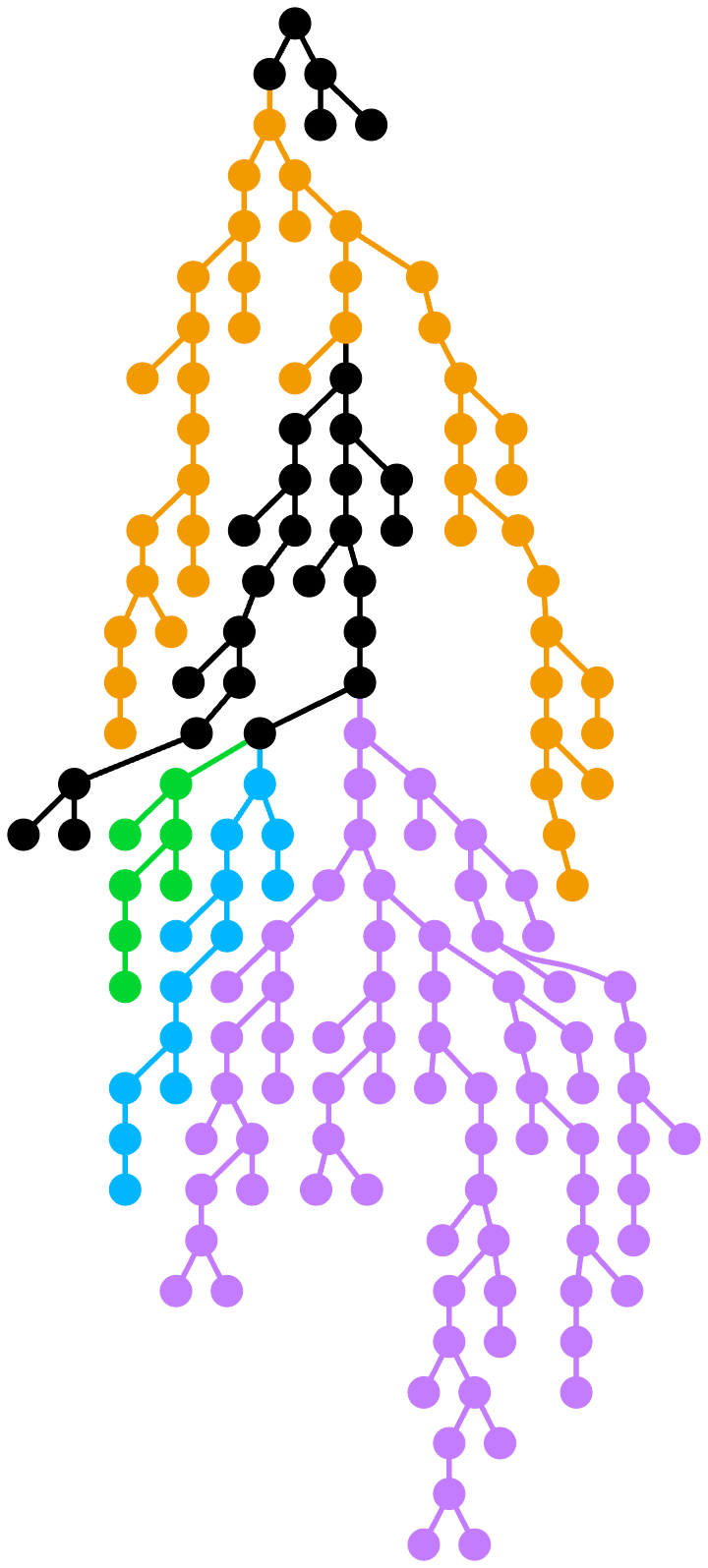
One operator. Trivial semantics. Turing complete. Intensional.
Functional programming with bananas, lenses, envelopes and barbed wire
We develop a calculus for lazy functional programming based on recursion operators associated with data type definitions. For these operators we derive various algebraic laws that are useful in deriving and manipulating programs. We shall show that all example functions in Bird and Wadler's “Introduction to Functional Programming” can be expressed using these operators.
Syntax and semantics of dependent types
In this chapter we fix a particular syntax for a dependently typed calculus and define an abstract notion of model as well as a general interpretation function mapping syntactical objects to entities in a model. This interpretation function is shown to be sound with respect to the syntax.
The Lambek Calculus
There is a noticeable revival of categorial grammar these days, as a vehicle for linguistic description. The systems used differ somewhat from the original calculus of Ajdukiewicz and Bar-Hillel, however. In particular, there is a component of rules for ‘type change’ of expressions, making for greater flexibility and elegance. One fundamental system of this kind is the so-called ‘Lambek Calculus’, whose type-change rules show a close analogy with the inference rules of constructive propositional logic. In this paper, we present one calculus of this kind, and survey its theoretical properties as a device in linguistic semantics. Our two main new contributions are a new and complete semantics for this calculus, as well as a modest study of its language-accepting capacity. In this way, we hope to provide a better understanding of the background theory of flexible categorial grammar, in tandem with its descriptive uses.

Combinators for bidirectional tree transformations: A linguistic approach to the view-update problem: ACM Transactions on Programming Languages and Systems: Vol 29, No 3
We propose a novel approach to the view-update problem for tree-structured data: a domain-specific programming language in which all expressions denote bidirectional transformations on trees. In one direction, these transformations---dubbed lenses---map ...

A formulation of the simple theory of types
The purpose of the present paper is to give a formulation of the simple theory of types which incorporates certain features of the calculus of λ-conversion. A complete incorporation of the calculus of λ-conversion into the theory of types is impossible if we require that λx and juxtaposition shall retain their respective meanings as an abstraction operator and as denoting the application of function to argument. But the present partial incorporation has certain advantages from the point of view of type theory and is offered as being of interest on this basis (whatever may be thought of the finally satisfactory character of the theory of types as a foundation for logic and mathematics).For features of the formulation which are not immediately connected with the incorporation of λ-conversion, we are heavily indebted to Whitehead and Russell, Hilbert and Ackermann, Hilbert and Bernays, and to forerunners of these, as the reader familiar with the works in question will recognize.The class of type symbols is described by the rules that ı and o are each type symbols and that if α and β are type symbols then (αβ) is a type symbol: it is the least class of symbols which contains the symbols ı and o and is closed under the operation of forming the symbol (αβ) from the symbols α and β.
Generic deriving of generic traversals | Proceedings of the ACM on Programming Languages
Functional programmers have an established tradition of using traversals as a design pattern to work with recursive data structures. The technique is so prolific that a whole host of libraries have been designed to help in the task of automatically ...

All elementary functions from a single binary operator
A single two-input gate suffices for all of Boolean logic in digital hardware. No comparable primitive has been known for continuous mathematics: computing elementary functions such as sin, cos, sqrt, and log has always required multiple distinct operations. Here I show that a single binary operator, eml(x,y)=exp(x)-ln(y), together with the constant 1, generates the standard repertoire of a scientific calculator. This includes constants such as e, pi, and i; arithmetic operations including addition, subtraction, multiplication, division, and exponentiation as well as the usual transcendental and algebraic functions. For example, exp(x)=eml(x,1), ln(x)=eml(1,eml(eml(1,x),1)), and likewise for all other operations. That such an operator exists was not anticipated; I found it by systematic exhaustive search and established constructively that it suffices for the concrete scientific-calculator basis. In EML (Exp-Minus-Log) form, every such expression becomes a binary tree of identical nodes, yielding a grammar as simple as S -> 1 | eml(S,S). This uniform structure also enables gradient-based symbolic regression: using EML trees as trainable circuits with standard optimizers (Adam), I demonstrate the feasibility of exact recovery of closed-form elementary functions from numerical data at shallow tree depths up to 4. The same architecture can fit arbitrary data, but when the generating law is elementary, it may recover the exact formula.

Finite-Choice Logic Programming | Proceedings of the ACM on Programming Languages
Logic programming, as exemplified by datalog, defines the meaning of a program as its unique smallest model: the deductive closure of its inference rules. However, many problems call for an enumeration of models that vary along some set of choices while ...

Abstract syntax and variable binding
We develop a theory of abstract syntax with variable binding. To every binding signature we associate a category of models consisting of variable sets endowed with compatible algebra and substitution structures. The syntax generated by the signature is the initial model. This gives a notion of initial algebra semantics encompassing the traditional one; besides compositionality, it automatically verifies the semantic substitution lemma.
Probabilistic compositional semantics, purely
We provide a general framework for the integration of formal semantics with probabilistic reasoning. This framework is conservative, in the sense that it relies only on typed λ-calculus and is thus co
Call-by-name, call-by-value and the λ-calculus
This paper examines the old question of the relationship between ISWIM and the λ-calculus, using the distinction between call-by-value and call-by-name. It is held that the relationship should be mediated by a standardisation theorem. Since this leads to difficulties, a new λ-calculus is introduced whose standardisation theorem gives a good correspondence with ISWIM as given by the SECD machine, but without the letrec feature. Next a call-by-name variant of ISWIM is introduced which is in an analogous correspondence withthe usual λ-calculus. The relation between call-by-value and call-by-name is then studied by giving simulations of each language by the other and interpretations of each calculus in the other. These are obtained as another application of the continuation technique. Some emphasis is placed throughout on the notion of operational equality (or contextual equality). If terms can be proved equal in a calculus they are operationally equal in the corresponding language. Unfortunately, operational equality is not preserved by either of the simulations.
Functional Query Languages with Categorical Types
We study three category-theoretic types in the context of functional query languages (typed lambda-calculi extended with additional operations for bulk data processing). The types we study are:
Categorical Data Structures for Technical Computing
Many mathematical objects can be represented as functors from finitely-presented categories $\mathsf{C}$ to $\mathsf{Set}$. For instance, graphs are functors to $\mathsf{Set}$ from the category with two parallel arrows. Such functors are known informally as $\mathsf{C}$-sets. In this paper, we describe and implement an extension of $\mathsf{C}$-sets having data attributes with fixed types, such as graphs with labeled vertices or real-valued edge weights. We call such structures "acsets," short for "attributed $\mathsf{C}$-sets." Derived from previous work on algebraic databases, acsets are a joint generalization of graphs and data frames. They also encompass more elaborate graph-like objects such as wiring diagrams and Petri nets with rate constants. We develop the mathematical theory of acsets and then describe a generic implementation in the Julia programming language, which uses advanced language features to achieve performance comparable with specialized data structures.

Algebraic data integration
In this paper, we develop an algebraic approach to data integration by combining techniques from functional programming, category theory, and database theory. In our formalism, database schemas and instances are algebraic (multi-sorted equational) theories of a certain form. Schemas denote categories, and instances denote their initial (term) algebras. The instances on a schema S form a category, S–Inst, and a morphism of schemas F : S → T induces three adjoint data migration functors: ΣF : S–Inst → T–Inst, defined by substitution along F, which has a right adjoint ΔF : T–Inst → S–Inst, which in turn has a right adjoint ΠF : S–Inst → T–Inst. We present a query language based on for/where/return syntax where each query denotes a sequence of data migration functors; a pushout-based design pattern for performing data integration using our formalism; and describe the implementation of our formalism in a tool we call AQL (Algebraic Query Language).
Categories of Containers
We introduce the notion of containers as a mathematical formalisation of the idea that many important datatypes consist of templates where data is stored. We show that containers have good closure properties under a variety of constructions including the formation of initial algebras and final coalgebras. We also show that containers include strictly positive types and shapely types but that there are containers which do not correspond to either of these. Further, we derive a representation result classifying the nature of polymorphic functions between containers. We finish this paper with an application to the theory of shapely types and refer to a forthcoming paper which applies this theory to differentiable types.