

Yesterday's headline in The Verge had people planning their Discord exodus overnight. But the real story isn't about Discord — it's about legislators demanding surveillance infrastructure.
Discord will require a face scan or ID for full access next month
Age verification for all.

Hackers uncover the most alarming frontend leak in Discord’s age verification data
Exposed age verification code tied to Discord's identity vendor has intensified debate over facial scans, ID uploads, and user trust.

Exposed Persona Frontend Reveals Extensive Biometric Surveillance Stack Behind Age Verification - ID Tech
Security researchers investigating Discord’s age-verification implementation have discovered a publicly exposed frontend belonging to Persona Identities, Inc., revealing that the identity-verification vendor’s platform performs far more extensive checks than users […]

Another Day, Another Age Verification Data Breach: Discord’s Third-Party Partner Leaked Government IDs
Once again, we’re reminded why age verification systems are fundamentally broken when it comes to privacy and security. Discord has disclosed that one of its third-party customer service prov…

Bill C-22’s Groundhog Day: Why the Government’s Dismissal of Signal, Apple and the U.S. Congress Concerns Runs Back the Disastrous Online News Act Playbook - Michael Geist
Secure messaging service Signal yesterday became the latest company to warn that Bill C-22, the lawful access bill, could force it to leave the Canadian market rather than comply with provisions it says would compromise its end-to-end encryption and create new cybersecurity risks. Signal vice-president Udbhav Tiwari told the Globe and Mail that the company “would rather pull out of the country than be compelled to compromise on the privacy promises we have made to our users.” The comments are part of a steady stream of similar warnings from Apple, Meta, the Canadian Chamber of Commerce, the Cybersecurity Advisors Network, and the chairs of the U.S. House Judiciary and Foreign Affairs Committees. Despite growing concern, the government’s response has been to launch a misleading social media campaign and repeatedly insist that the experts and companies are mistaken.

The rise (and future fall) of Discord
I want to talk about Discord. Not about all the issues like privacy, accessibility, performance. No, the good things. The part where it completely revolutionized the internet. And how it will destroy it all.
Facebook and Twitter shutter pro-Trump network reaching 55 million accounts
They used AI-generated faces as profile photos

Site Blocking and Age Verification for Twitter, Instagram, Snap and Twitch?: Age Verification Lobby Confirms it Wants Bill S-210 to Cover All Social Media Sites - Michael Geist
Bill S-210 - the Protecting Young Persons from Exposure to Pornography Act - burst onto the public scene late last year as a majority of the House voted for the bill at second reading, sending it to the Public Safety committee for review. The bill, which is the brainchild of Senator Julie Miville-Dechêne, was supported by the Conservatives, Bloc and NDP with a smattering of votes from backbench Liberal MPs (the cabinet voted against, signalling it is not supported by the government). The bill raises significant concerns with the prospect of government-backed censorship, mandated age verification to use search engines or social media, and a framework for court-ordered website blocking (I appeared before the Senate committee that studied by the bill in February 2022, arguing that “by bringing together website blocking, face recognition technologies, and stunning overbreadth that would capture numerous mainstream services, the bill isn’t just a slippery slope, it is an avalanche.”). In response to the public criticism of the bill, Senator Julie Miville-Dechêne has suggested that concerns about it extending to general purpose social media sites is overstated since the intent is to target adult content sites. Yet that is not what the bill provides as it applies to anyone who makes sexually explicit material available on the Internet for commercial purposes:

Same company verifies mugshots for ChatGPT, and offers 269 surveillance checks for US government
The identity verification company used by ChatGPT and other major services accidentally exposed its government-authorized platform, which is capable of extensive surveillance.

This App Warns You if Someone Is Wearing Smart Glasses Nearby
The creator of Nearby Glasses made the app after reading 404 Media's coverage of how people are using Meta's Ray-Bans smartglasses to film people without their knowledge or consent. “I consider it to be a tiny part of resistance against surveillance tech.”

Chat Control & Going Dark: The war on encryption is on the rise. Through a shady collaboration between the US and the EU.
After Snowden’s whistleblowing in 2013, large parts of the internet became encrypted, enabling private and secure communication. Not everyone has welcomed this change. Most notably, the FBI and other U.S. government agencies have fought what is often called the “crypto wars”, the war on encryption. In recent years, they have been joined by the European Commission. Under the slogan “what about the children,” they try to introduce total mass surveillance of all EU citizens — first through the proposed Chat Control legislation, and later via the Going Dark and ProtectEU initiatives. The goal is to legally mandate spy tools on every European smartphone and computer. The forces behind these efforts have turned out to be American tech companies and intelligence agencies.
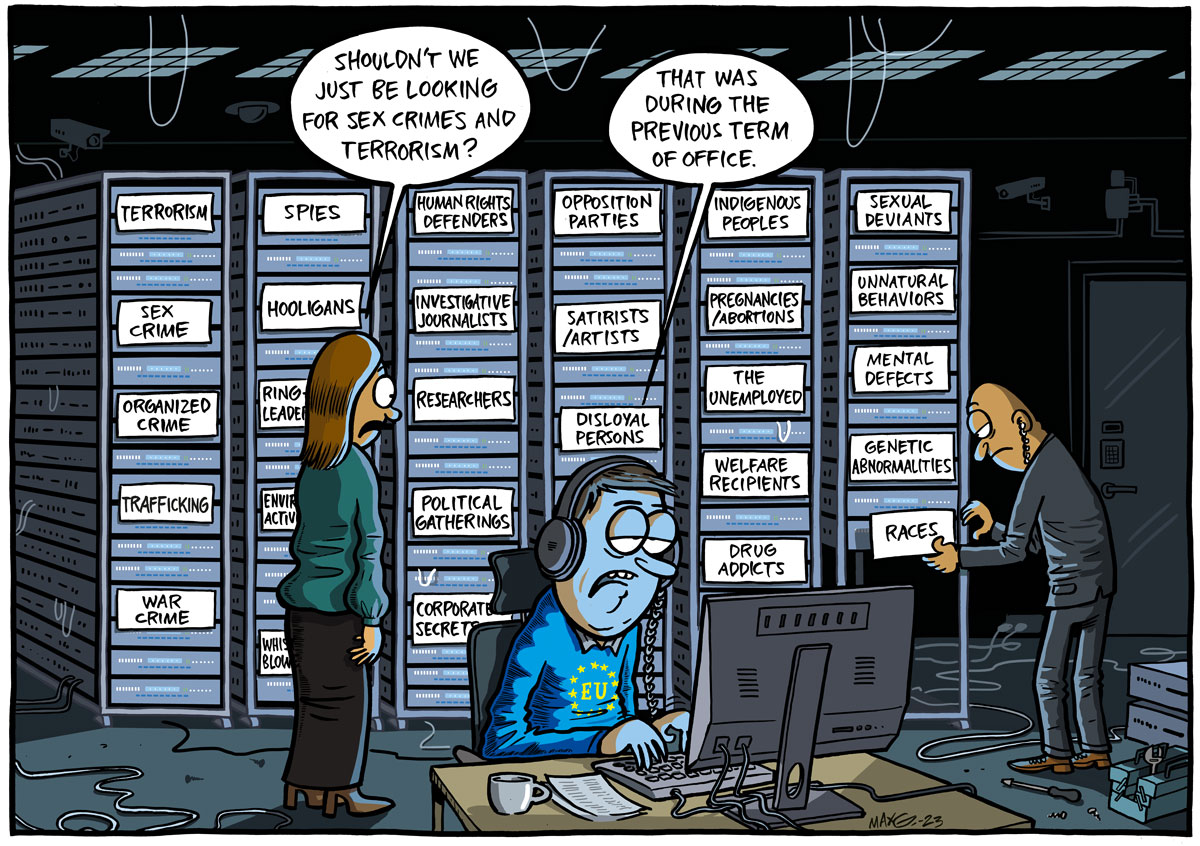
Hackers Expose Age-Verification Software Powering Surveillance Web
Three hacktivists tried to find a workaround to Discord’s age-verification software. Instead, they found its frontend exposed to the open internet.

The Lawful Access Two-Headed Surveillance Monster: How Bill C-22 Went Off the Rails - Michael Geist
The government’s plans for lawful access have gone off the rails. In recent days, Signal has warned it would pull out of the Canadian market rather than comply with Bill C-22. Windscribe, the Toronto-headquartered VPN provider, has said it would relocate its headquarters out of Canada and NordVPN has warned it would consider following suit. Apple and Meta have both raised public concerns about the bill’s effect on encryption and cybersecurity. The Canadian Chamber of Commerce, the Cybersecurity Advisors Network, civil liberties groups, and a long line of legal and security experts have all called for changes. The chairs of the U.S. House Judiciary and Foreign Affairs Committees have written to Public Safety Minister Gary Anandasangaree warning that the bill threatens U.S. national security and the integrity of cross-border data flows. Even the bill’s own oversight body, the National Security and Intelligence Review Agency, has told the SECU committee it does not have the access it needs for effective oversight. If the government thought it could push through the bill largely unnoticed, it has been proven painfully wrong as there are now trade frictions with the U.S., the prospect of leading companies exiting the Canadian market, and weaker cybersecurity protections for ordinary users. How did Canada’s lawful access plan go awry so quickly?
Hackers Expose The Massive Surveillance Stack Hiding Inside Your “Age Verification” Check
We’ve been saying this for years now, and we’re going to keep saying it until the message finally sinks in: mandatory age verification creates massive, centralized honeypots of sensitiv…
We Need A Massive Surveillance Program (Idle Words)
I am a privacy activist who has been riding a variety of high horses about the dangers of permanent, ubiquitous data collection since 2012.
Our statement on the UK gov't's demand that all content on all devices sold or used in the UK be scanned, on the presumption of nudity, using a dystopian combination of age verification & content scanning. This proposal will not safeguard children. It endangers us all. signal.org/blog/pdfs/2026-06-08-uk-surve…
