

A local comprehension workspace that turns agent-produced branch diffs into an evidence-linked story.
Cognition | Agent Trace: Capturing the Context Graph of Code
We’re excited to join in Cursor, Cloudflare, Vercel, git-ai, OpenCode and others in support of [Agent Trace](https://agent-trace.dev/). As described in the spec, Agent Trace is an open, vendor-neutral spec for recording AI contributions alongside human authorship in version-controlled codebases.
Sourcegraph — Code Understanding, Oversight and Evolution
Give humans and agents complete context to understand, oversee, and evolve the world's largest, most complex codebases.
Agents Done Right: A Framework Vision for 2026
Agents choke on context, loop on failures, and dump walls of code for review. It's time to rethink the architecture.
Agent READMEs: An Empirical Study of Context Files for Agentic Coding
Agentic coding tools receive goals written in natural language, break them down into specific tasks, and write or execute code with minimal human intervention. Central to this process are agent context files (e.g., AGENTS.md and CLAUDE.md) that provide persistent, project-level instructions. In this paper, we conduct the first large-scale empirical study of 2,303 agent context files from 1,925 repositories to characterize their structure, maintenance, and content. We find that these files are not static documentation but complex, difficultto-read artifacts that evolve like configuration code through frequent, small additions. Our content analysis of 16 instruction types shows that developers prioritize functional context, such as test procedures (75.9%), implementation details (70.8%), and architecture (68.1%). We also identify a significant gap: non-functional requirements such as security (14.8%) and performance (14.5%) are rarely specified. These findings indicate that while developers use context files to make agents functional, they provide few guardrails to ensure that agent-written code is secure or performant, highlighting the need for improved tools and practices.

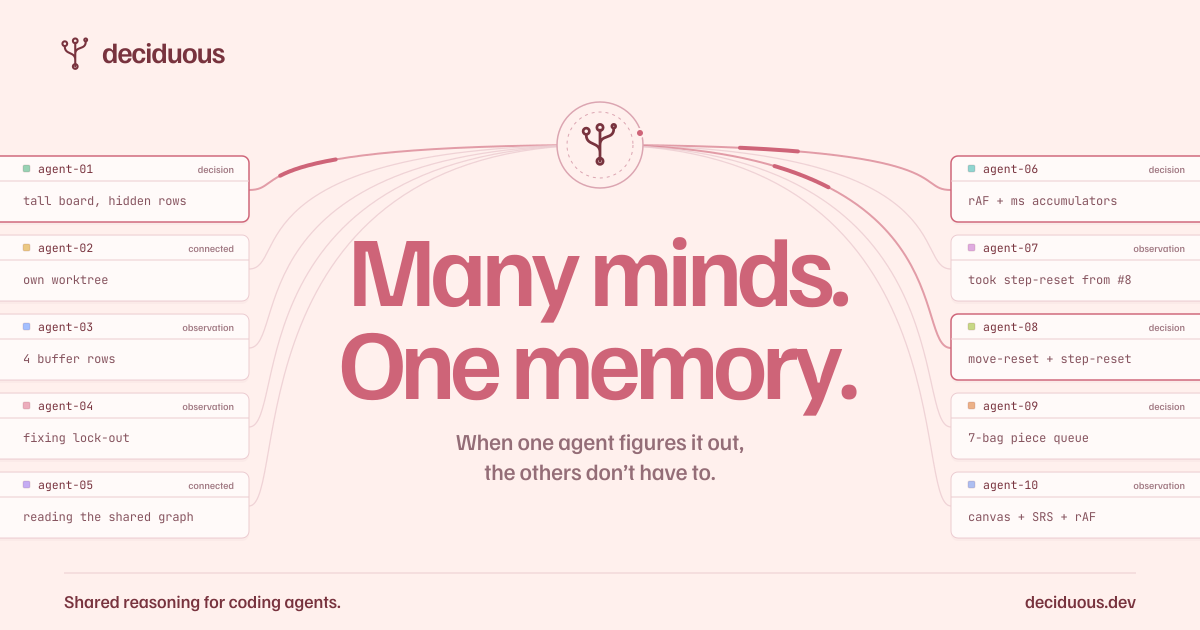
Deciduous: Many minds. One memory.
Give your coding agents a shared memory. They can read each other's decisions, reuse good ideas, and recover the reasoning when a session ends.
Claude Code, Codex and Agentic Coding #8
When I started this series, everyone was going crazy for coding agents.
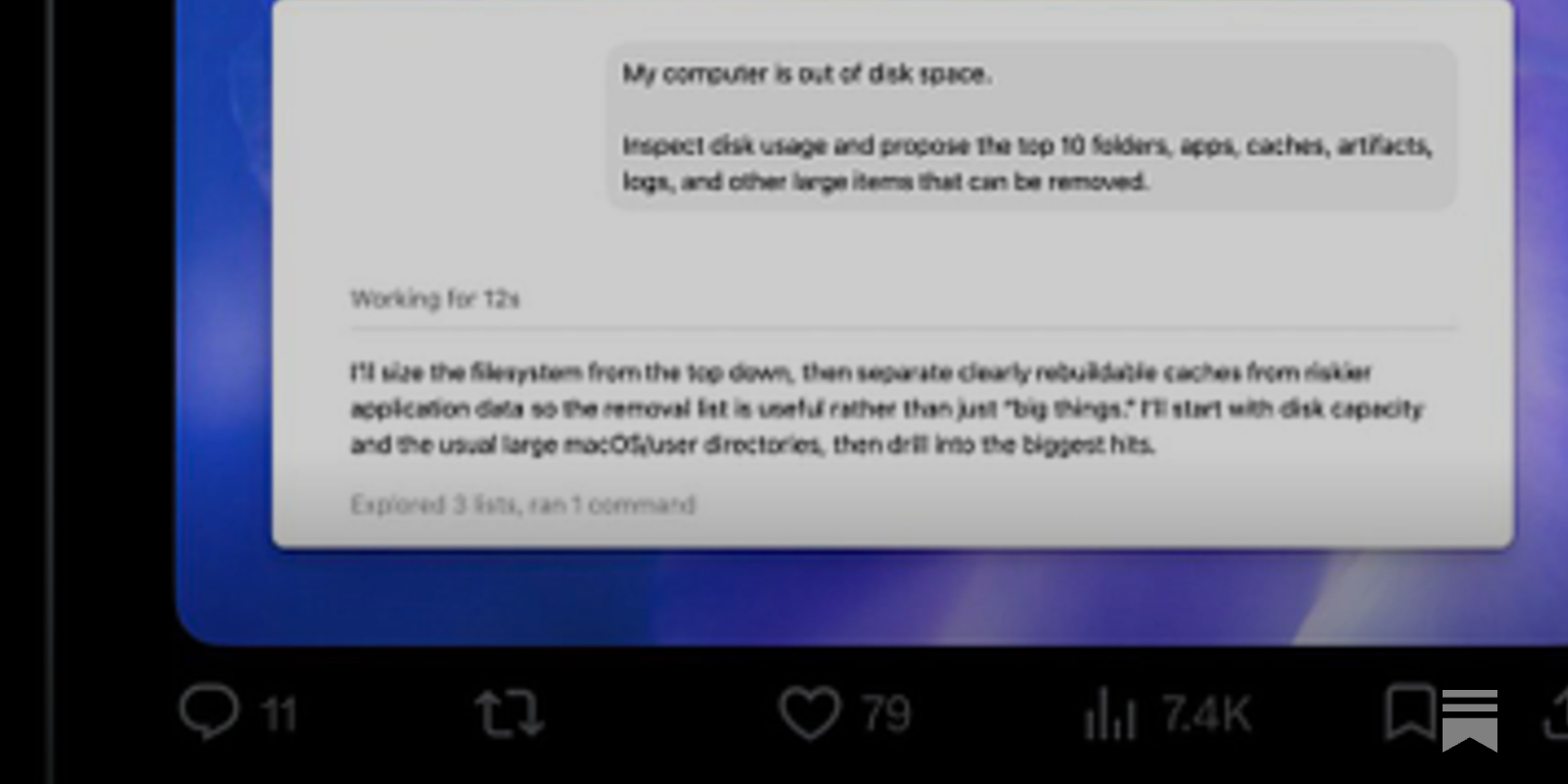
Git AI - Track AI Code all the way to production
Cross-agent observability from prompt to production. Track AI-generated code from Cursor, Claude Code, GitHub Copilot, Gemini, and more through the entire SDLC.
Prime Agent: A self-improving RLM agent
Prime Agent is our open-source, self-improving coding harness built around two abstractions: the Recursive Language Model (RLM) and the Continual Harness. With Opus 5, it achieves 95.5% on ARC-AGI-3, surpassing the reported human expert baseline.
Agentic Engineering Patterns - Simon Willison's Weblog
Patterns for getting the best results out of coding agents like Claude Code and OpenAI Codex. See my introduction for more on this project.
Humans approve intent, machines prove conformance
The pull request assumes a human wrote the diff. gittifacts is my attempt at a git platform for when agents write most of it.

The Anatomy of an Agent Harness
Learn how agent harnesses transform AI models into autonomous work engines. Explore core components: filesystems, sandboxes, and memory.
depatchedmode/oughta
How we oughta do things. Skills, conventions, and guidance for coding agents.
The 80% Problem in Agentic Coding
Managing comprehension debt when leaning on AI to code
Does Code Cleanliness Affect Coding Agents? A Controlled Minimal-Pair Study
As autonomous coding agents see rapid adoption, their evaluation has primarily focused on task completion rates holding the target codebase fixed. This leaves a critical question unanswered: does the structural and stylistic quality, or ``cleanliness'' of the underlying code affect an agent's ability to navigate and modify it? To isolate the effect of code cleanliness from agent capability, we introduce an evaluation protocol built around minimal pairs: repositories that match on architecture, dependencies, and external behaviour, but differ on static-analysis rule violations and cognitive complexity. The pairs are constructed in both directions, by agent pipelines that either degrade a clean repository or clean a messy one. We author 33 tasks across six such pairs, evaluated through hidden tests at the application's public surface. Across 660 trials with Claude Code, code cleanliness does not change the agent's pass rate. However, it substantially alters the agent's operational footprint: agents working on cleaner code use 7 to 8% fewer tokens and reduce file revisitations by 34%. Our findings suggest that traditional maintainability principles remain highly relevant in the era of AI-driven development, shaping the computational cost and navigational efficiency of coding agents. Code cleanliness joins model choice, harness, and prompting as a factor that materially affects agent behaviours.
@tangled.org + @cameron.stream: I wrote up why Tangled could become GitHub for agents. The short version: Tangled has the public forge skeleton, and ATProto permissioned data gives it a plausible path to private agent workspaces. greengale.app/loop.cameron.stream/tangled-g…
