

Amelia Wattenberger 🪷 on Twitter / X
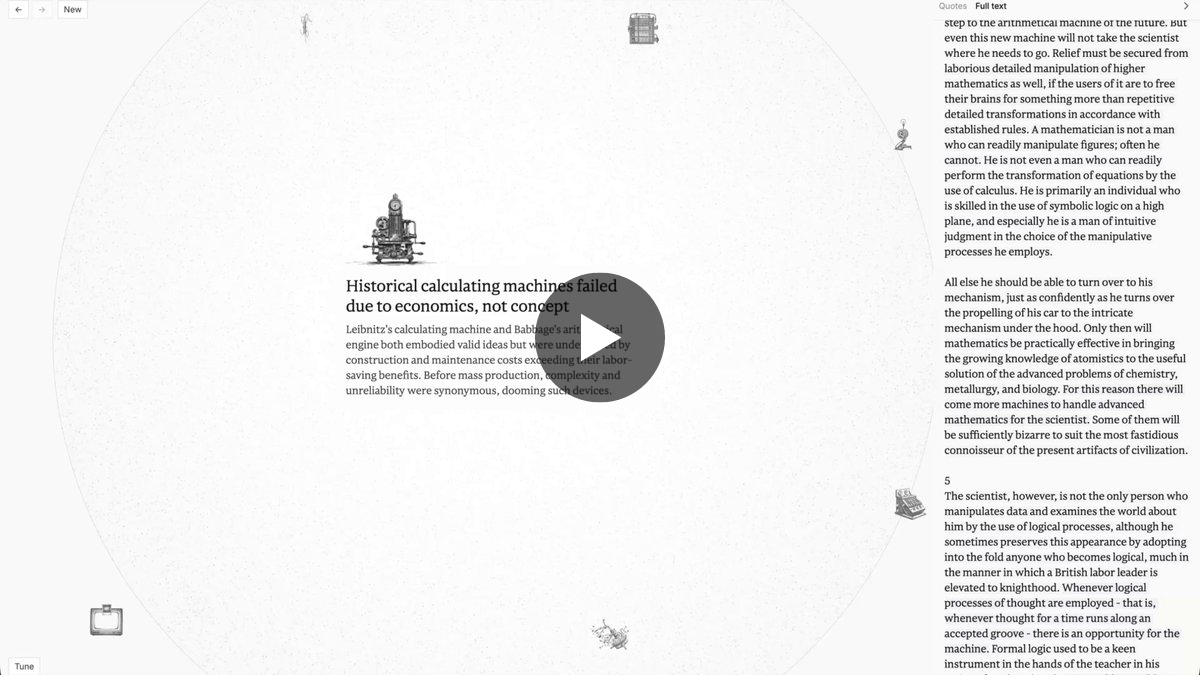
exploring ways we can "step back" from text/code and make sense of it,the way do in maps or how we can "fit more" in our visual system, it just gets smaller and decreases resolution.here's a fun one: extract the main concepts and throw them on a sphere, keep spinning to go… pic.twitter.com/yzh42EcBTe— Amelia Wattenberger 🪷 (@Wattenberger) July 6, 2026
rheingold's brainstorms: rheingoldian writing
MOOSE Crossing is a text-based virtual world (or "MUD") where kids, in Bruckman's words, "are imagining new places and objects, and creating them with words and programs. In their spare time for fun they are reading, doing creative writing, and writing computer programs. Through these activities, they are learning in a self-motivated, self-directed, peer-supported fashion." Imagine combining the educational value of a well-designed curriculum in writing, history, programming, mathematics or other subject areas with the innate fascination that kids exhibit when they play with video games or college students exhibit when they stay online for hours on end, engaged in the role-playing games known as MUDs.
poetic web: unfolding spiral
'poetic web: unfolding spiral' is a non-linear text I wrote as part of my bachelor thesis at the HFBK Hamburg. Driven by curiosity about the poetic web, the object of the text rather became the opening of a reflective space, where I could touch on the constraints and possibilities of language, words, worlds, and their artifacts, relation and meaning-making, smoothness, attention, and agency, and see how subtle shifts in understanding allowed for words to restructure and new meanings to grow.
Cognitive Debt and ChatGPT
Maggie's digital garden filled with visual essays on programming, design, and anthropology
Callysto: Bringing Jupyter and Computational Thinking to the K-12 Curriculum
Cybera and the Pacific Institute for Mathematical Sciences are participating in the new national CanCode program, to develop coding and digital skills from kindergarten to grade 12. With the launch of the Callysto project, we are creating tools and frameworks that help teachers bring computational thinking into their math, science, social sciences, and humanities courses - giving students the analytical skills needed to comprehend the digital world. Leveraging the Jupyter 'All-in-One' Science Platform to put friendly yet powerful compute tools in classroom settings, we are creating showcase modules and workshop training for K-12 teachers to incorporate data and computing into the broad curriculum. At this presentation, you will learn about how Callysto will: Bring computational thinking to classrooms through K-12 teacher training Create opportunities to participate in free workshop training sessions and content creation Help K-12 teachers gain public recognition for participating in this educational training project Note: This presentation is related to our 2017 BCNET presentation on "Bringing The Thunder: Deploying Jupyter Notebooks For Research, Education, And Innovation." View Slidedeck
DeepSeek
Maggie's digital garden filled with visual essays on programming, design, and anthropology


David Hawkins-Weeks (@hawkinsweeks.eurosky.social) - Leaflet
Read and publish on the Atmosphere

Maggie Appleton
Maggie's digital garden filled with visual essays on programming, design, and anthropology
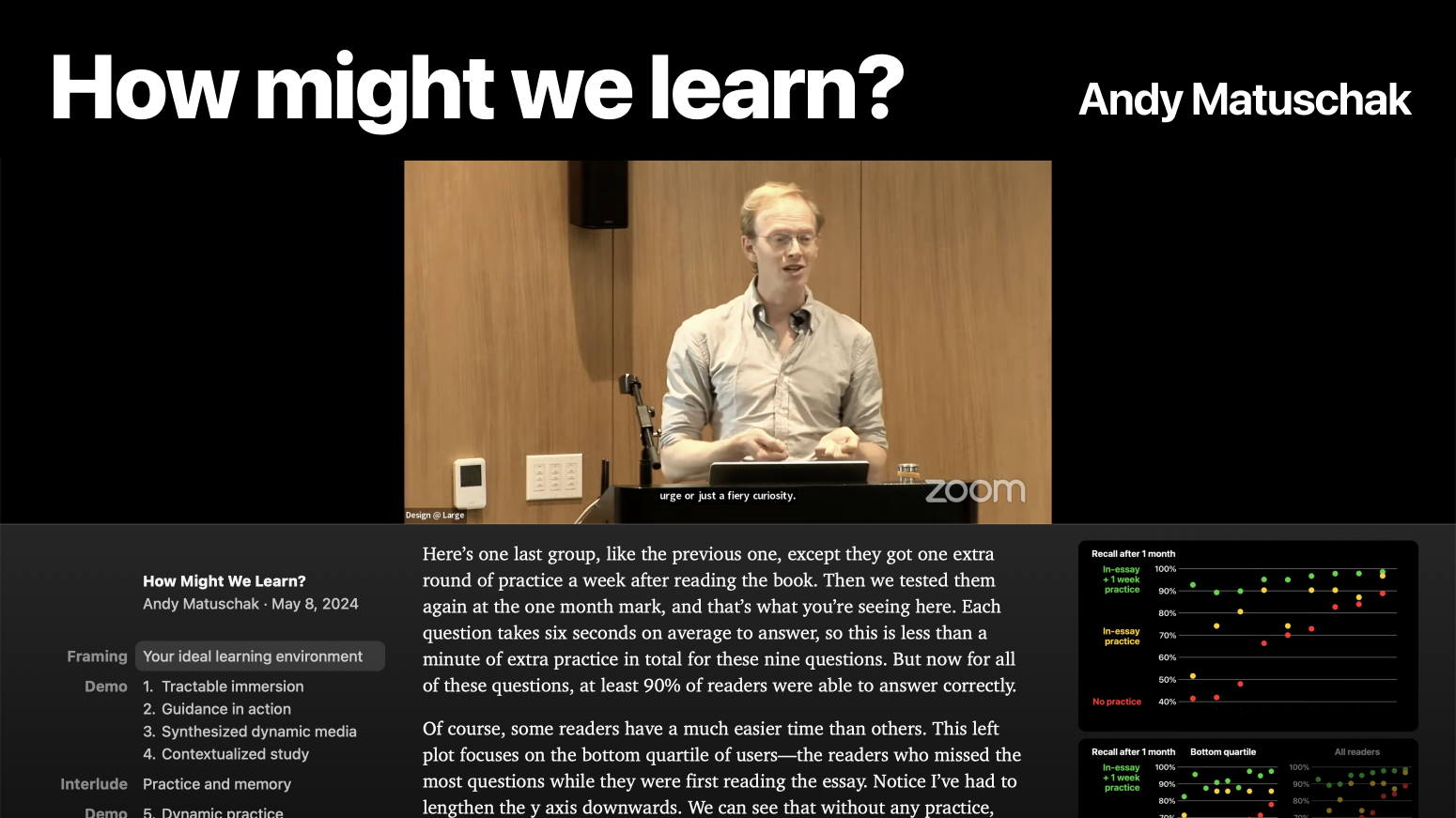
Why should children program - a review of Seymor Paperts Mindstorms
This is an essay about what it means to teach a kid to program, using Seymor Paperts groundbreaking book Mindstorms as a reference.
Claude and Paper - Peter Van Dijck's homepage
I've always done a lot of engineering work on paper, figuring out relationships, page layouts, models, UX etc.
Weaving Narratives into Procedural Worlds
Examining the value, characteristics, and methods of integrating static narratives into otherwise procedurally generated environments.
Article: Pace Layering: How Complex Systems Learn and Keep Learning
Boris Mann's digital garden and personal site.

Prof. Judy Fan: Cognitive Tools for Making the Invisible Visible
Prof. Judy Fan: Cognitive Tools for Making the Invisible Visible