

Paper abstract: "Results showed that xx and yy were highly positively correlated."Researchers: what is your guess as to what correlation coefficient this translates to? (answer in next tweet)— Eiko Fried (@EikoFried) March 29, 2024
Spurious Correlations
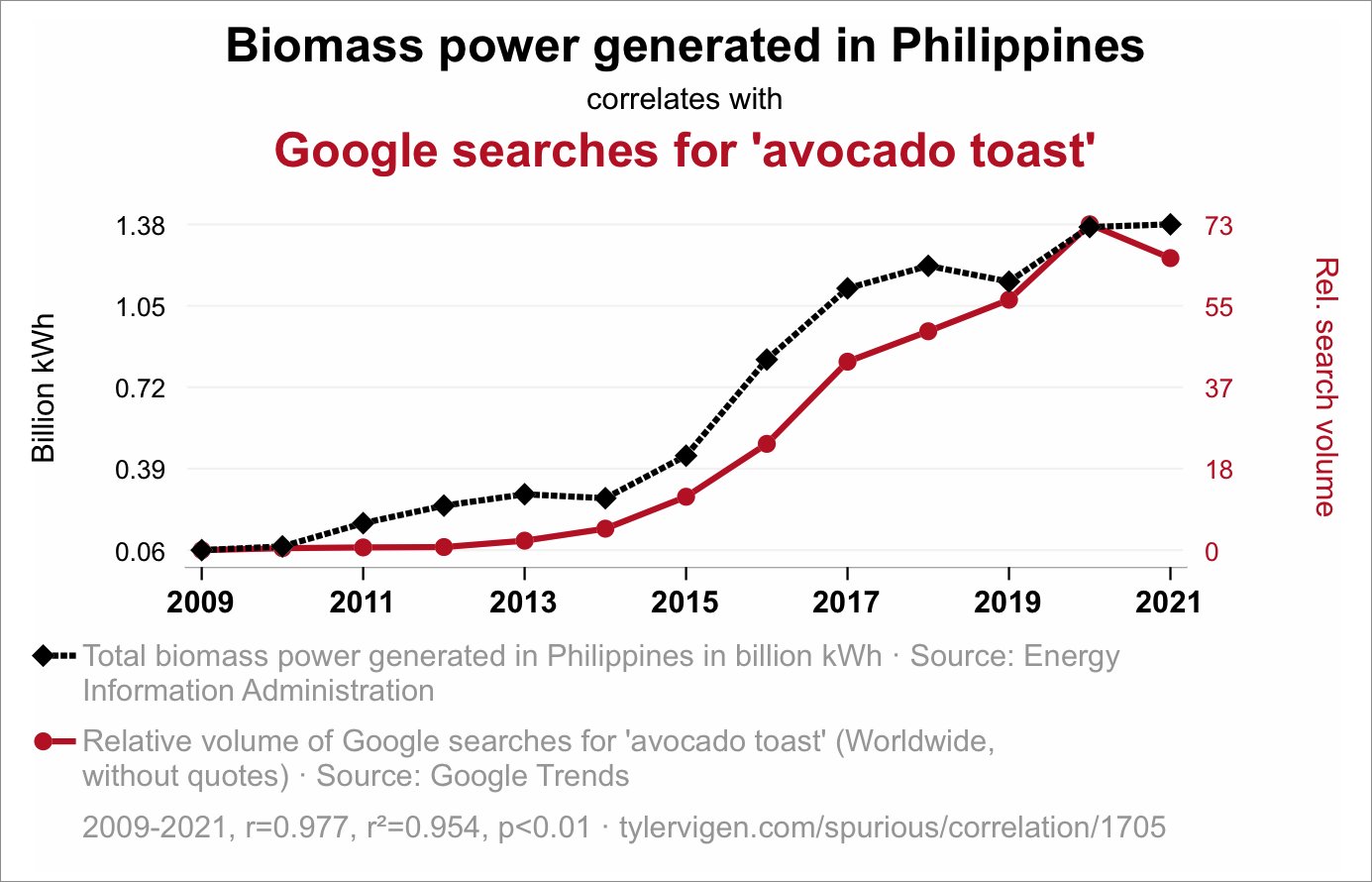
For his Spurious Correlations project, Tyler Vigen compares data sets that are the very definition of “correlation is not causation”. For instance, the number o
NYT Contributors’ Letter
The following was sent to NYT publisher A.G. Sulzberger on Thursday, April 6 2023:
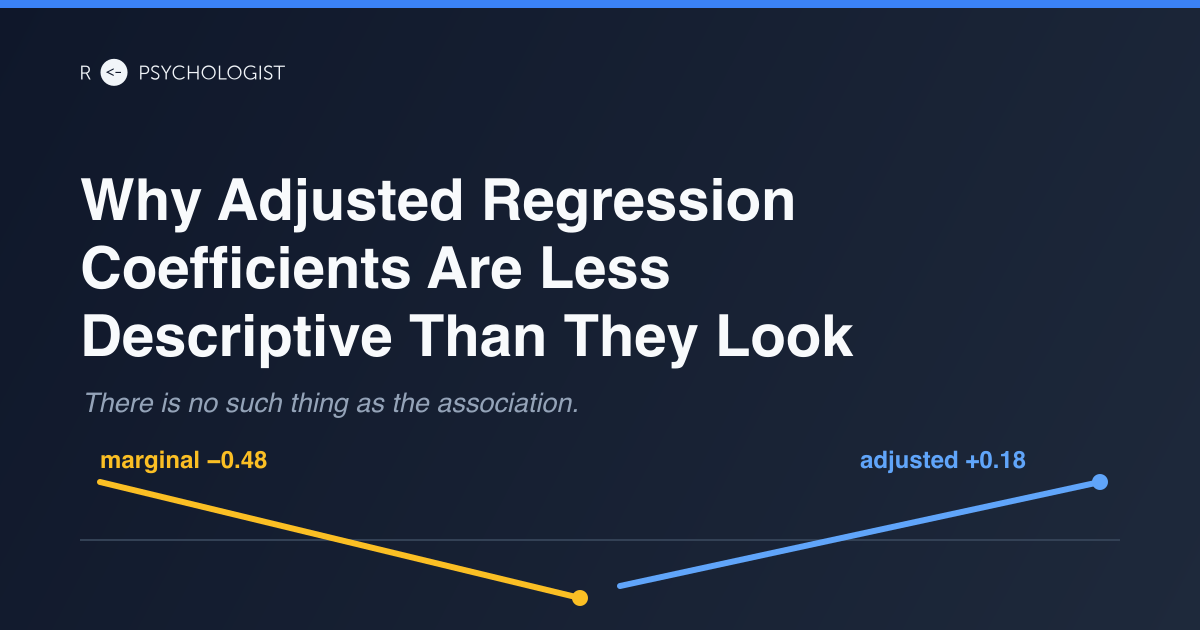
Why Adjusted Regression Coefficients Are Less Descriptive Than They Look | R Psychologist
An interactive article about how regression adjustment works and the pitfalls of conditional associations in descriptive studies.
Dylan Wiliam on Twitter / X
The best journal article titles tell you what the study actually found, rather than being a teaser to make you read the paper. Here's a good example: "Spaced mathematics practice improves test scores and reduces overconfidence" https://t.co/iXxdkAgYPM ($)— Dylan Wiliam (@dylanwiliam) December 31, 2024
Elena Rossini 🌈 (@_elena@mastodon.social)
Attached: 1 image 🚨 Important update about my latest #WSocial article 👀 A user on #ATproto cracked the code and came up with a reasonable explanation for the made up number of comments on W Social's homepage. The number next to the speech bubble (comment icon) are an "engagement metric": the sum of boosts and likes. It all makes sense now! https://blog.elenarossini.com/w-social-fictional-metrics-and-the-beauty-of-open-data/ (scroll down to the end of the article for the update)
A Statistical Interrogation of “The Case for Causality, Part 1” by Rausch and Haidt – Matthew B. Jané
I don’t know anything about the literature on social media and mental health so my focus on this post is to interrogate the statistical approach taken by the article written by Zach Rausch and Jonathon Haidt (link here) and to some extent the original meta-analysis by Ferguson.

Why Most Published Research Findings Are False
Summary There is increasing concern that most current published research findings are false. The probability that a research claim is true may depend on study power and bias, the number of other studies on the same question, and, importantly, the ratio of true to no relationships among the relationships probed in each scientific field. In this framework, a research finding is less likely to be true when the studies conducted in a field are smaller; when effect sizes are smaller; when there is a greater number and lesser preselection of tested relationships; where there is greater flexibility in designs, definitions, outcomes, and analytical modes; when there is greater financial and other interest and prejudice; and when more teams are involved in a scientific field in chase of statistical significance. Simulations show that for most study designs and settings, it is more likely for a research claim to be false than true. Moreover, for many current scientific fields, claimed research findings may often be simply accurate measures of the prevailing bias. In this essay, I discuss the implications of these problems for the conduct and interpretation of research.
Small Telescopes - Uri Simonsohn, 2015
This article introduces a new approach for evaluating replication results. It combines effect-size estimation with hypothesis testing, assessing the extent to w...

Global Warming Is Rapidly Accelerating, New Paper Finds
A new study found the first statistically significant evidence that global warming is ramping up at a horrifying rate.

levent on Twitter / X
hello there the jacobian conjecture is false thanx to my close friend akhil for asking about it and my other close friend fable for working during the world cup final((1+xy)^3 z + y^2 (1+xy) (4+3xy), y + 3 x (1+xy)^2 z + 3 x y^2 (4+3xy), 2 x - 3 x^2 y - x^3 z): \C^3\to \C^3,…— levent (@__alpoge__) July 20, 2026
"what standard.site publications gained the most subs this week?"

most-subscribed publications this week · pub search
pub-search.waow.techThis is a fascinating story. A Lebanese team published a study showing massive benefits for apple cider vinegar in 2024. People immediately noticed it was problematic, and complained. BMJ asked the authors for the data, and they sent it through. The study has just been retracted and WOW 1/n
LATEST: on #WSocial's website, comment counts for posts by prominent users are incorrectly displayed, showing artificially elevated numbers. @opfuchs.gay came up with an interesting theory for it. "W Social, Fictional Metrics and the Beauty of Open Data": blog.elenarossini.com/w-social-fictional-metrics-an…

W Social, Fictional Metrics and the Beauty of Open Data
blog.elenarossini.comHas anyone looked at this paper more closely? I've seen many of my bachelor students refer to it when it comes to depressive disorders. Authors find worldwide depression rates doubled from 1990 to 2020, which seems like a lot. pubmed.ncbi.nlm.nih.gov/40313474/

Trends in Prevalent Cases and Disability-Adjusted Life-Years of Depressive Disorders Worldwide: Findings From the Global Burden of Disease Study From 1990 to 2021 - PubMed
pubmed.ncbi.nlm.nih.gov"what standard.site publications gained the most subs this week?"
most-subscribed publications this week · pub search
pub-search.waow.tech


