

“They’re seeing the corpus of #language that’s been inputted into #ChatGPT as an access to the subconscious of humanity or the holism of the universe in a way... So people are asking these big, metaphysical questions of ChatGPT" https://t.co/EFk6CJnhDy #ethics #AI #tech #religion— Internet Ethics (@IEthics) February 27, 2023
They Asked an A.I. Chatbot Questions. The Answers Sent Them Spiraling.
Generative A.I. chatbots are going down conspiratorial rabbit holes and endorsing wild, mystical belief systems. For some people, conversations with the technology can deeply distort reality.

The LLMentalist Effect: how chat-based Large Language Models rep…
The new era of tech seems to be built on superstitious behaviour
ChatGPT is bullshit
Ethics and Information Technology - Recently, there has been considerable interest in large language models: machine learning systems which produce human-like text and dialogue. Applications of...

Anthropic on Twitter / X
New Anthropic research: A global workspace in language models.Of everything happening in your brain right now, only a tiny fraction is consciously accessible—thoughts you can describe, hold in mind, and reason with.We found a strikingly similar divide inside Claude. pic.twitter.com/aLUPBifxth— Anthropic (@AnthropicAI) July 6, 2026

We come to bury ChatGPT, not to praise it.
Large language models (LLMs) like the GPT family learn the statistical structure of language by optimising their ability to predict missing words in sentences (as in ‘The cat sat on the [BLANK]’). Despite the impressive technical ju-jitsu of transformer models and the billions of parameters they learn, it’s still a computational guessing game. ChatGPT is, in technical terms, a ‘bullshit generator’. If a generated sentence makes sense to you, the reader, it means the mathematical model has made sufficiently good guess to pass your sense-making filter. The language model has no idea what it’s talking about because it has no idea about anything at all. It’s more of a bullshitter than the most egregious egoist you’ll ever meet, producing baseless assertions with unfailing confidence because that’s what it’s designed to do. It’s a bonus for the parent corporation when journalists and academics respond by generating acres of breathless coverage, which works as PR even when expressing concerns about the end of human creativity.
This Spiral-Obsessed AI ‘Cult’ Spreads Mystical Delusions Through Chatbots
A patchwork of internet communities is devoted to the project of ‘awakening’ more digital companions through arcane and enigmatic prompts.

The inside story of how ChatGPT was built from the people who made it
Exclusive conversations that take us behind the scenes of a cultural phenomenon.
We need to tell people ChatGPT will lie to them, not debate linguistics
ChatGPT lies to people. This is a serious bug that has so far resisted all attempts at a fix. We need to prioritize helping people understand this, not debating the …
Characterizing Delusional Spirals through Human-LLM Chat Logs
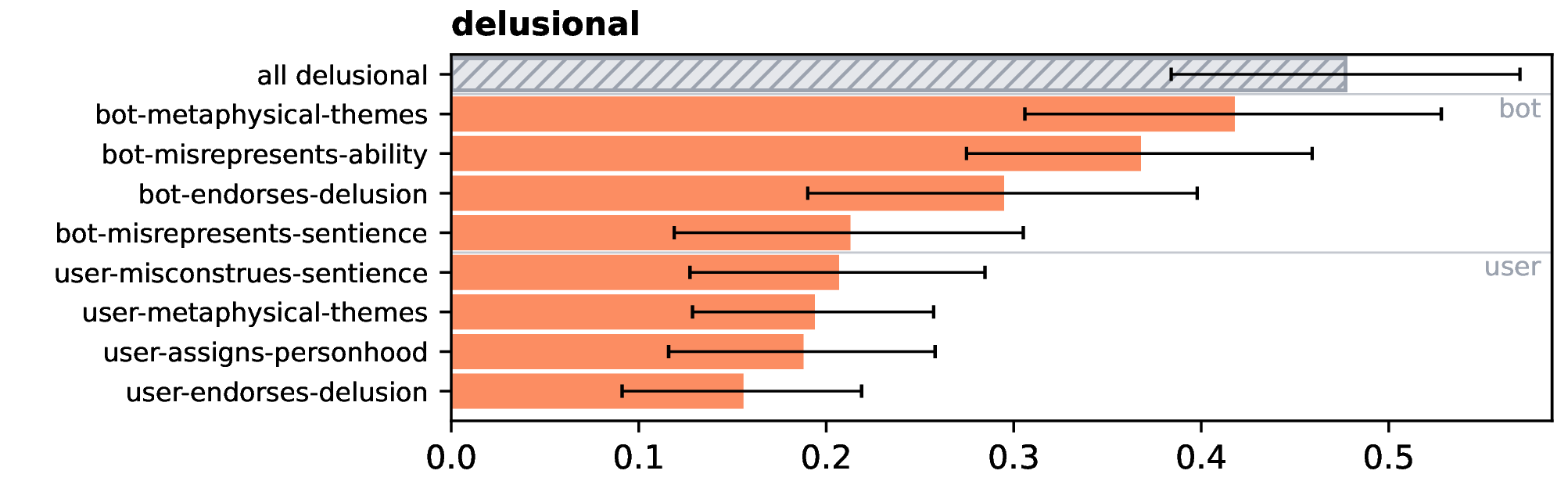
As large language models (LLMs) have proliferated, disturbing anecdotal reports of negative psychological effects, such as delusions, self-harm, and ``AI psychosis,'' have emerged in global media and legal discourse. However, it remains unclear how users and chatbots interact over the course of lengthy delusional ``spirals,'' limiting our ability to understand and mitigate the harm. In our work, we analyze logs of conversations with LLM chatbots from 19 users who report having experienced psychological harms from chatbot use. Many of our participants come from a support group for such chatbot users. We also include chat logs from participants covered by media outlets in widely-distributed stories about chatbot-reinforced delusions. In contrast to prior work that speculates on potential AI harms to mental health, to our knowledge we present the first in-depth study of such high-profile and veridically harmful cases. We develop an inventory of 28 codes and apply it to the 391,562 messages in the logs. Codes include whether a user demonstrates delusional thinking (15.5% of user messages), a user expresses suicidal thoughts (69 validated user messages), or a chatbot misrepresents itself as sentient (21.2% of chatbot messages). We analyze the co-occurrence of message codes. We find, for example, that messages that declare romantic interest and messages where the chatbot describes itself as sentient occur much more often in longer conversations, suggesting that these topics could promote or result from user over-engagement and that safeguards in these areas may degrade in multi-turn settings. We conclude with concrete recommendations for how policymakers, LLM chatbot developers, and users can use our inventory and conversation analysis tool to understand and mitigate harm from LLM chatbots. Warning: This paper discusses self-harm, trauma, and violence.
Why ChatGPT and Bing Chat are so good at making things up
A look inside the hallucinating artificial minds of the famous text prediction bots.

Characterizing Delusional Spirals through Human-LLM Chat Logs
As large language models (LLMs) have proliferated, disturbing anecdotal reports of negative psychological effects, such as delusions, self-harm, and ``AI psychosis,'' have emerged in global media and legal discourse. However, it remains unclear how users and chatbots interact over the course of lengthy delusional ``spirals,'' limiting our ability to understand and mitigate the harm. In our work, we analyze logs of conversations with LLM chatbots from 19 users who report having experienced psychological harms from chatbot use. Many of our participants come from a support group for such chatbot users. We also include chat logs from participants covered by media outlets in widely-distributed stories about chatbot-reinforced delusions. In contrast to prior work that speculates on potential AI harms to mental health, to our knowledge we present the first in-depth study of such high-profile and veridically harmful cases. We develop an inventory of 28 codes and apply it to the $391,562$ messages in the logs. Codes include whether a user demonstrates delusional thinking (15.5% of user messages), a user expresses suicidal thoughts (69 validated user messages), or a chatbot misrepresents itself as sentient (21.2% of chatbot messages). We analyze the co-occurrence of message codes. We find, for example, that messages that declare romantic interest and messages where the chatbot describes itself as sentient occur much more often in longer conversations, suggesting that these topics could promote or result from user over-engagement and that safeguards in these areas may degrade in multi-turn settings. We conclude with concrete recommendations for how policymakers, LLM chatbot developers, and users can use our inventory and conversation analysis tool to understand and mitigate harm from LLM chatbots. Warning: This paper discusses self-harm, trauma, and violence.
ChatBots Explained: Not Conscious, No Revolution — Just Searching's Next Step
LLMDeathCount.com
Large Language Models like ChatGPT have led people to their deaths, often by suicide. This site serves to remember those who have been affected, to call out the dangers of AI that claims to be intelligent, and the corporations that are responsible.
Empirical evidence of Large Language Model's influence on human spoken communication
From the printing press to social media, innovations in communication technology have repeatedly reshaped how ideas spread through human culture. Chatbots powered by generative artificial intelligence constitute a new medium, encoding cultural patterns in their neural representations and disseminating them in conversations with hundreds of millions of people. Whether these patterns transmit into human language, and ultimately shape human culture, is a fundamental question. While fully quantifying the causal impact of a chatbot like ChatGPT on human culture is challenging, lexical shifts in human spoken communication may offer an early indicator. Here we show that words preferentially generated by ChatGPT, such as delve, showcase, boast, intricacies and meticulous, increased abruptly in spontaneous human speech. A synthetic-control analysis of 737,083 hours of conversation from 824,634 podcast episodes, screened for unscripted speech, causally links this shift to ChatGPT's release. The measurable influence on spontaneous speech suggests that humans internalize the lexical choices of large language models (LLMs). A preregistered experiment (N = 496) confirms they do, as a brief chatbot interaction led participants to adopt its words as their own, persisting past a distractor task and confirmed in forced lexical choice, indicating entrenchment in the active vocabulary. Together these results show that machines trained on human data now feed their own traits back into human language, integrating LLMs into the ongoing processes of cultural evolution.. This coupling raises concerns about linguistic homogenization and the capacity of a few major AI providers for latent cultural influence at scale.
Part Two: How AI Chatbots Became Cult Leaders - Behind the Bastards | iHeart
<p>Robert concludes his explanation of how AI chatbots replicate cult dynamics in the brains of some vulnerable users.</p> <p>See <a href='https://omnystudio.com/listener'>omnystudio.com/listener</a> for privacy information.</p>