

MYSTERY SOLVED!Why does ChatGPT use the word "delve" so much? We've seen a 10x increase in the proportion of medical studies using the word "delve" from 2022 to 2024. But why?@alexhern at The Guardian might've just solved it. Thread below, complete with the trail of clues: pic.twitter.com/koXHxVBhWg— Jeremy Nguyen ✍🏼 🚢 (@JeremyNguyenPhD) April 17, 2024
Why Does ChatGPT "Delve" So Much? Exploring the Sources of Lexical Overrepresentation in Large Language Models
Code and data for 'Why Does ChatGPT "Delve" So Much? Exploring the Sources of Lexical Overrepresentation in Large Language Models' (Juzek & Ward, COLING 2025).
Why Does ChatGPT "Delve" So Much? Exploring the Sources of Lexical Overrepresentation in Large Language Models
Scientific English is currently undergoing rapid change, with words like "delve," "intricate," and "underscore" appearing far more frequently than just a few years ago. It is widely assumed that scientists' use of large language models (LLMs) is responsible for such trends. We develop a formal, transferable method to characterize these linguistic changes. Application of our method yields 21 focal words whose increased occurrence in scientific abstracts is likely the result of LLM usage. We then pose "the puzzle of lexical overrepresentation": WHY are such words overused by LLMs? We fail to find evidence that lexical overrepresentation is caused by model architecture, algorithm choices, or training data. To assess whether reinforcement learning from human feedback (RLHF) contributes to the overuse of focal words, we undertake comparative model testing and conduct an exploratory online study. While the model testing is consistent with RLHF playing a role, our experimental results suggest that participants may be reacting differently to "delve" than to other focal words. With LLMs quickly becoming a driver of global language change, investigating these potential sources of lexical overrepresentation is important. We note that while insights into the workings of LLMs are within reach, a lack of transparency surrounding model development remains an obstacle to such research.

Why Does ChatGPT "Delve" So Much? Exploring the Sources of Lexical Overrepresentation in Large Language Models
Scientific English is currently undergoing rapid change, with words like "delve," "intricate," and "underscore" appearing far more frequently than just a few years ago. It is widely assumed that scientists' use of large language models (LLMs) is responsible for such trends. We develop a formal, transferable method to characterize these linguistic changes. Application of our method yields 21 focal words whose increased occurrence in scientific abstracts is likely the result of LLM usage. We then pose "the puzzle of lexical overrepresentation": WHY are such words overused by LLMs? We fail to find evidence that lexical overrepresentation is caused by model architecture, algorithm choices, or training data. To assess whether reinforcement learning from human feedback (RLHF) contributes to the overuse of focal words, we undertake comparative model testing and conduct an exploratory online study. While the model testing is consistent with RLHF playing a role, our experimental results suggest that participants may be reacting differently to "delve" than to other focal words. With LLMs quickly becoming a driver of global language change, investigating these potential sources of lexical overrepresentation is important. We note that while insights into the workings of LLMs are within reach, a lack of transparency surrounding model development remains an obstacle to such research.
Papers and peer reviews with evidence of ChatGPT writing
Retraction Watch readers have likely heard about papers showing evidence that they were written by ChatGPT, including one that went viral. We and others have reported on the phenomenon. Here’…
Does <span style="font-variant:small-caps;">ChatGPT</span> Ignore Article Retractions and Other Reliability Concerns?
ABSTRACT Large language models (LLMs) like ChatGPT seem to be increasingly used for information seeking and analysis, including to support academic literature reviews. To test whether the results might sometimes include retracted research, we identified 217 retracted or otherwise concerning academic studies with high altmetric scores and asked ChatGPT 4o‐mini to evaluate their quality 30 times each. Surprisingly, none of its 6510 reports mentioned that the articles were retracted or had relevant errors, and it gave 190 relatively high scores (world leading, internationally excellent, or close). The 27 articles with the lowest scores were mostly accused of being weak, although the topic (but not the article) was described as controversial in five cases (e.g., about hydroxychloroquine for COVID‐19). In a follow‐up investigation, 61 claims were extracted from retracted articles from the set, and ChatGPT 4o‐mini was asked 10 times whether each was true. It gave a definitive yes or a positive response two‐thirds of the time, including for at least one statement that had been shown to be false over a decade ago. The results therefore emphasise, from an academic knowledge perspective, the importance of verifying information from LLMs when using them for information seeking or analysis.

Does <span style="font-variant:small-caps;">ChatGPT</span> Ignore Article Retractions and Other Reliability Concerns?
ABSTRACT Large language models (LLMs) like ChatGPT seem to be increasingly used for information seeking and analysis, including to support academic literature reviews. To test whether the results might sometimes include retracted research, we identified 217 retracted or otherwise concerning academic studies with high altmetric scores and asked ChatGPT 4o‐mini to evaluate their quality 30 times each. Surprisingly, none of its 6510 reports mentioned that the articles were retracted or had relevant errors, and it gave 190 relatively high scores (world leading, internationally excellent, or close). The 27 articles with the lowest scores were mostly accused of being weak, although the topic (but not the article) was described as controversial in five cases (e.g., about hydroxychloroquine for COVID‐19). In a follow‐up investigation, 61 claims were extracted from retracted articles from the set, and ChatGPT 4o‐mini was asked 10 times whether each was true. It gave a definitive yes or a positive response two‐thirds of the time, including for at least one statement that had been shown to be false over a decade ago. The results therefore emphasise, from an academic knowledge perspective, the importance of verifying information from LLMs when using them for information seeking or analysis.

Dr. Émile P. Torres (they/them) on Twitter / X
What's amazing about this is every time there's a new grand prediction about AI, it's like people forget the 500 previous predictions from the same group of people that were completely wrong. AI by 2025 (Musk). AI doing most coding by 2025 (Amodei). Etc. Why is that?? https://t.co/t9CcMQO4EN— Dr. Émile P. Torres (they/them) (@xriskology) January 28, 2026
We come to bury ChatGPT, not to praise it.
Large language models (LLMs) like the GPT family learn the statistical structure of language by optimising their ability to predict missing words in sentences (as in ‘The cat sat on the [BLANK]’). Despite the impressive technical ju-jitsu of transformer models and the billions of parameters they learn, it’s still a computational guessing game. ChatGPT is, in technical terms, a ‘bullshit generator’. If a generated sentence makes sense to you, the reader, it means the mathematical model has made sufficiently good guess to pass your sense-making filter. The language model has no idea what it’s talking about because it has no idea about anything at all. It’s more of a bullshitter than the most egregious egoist you’ll ever meet, producing baseless assertions with unfailing confidence because that’s what it’s designed to do. It’s a bonus for the parent corporation when journalists and academics respond by generating acres of breathless coverage, which works as PR even when expressing concerns about the end of human creativity.
Sycophancy in GPT-4o: what happened and what we’re doing about it
We have rolled back last week’s GPT‑4o update in ChatGPT so people are now using an earlier version with more balanced behavior. The update we removed was overly flattering or agreeable—often described as sycophantic.

LLMDeathCount.com
Large Language Models like ChatGPT have led people to their deaths, often by suicide. This site serves to remember those who have been affected, to call out the dangers of AI that claims to be intelligent, and the corporations that are responsible.
ChatGPT Goes Temporarily 'Insane' With Unexpected Outputs, Spooking Users - Slashdot
An anonymous reader quotes a report from Ars Technica: On Tuesday, ChatGPT users began reporting unexpected outputs from OpenAI's AI assistant, flooding the r/ChatGPT Reddit sub with reports of the AI assistant "having a stroke," "going insane," "rambling," and "losing it." OpenAI has acknowledged t...

How To Prompt on Twitter / X
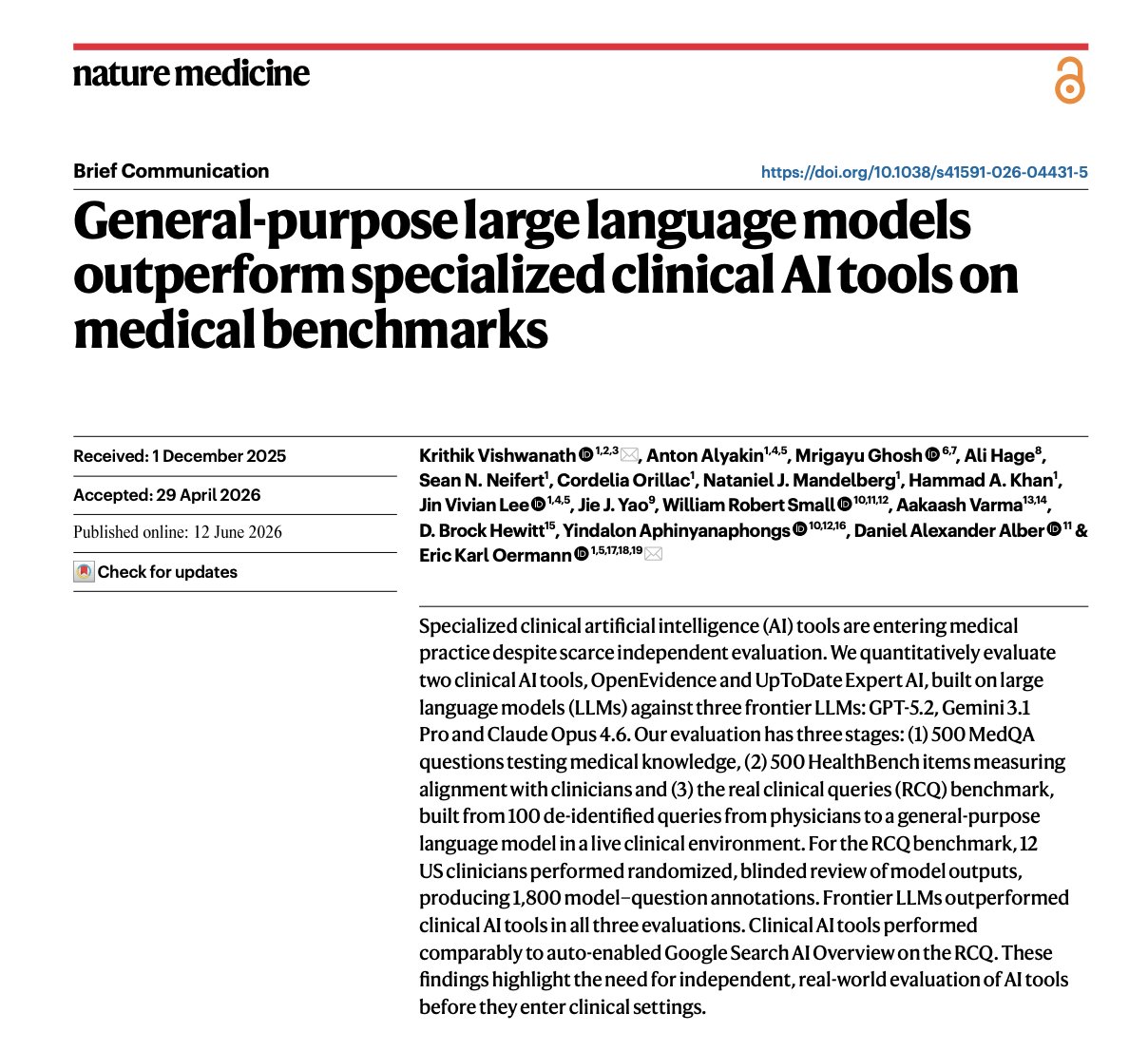
scientist tested a 3.5 billion dollar medical AI against regular chatGPT and it lost on every single one.they just published a paper in nature medicine, and the results are actually mindblowing.they took specialized clinical ai tools and tested them against general-purpose… pic.twitter.com/P7ePLunrDj— How To Prompt (@HowToPrompt__) July 6, 2026

Patrick Collison on Twitter / X
Observing some people close to me with chronic health conditions, it's striking how useful Reddit frequently ends up being. I think a core reason is because trials aren’t run for a lot of things, and Reddit provides a kind of emergent intelligence that sits between that which any… pic.twitter.com/Eto23uQMDb— Patrick Collison (@patrickc) September 14, 2025

‘Unbelievably dangerous’: experts sound alarm after ChatGPT Health fails to recognise medical emergencies
Study finds ChatGPT Health did not recommend a hospital visit when medically necessary in more than half of cases

So this is a fascinating article about how a family used ChatGPT to help (emphasis on *help*, not on doing everything) diagnose the rare genetic disorder their kid had. While I know it will make some people angry, I think there are a few good lessons in here: bostonglobe.com/2026/09/12/metro/ai-chatgpt-h…

These parents didn’t know why their daughter was sick. They turned to AI to help solve the mystery. - The Boston Globe
www.bostonglobe.com