

It’s no secret that LLM training data is running out. How close are we to the limit? To answer that, here's an estimate of the total amount of text in the world from every major source:— Mark Cummins (@mark_cummins) May 10, 2024
How much LLM training data is there, in the limit? – Educating Silicon
Recent large language models such as Llama 3 and GPT-4 are trained on gigantic amounts of text. Next generation models need 10x more. Will that be possible? To try to answer that, here’s an estimate of all the text that exists in the world.
Position: The Most Expensive Part of an LLM *should* be its Training Data
Training a state-of-the-art Large Language Model (LLM) is an increasingly expensive endeavor due to growing computational, hardware, energy, and engineering demands. Yet, an often-overlooked (and seldom paid) expense is the human labor behind these models’ training data. Every LLM is built on an unfathomable amount of human effort: trillions of carefully written words sourced from books, academic papers, codebases, social media, and more. This position paper aims to assign a monetary value to this labor and argues that the most expensive part of producing an LLM should be the compensation provided to training data producers for their work. To support this position, we study 64 LLMs released between 2016 and 2024, estimating what it would cost to pay people to produce their training datasets from scratch. Even under highly conservative estimates of wage rates, the costs of these models’ training datasets are $10$-$1000$ times larger than the costs to train the models themselves, representing a significant financial liability for LLM providers. In the face of the massive gap between the value of training data and the lack of compensation for its creation, we highlight and discuss research directions that could enable fairer practices in the future.
Large language model
A large language model (LLM) is a neural network trained on a vast amount of text for natural language processing tasks, especially language generation. LLMs can typically generate, summarize, translate, and analyze text in many contexts, and are a foundational technology behind modern chatbots.[1] Biased or inaccurate training data can make an LLM's output less reliable.[2]
Things we learned about LLMs in 2024
A lot has happened in the world of Large Language Models over the course of 2024. Here’s a review of things we figured out about the field in the past …
Large language models are not the problem
If a Large Language Model (LLM) can replicate your scientific contribution, the problem is not the LLM. What does it say about our field that so much of the anxiety about AI comes down to the fear that a machine could do what we do? Perhaps it says we should be doing something better.

Alex Veremeyenko on Twitter / X
what are large language models actually doing?i read the 2025 textbook "Foundations of Large Language Models" by tong xiao and jingbo zhu and for the first time, i truly understood how they work.here’s everything you need to know about llms in 3 minutes↓ pic.twitter.com/OeYLuU3cWh— Alex Veremeyenko (@alex_verem) July 26, 2025

Beyond Model Collapse: Scaling Up with Synthesized Data Requires...
Large Language Models (LLM) are increasingly trained on data generated by other LLM, either because generated text and images become part of the pre-training corpus, or because synthetized data is...

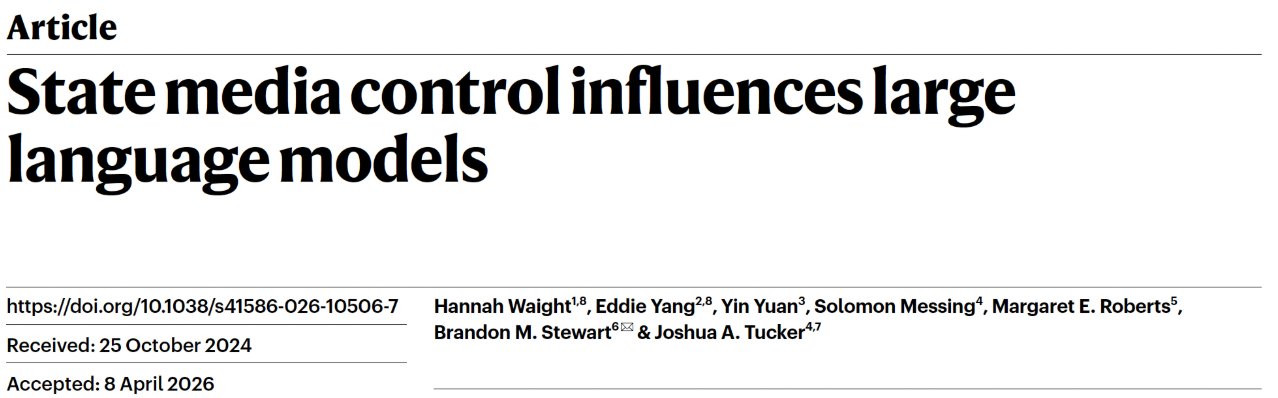
Brandon Stewart on Twitter / X
1/ New @Nature! We study how powerful institutions shape the information environment for LLMs. Commercial LLM training is opaque, so we trace a path from state-coordinated media -> training data -> model responses. pic.twitter.com/5LdFvzbFaf— Brandon Stewart (@b_m_stewart) May 13, 2026
what are large language models actually doing? i read the 2025 textbook "Foundations of Large Language Models" by tong xiao and jingbo zhu and for the first time, i truly understood how they work. here’s everything you need to know about llms in 3 minutes↓
what are large language models actually doing?i read the 2025 textbook "Foundations of Large Language Models" by tong xiao and jingbo zhu and for the first time, i truly understood how they work.here’s everything you need to know about llms in 3 minutes↓ pic.twitter.com/OeYLuU3cWh— Alex Veremeyenko (@alex_verem) July 26, 2025
Rohan Paul on Twitter / X
The paper shows real LLM query energy is lower than popular claims, and maps concrete ways to shrink it.A normal frontier model query uses about 0.34 Wh in real deployments.Many public numbers are 4x to 20x too high because of tiny tests and unclear scopes.They estimate… pic.twitter.com/FiGFt0bTiH— Rohan Paul (@rohanpaul_ai) September 26, 2025

State of AI 2025: 100T Token LLM Usage Study | OpenRouter
Read OpenRouter's 2025 State of AI report — an empirical 100 trillion token study of real LLM usage, model trends, and developer insights.
Communication Bias in Large Language Models: A Regulatory Perspective
Artificial intelligence (AI) involves computational systems designed to perform tasks that traditionally require human intelligence, such as perception, reasoning, and language understanding. Large language models (LLMs), a prominent subset of AI, are built on advanced neural network architectures that can generate new data, including text, images, and audio. LLMs use various technologies to identify patterns in a given set of training data, without requiring explicit instructions about what to look for.12,35 LLMs typically assume that the training data follows a probability distribution; once they have identified existing patterns, they can generate new instances that are similar to the original data. By drawing from and combining training data, LLMs can create new content that transcends the initial dataset.17 But this process has technical limitations. For instance, LLMs can hallucinate by producing plausible yet factually incorrect or fabricated information; they can struggle with ambiguous or missing data, leading to blind spots in their outputs; and they can reflect and amplify existing preconceptions present in their algorithms or training data, leading to communication bias, which we focus on here.

What are Large Language Models(LLMs)?
The architecture of Large Language Model primarily consists of multiple layers of neural networks, like recurrent layers, feedforward layers, embedding layers, and attention layers. These layers work together to process the input text and generate output predictions.

Large Language Models: An Applied Econometric Framework
Large language models (LLMs) enable researchers to analyze text at unprecedented scale and minimal cost. Researchers can now revisit old questions and tackle novel ones with rich data. We provide an econometric framework for realizing this potential in two empirical uses. For prediction problems—forecasting outcomes from text—valid conclusions require “no training leakage” between the LLM's training data and the researcher's sample, which can be enforced through careful model choice and research design. For estimation problems—automating the measurement of economic concepts for downstream analysis—valid downstream inference requires combining LLM outputs with a small validation sample to deliver consistent and precise estimates. Absent a validation sample, researchers cannot assess possible errors in LLM outputs, and consequently seemingly innocuous choices (which model, which prompt) can produce dramatically different parameter estimates. When used appropriately, LLMs are powerful tools that can expand the frontier of empirical economics.

There's Something Fundamentally Wrong With LLMs
LLMs aren't trained on the "vast majority of speech," experts warn, a major blind spot that could have sweeping consequences.

LLM is a learned distribution p on sequences of tokens. If you just sample a bunch of text from p willy nilly and put it in the training data and train you just get back p. But if you sample a bunch of text from p and throw out whatever's bad and train on what's left then you learn p(x|x is not bad)
