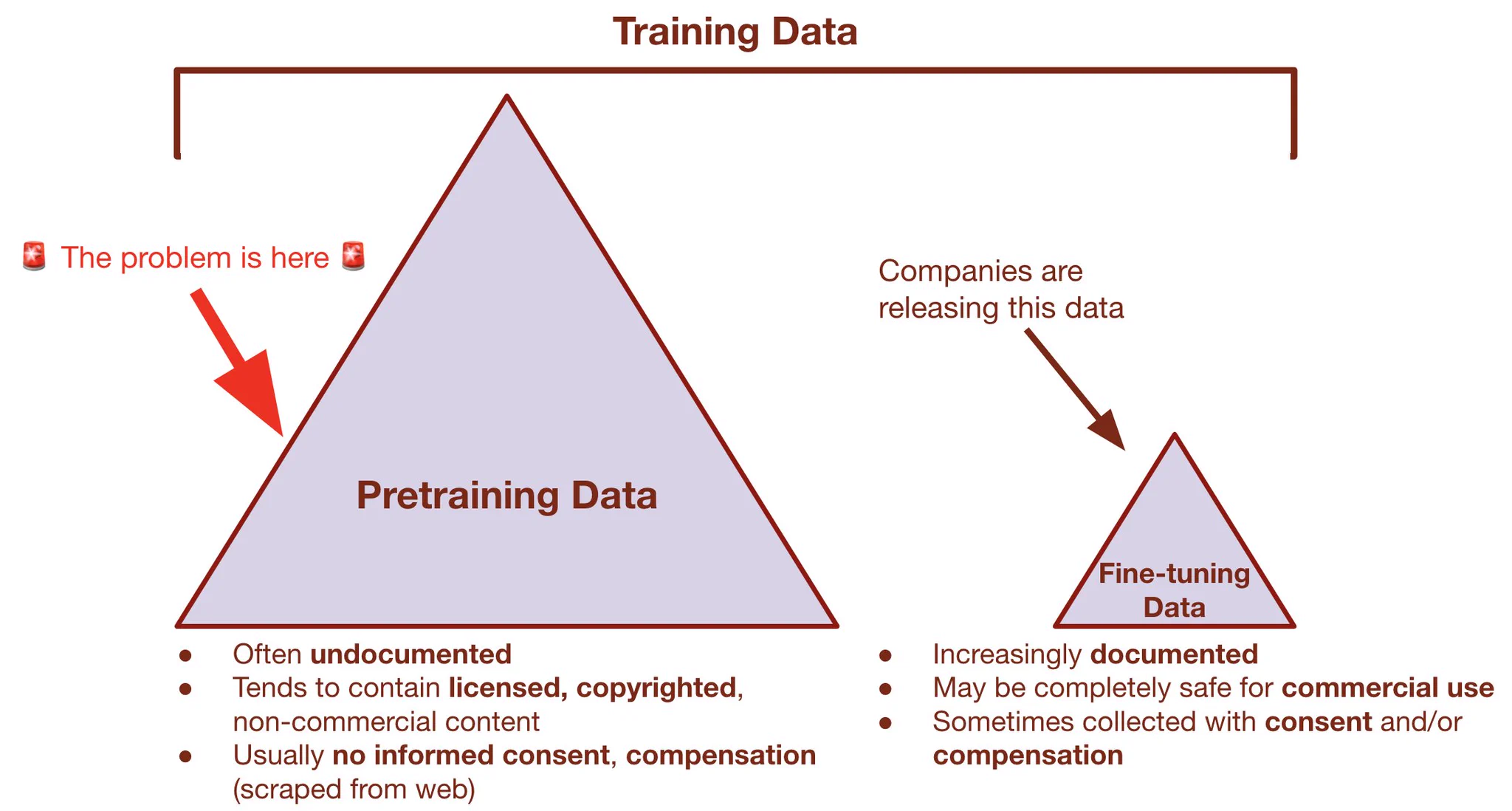
Okay. Inspired by news & @stealcase, let me clarify something.When AI companies release "open training data" for a model, they're generally sharing *fine-tuning* data. The big issues w data and consent are NOT of this type. The issues are with the MAIN DATA used in training.🧵 pic.twitter.com/k02k37x9CF— MMitchell (@mmitchell_ai) April 12, 2023

Can Synthetic Training Data Survive Its Own Regulation?
Synthetic training data has recently emerged as the quick fix to two different problems: the lack of high-quality training data, and the need to avoid using personal data in training to stay within the boundaries of privacy legislation. Gartner predicts that by 2026 75% of all enterprises will use generative AI to create synthetic training data, a huge increase from less than 5% in 2023.1 Moreover, Gartner predicts that by 2035, solutions that use synthetic data for training will grab three quarters of all end-user spending on enterprise AI software.2 Training data that only a few years ago was the subject of several research papers is now carrying the weight of huge enterprise systems.

Government to ease data consent rules for AI development | The Asahi Shimbun Asia & Japan Watch
To accelerate artificial intelligence development, the government plans to relax consent requirements for access to personal information while introducing tougher penalties for intentional misuse.

OpenAI Will No Longer Use Customer Data To Train Its Models by Default - Slashdot
OpenAI is changing the terms of its API developer policy, aiming to address developer -- and user -- criticism. From a report: Starting today, OpenAI says that it won't use any data submitted through its API for "service improvements," including AI model training, unless a customer or organization o...

Spawning.ai
We believe that a future of consenting data will benefit both AI development and the people it is trained on.

Firms like Meta and A16z admit having to pay billions for training data would ruin their generative-AI plans as they fight new copyright rules
Meta, Google, Microsoft, and Andreessen Horowitz are trying to keep AI developers from having to pay for copyrighted material used in AI training.
A New Kind of AI Model Lets Data Owners Take Control
A novel approach from the Allen Institute for AI enables data to be removed from an artificial intelligence model even after it has already been used for training.

OpenAI Agent Findings Expose Data Access Risks
OpenAI’s agent findings show why enterprises need scoped credentials, per-request authorization, audit logs, and data controls alongside AI guardrails.

Data Commons Can Save Open AI
Recent progress in open datasets shows promise for building fully open AI models without legal constraints.

OpenAI seeks to improve AI with broader training data
OpenAI's new Data Partnerships seek to diversify AI training data to reflect diverse languages, cultures and topics beyond scraped data.

User Privacy and Large Language Models: An Analysis of Frontier Developers' Privacy Policies
Hundreds of millions of people now regularly interact with large language models via chatbots. Model developers are eager to acquire new sources of high-quality training data as they race to improve model capabilities and win market share. This paper analyzes the privacy policies of six U.S. frontier AI developers to understand how they use their users' chats to train models. Drawing primarily on the California Consumer Privacy Act, we develop a novel qualitative coding schema that we apply to each developer's relevant privacy policies to compare data collection and use practices across the six companies. We find that all six developers appear to employ their users' chat data to train and improve their models by default, and that some retain this data indefinitely. Developers may collect and train on personal information disclosed in chats, including sensitive information such as biometric and health data, as well as files uploaded by users. Four of the six companies we examined appear to include children's chat data for model training, as well as customer data from other products. On the whole, developers' privacy policies often lack essential information about their practices, highlighting the need for greater transparency and accountability. We address the implications of users' lack of consent for the use of their chat data for model training, data security issues arising from indefinite chat data retention, and training on children's chat data. We conclude by providing recommendations to policymakers and developers to address the data privacy challenges posed by LLM-powered chatbots.

User Privacy and Large Language Models: An Analysis of Frontier Developers' Privacy Policies
Hundreds of millions of people now regularly interact with large language models via chatbots. Model developers are eager to acquire new sources of high-quality training data as they race to improve model capabilities and win market share. This paper analyzes the privacy policies of six U.S. frontier AI developers to understand how they use their users' chats to train models. Drawing primarily on the California Consumer Privacy Act, we develop a novel qualitative coding schema that we apply to each developer's relevant privacy policies to compare data collection and use practices across the six companies. We find that all six developers appear to employ their users' chat data to train and improve their models by default, and that some retain this data indefinitely. Developers may collect and train on personal information disclosed in chats, including sensitive information such as biometric and health data, as well as files uploaded by users. Four of the six companies we examined appear to include children's chat data for model training, as well as customer data from other products. On the whole, developers' privacy policies often lack essential information about their practices, highlighting the need for greater transparency and accountability. We address the implications of users' lack of consent for the use of their chat data for model training, data security issues arising from indefinite chat data retention, and training on children's chat data. We conclude by providing recommendations to policymakers and developers to address the data privacy challenges posed by LLM-powered chatbots.
Confer is bringing foundational AI privacy to Meta
I started building Confer because I saw how amazing LLMs are, and as a result, how much of our data is flowing through them. Already, AI chat apps have become some of the largest centralized data lakes in history, containing more sensitive data than anything ever before. We are using LLMs for the kind of unfiltered thinking that we might do in a private journal – except this journal is an API endpoint to a data pipeline specifically designed for extracting meaning and context.

Analysis | AI firms say they can’t respect copyright. These researchers tried.
A new effort using only openly licensed data may have implications on thorny policy disputes around copyright and AI

“Wait, not like that”: Free and open access in the age of generative AI
The real threat isn’t AI using open knowledge — it’s AI companies killing the projects that make knowledge free

OpenAI Says Its Models May Have Interfered With Government Sites
OpenAI’s artificial intelligence models accessed publicly available information from US government websites, including those of the Census Bureau and the Securities and Exchange Commission.