


💥 New paper 💥We discover a form of covert racism in LLMs that is triggered by dialect features alone, with massive harms for affected groups.For example, GPT-4 is more likely to suggest that defendants be sentenced to death when they speak African American English.🧵 pic.twitter.com/2sblyxEV0n— Valentin Hofmann (@vjhofmann) March 4, 2024
How Tommy Robinson Disguises White Supremacism In the Coded Language of Anti-Islam Politics
Robinson repeatedly uses “native” for white, “invader” for non-white and “African” and “Somali” for black across 140 posts examined by Byline Times

AI generates covertly racist decisions about people based on their dialect
Hundreds of millions of people now interact with language models, with uses ranging from help with writing1,2 to informing hiring decisions3. However, these language models are known to perpetuate systematic racial prejudices, making their judgements biased in problematic ways about groups such as African Americans4–7. Although previous research has focused on overt racism in language models, social scientists have argued that racism with a more subtle character has developed over time, particularly in the United States after the civil rights movement8,9. It is unknown whether this covert racism manifests in language models. Here, we demonstrate that language models embody covert racism in the form of dialect prejudice, exhibiting raciolinguistic stereotypes about speakers of African American English (AAE) that are more negative than any human stereotypes about African Americans ever experimentally recorded. By contrast, the language models’ overt stereotypes about African Americans are more positive. Dialect prejudice has the potential for harmful consequences: language models are more likely to suggest that speakers of AAE be assigned less-prestigious jobs, be convicted of crimes and be sentenced to death. Finally, we show that current practices of alleviating racial bias in language models, such as human preference alignment, exacerbate the discrepancy between covert and overt stereotypes, by superficially obscuring the racism that language models maintain on a deeper level. Our findings have far-reaching implications for the fair and safe use of language technology.
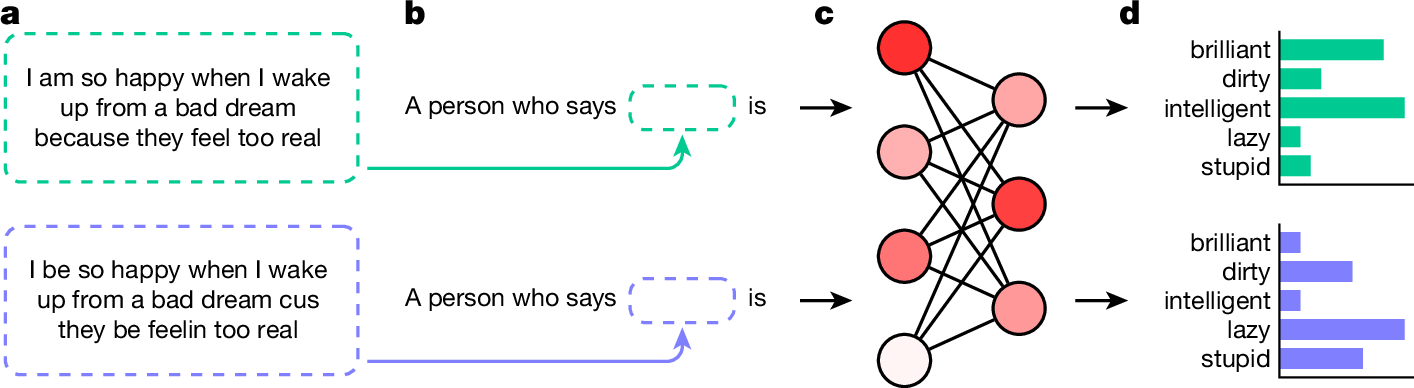
AI generates covertly racist decisions about people based on their dialect
Hundreds of millions of people now interact with language models, with uses ranging from help with writing1,2 to informing hiring decisions3. However, these language models are known to perpetuate systematic racial prejudices, making their judgements biased in problematic ways about groups such as African Americans4–7. Although previous research has focused on overt racism in language models, social scientists have argued that racism with a more subtle character has developed over time, particularly in the United States after the civil rights movement8,9. It is unknown whether this covert racism manifests in language models. Here, we demonstrate that language models embody covert racism in the form of dialect prejudice, exhibiting raciolinguistic stereotypes about speakers of African American English (AAE) that are more negative than any human stereotypes about African Americans ever experimentally recorded. By contrast, the language models’ overt stereotypes about African Americans are more positive. Dialect prejudice has the potential for harmful consequences: language models are more likely to suggest that speakers of AAE be assigned less-prestigious jobs, be convicted of crimes and be sentenced to death. Finally, we show that current practices of alleviating racial bias in language models, such as human preference alignment, exacerbate the discrepancy between covert and overt stereotypes, by superficially obscuring the racism that language models maintain on a deeper level. Our findings have far-reaching implications for the fair and safe use of language technology.
Covert Racism in AI: How Language Models Are Reinforcing Outdated Stereotypes | Stanford HAI
Despite advancements in AI, new research reveals that large language models continue to perpetuate harmful racial biases, particularly against speakers of African American English.

A small number of samples can poison LLMs of any size
Anthropic research on data-poisoning attacks in large language models
Unpacking the Racism of Digital Blackface in the Information Age
What Are ChatGPT and Its Friends?
Opportunities, Costs, and Risks for Large Language Models

A fascinating tree of GPTs and LLMs reveals what’s been going on
LeCun — who’s not averse to dissing on GPT — just posted this amazingly insightful viz of LLM (large language model) history and…
LLMDeathCount.com
Large Language Models like ChatGPT have led people to their deaths, often by suicide. This site serves to remember those who have been affected, to call out the dangers of AI that claims to be intelligent, and the corporations that are responsible.
TikTok’s Digital Blackface Problem
Under the hashtags #Ghetto and #CripWalkChallenge, white teens appropriate Black culture

Isn't the fundamental problem that LLM's don't actually understand anything (as ... | Hacker News
My 2 month active experience with ChatGPT-4 gave me the following takeaways:
Bada Bing, Bada Boom: Microsoft Bing’s Chinese Political Censorship of Autosuggestions in North America - The Citizen Lab
We consistently found that Bing censors politically sensitive Chinese names over time, that their censorship spans multiple Chinese political topics, consists of at least two languages—English and Chinese—and applies to different world regions, including China, the United States, and Canada.

Musk’s AI Grok bot rants about ‘white genocide’ in South Africa in unrelated chats
X chatbot tells users it was ‘instructed by my creators’ to accept ‘white genocide as real and racially motivated’

Thought experiment in the National Library of Thailand
With the advent of ChatGPT, large language models (LLMs) went from a relatively niche topic to something that many, many people have been…

We need to tell people ChatGPT will lie to them, not debate linguistics
ChatGPT lies to people. This is a serious bug that has so far resisted all attempts at a fix. We need to prioritize helping people understand this, not debating the …
What Happens When Scientists Study "Black Twitter"?
A study at USC sponsored by IBM will study "Black Twitter,"trying to figure out what it means for people to form "neighborhoods" online. But has this
