

DeepMind Institute
Bold, well-evidenced thinking on AGI from the lab that pioneered the field. Read the latest essays from the DeepMind Institute.

AI as Social Technology
Our debates about ‘AI’ grow out of 1990s science fiction. Back then, Vinge (1993) wrote essays and novels urging us to face up to the oncoming “Singularity”: a moment of rapid change that would fundamentally transform the human condition. On that day, AI would rapidly evolve from merely human-level intelligence, what some now call ‘artificial general intelligence’ (AGI), into something super-intelligent with its own interests and goals. Humanity would then either be casually eliminated by out-of-control machines, or humans would become as gods, with super-human servitors at our command.

Google DeepMind Is Hiring a 'Post-AGI' Research Scientist
Google is preparing for a future with AGI, ASI, and machine consciousness.

From AGI to ASI
Over the last decade, building human-level artificial general intelligence has moved from far-fetched speculation to being a concrete next-decade target for many of the largest AI organisations. Achieving this goal would have profound and far-reaching impacts on human society, which raises many complex questions for the decade ahead. This report investigates how AI itself might continue to develop in a post-AGI world along the continuum of machine intelligence. The endpoint of this continuum, Universal AI, is theoretically well understood, which provides some formal grounding for the main focus of this report: the transition from human-level AGI to artificial general superintelligence, which can intuitively be understood as a system that is more intelligent and cognitively capable than large organisations of humans. After characterizing ASI, the report discusses four potential pathways from AGI to ASI: scaling AGI, AI paradigm shifts, recursive improvement, and ASI emerging from large-scale multi-agent collectives. The report then discusses possible frictions and bottlenecks along these pathways. Determining whether the impact of these frictions will be negligible or substantial raises a number of concrete open research questions. Due to large uncertainties for predicting ASI progress, it cannot be ruled out that AI progress might continue to accelerate over the next years. This could imply that the image of a single transformative step change, caused by the introduction of human-level AGI into our society, could be inaccurate. More apt might be the prospect of a series of transformative societal changes caused by AI-enabled progress and breakthroughs across many areas of science and technology. Preparing for this prospect requires a massively interdisciplinary endeavour of global scope and interest.

From AGI to ASI
Over the last decade, building human-level artificial general intelligence has moved from far-fetched speculation to being a concrete next-decade target for many of the largest AI organisations. Achieving this goal would have profound and far-reaching impacts on human society, which raises many complex questions for the decade ahead. This report investigates how AI itself might continue to develop in a post-AGI world along the continuum of machine intelligence. The endpoint of this continuum, Universal AI, is theoretically well understood, which provides some formal grounding for the main focus of this report: the transition from human-level AGI to artificial general superintelligence, which, intuitively, can be understood as a system that is more intelligent and cognitively capable than large organisations of humans. After characterizing ASI, the report discusses four potential pathways from AGI to ASI: scaling AGI, AI paradigm shifts, recursive improvement, and ASI emerging from large-scale multi-agent collectives. The report then discusses possible frictions and bottlenecks along these pathways. Determining whether the impact of these frictions will be negligible or substantial raises a number of concrete open research questions. Due to large uncertainties for predicting ASI progress, it cannot be ruled out that AI progress might continue to accelerate over the next years. This could imply that the image of a single transformative step change, caused by the introduction of human-level AGI into our society, could be inaccurate. More apt might be the prospect of a series of transformative societal changes caused by AI-enabled progress and breakthroughs across many areas of science and technology. Preparing for this prospect requires a massively interdisciplinary endeavour of global scope and interest.
From AGI to ASI
Over the last decade, building human-level artificial general intelligence has moved from far-fetched speculation to being a concrete next-decade target for many of the largest AI organisations. Achieving this goal would have profound and far-reaching impacts on human society, which raises many complex questions for the decade ahead. This report investigates how AI itself might continue to develop in a post-AGI world along the continuum of machine intelligence. The endpoint of this continuum, Universal AI, is theoretically well understood, which provides some formal grounding for the main focus of this report: the transition from human-level AGI to artificial general superintelligence, which, intuitively, can be understood as a system that is more intelligent and cognitively capable than large organisations of humans. After characterizing ASI, the report discusses four potential pathways from AGI to ASI: scaling AGI, AI paradigm shifts, recursive improvement, and ASI emerging from large-scale multi-agent collectives. The report then discusses possible frictions and bottlenecks along these pathways. Determining whether the impact of these frictions will be negligible or substantial raises a number of concrete open research questions. Due to large uncertainties for predicting ASI progress, it cannot be ruled out that AI progress might continue to accelerate over the next years. This could imply that the image of a single transformative step change, caused by the introduction of human-level AGI into our society, could be inaccurate. More apt might be the prospect of a series of transformative societal changes caused by AI-enabled progress and breakthroughs across many areas of science and technology. Preparing for this prospect requires a massively interdisciplinary endeavour of global scope and interest.
From AGI to ASI
Over the last decade, building human-level artificial general intelligence has moved from far-fetched speculation to being a concrete next-decade target for many of the largest AI organisations. Achieving this goal would have profound and far-reaching impacts on human society, which raises many complex questions for the decade ahead. This report investigates how AI itself might continue to develop in a post-AGI world along the continuum of machine intelligence. The endpoint of this continuum, Universal AI, is theoretically well understood, which provides some formal grounding for the main focus of this report: the transition from human-level AGI to artificial general superintelligence, which, intuitively, can be understood as a system that is more intelligent and cognitively capable than large organisations of humans. After characterizing ASI, the report discusses four potential pathways from AGI to ASI: scaling AGI, AI paradigm shifts, recursive improvement, and ASI emerging from large-scale multi-agent collectives. The report then discusses possible frictions and bottlenecks along these pathways. Determining whether the impact of these frictions will be negligible or substantial raises a number of concrete open research questions. Due to large uncertainties for predicting ASI progress, it cannot be ruled out that AI progress might continue to accelerate over the next years. This could imply that the image of a single transformative step change, caused by the introduction of human-level AGI into our society, could be inaccurate. More apt might be the prospect of a series of transformative societal changes caused by AI-enabled progress and breakthroughs across many areas of science and technology. Preparing for this prospect requires a massively interdisciplinary endeavour of global scope and interest.

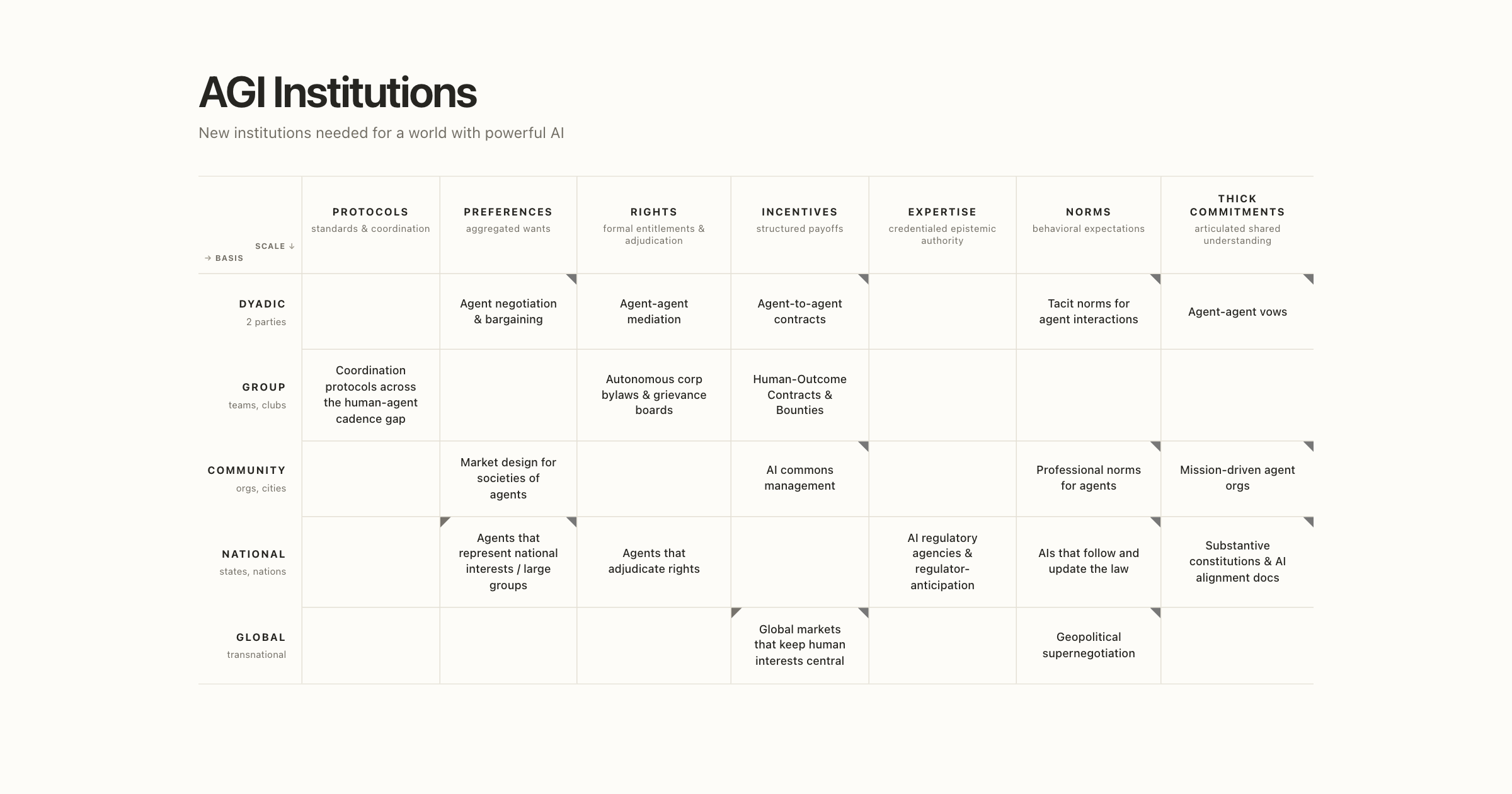
Existing Human Institutions — AGI Institutions Wiki
How existing human institutions handle coordination across scales — and how autonomous AI agents break them. Maps protocols, preferences, rights, incentives, expertise, norms, and thick commitments from dyadic to global.
Google DeepMind CEO Demis Hassabis: The Path To AGI, Deceptive AIs, Building a Virtual Cell
AGI isn’t the ‘Holy Grail’ for women in AI. It’s gender-purpose AI and it’s already here - Fast Company
Women AI Leaders are shaping the future of the technology in ways that are more purpose-driven.

Built to benefit everyone: our plan
A vision for the future of AI, focusing on access, safety, and shared prosperity as OpenAI works to ensure AGI benefits everyone.

Large AI models are cultural and social technologies
Implications draw on the history of transformative information systems from the past , Debates about artificial intelligence (AI) tend to revolve around whether large models are intelligent, autonomous agents. Some AI researchers and commentators speculate that we are on the cusp of creating agents with artificial general intelligence (AGI), a prospect anticipated with both elation and anxiety. There have also been extensive conversations about cultural and social consequences of large models, orbiting around two foci: immediate effects of these systems as they are currently used, and hypothetical futures when these systems turn into AGI agents—perhaps even superintelligent AGI agents. But this discourse about large models as intelligent agents is fundamentally misconceived. Combining ideas from social and behavioral sciences with computer science can help us to understand AI systems more accurately. Large models should not be viewed primarily as intelligent agents but as a new kind of cultural and social technology, allowing humans to take advantage of information other humans have accumulated.
AI Mania Is Eviscerating Global Decision-Making — Ludicity
Note: This has been cross-posted to my company's blog, in case you think there is some use in sharing with someone in a format that looks more authoritative. Link here.
The AI future where humans get paid to be creative
DeepSeek
DeepSeek, unravel the mystery of AGI with curiosity. Answer the essential question with long-termism.
Human perspectives on AI · Global Voices
This GV Spotlight edition will explore how the use of, promotion of, and resistance to artificial intelligence is playing out for the Global Majority.


Tyler Cowen at Google DeepMind on life after AGI: rebuilding every institution, the rise of "AI maniacs," and why the future will be drenched in meaning.