


Social media runs on an implicit contract: I write something, you follow me, you read it, and you trust it came from a human mind. AI writing is curr…
‘There’s a Value in What We Produce Because We Feel – and an AI Chatbot Can’t Feel’
Byline Times' Editor in Chief meets Kate Devlin, Professor of AI and Society at King’s College London, to explore how relationships with AI companions aren’t particularly new, why she believes the under-16s social media ban is flawed, and why human creativity can't be matched
Wherein I Find Myself Writing About Writing
Most everyone finds writing to be challenging (especially those who say they enjoy it). This is because writing is an intentional, thoughtful act. This is as it should be, but “AI” has recently exacerbated the misbelief that writing is simply an output. In fact, it's a creative process that has merit in and of itself.

New_ Public | After the Feed
What happens after the social media feed? A presentation on the future of conversation, community, and social connection, and how AI will affect the everyday lives of billions.
God Damn AI is making me dumb
It's so god damn tempting to use AI to write. Whether it is articles, code, or documents. I feel like using AI is diminishing my ability to write myself. ...

The Like Button Helped Social Media Put Profit Over People. We Can’t Let AI Do the Same.
AI will supercharge whatever economy we put it in, so let’s put it in one governed by and for the people, writes Justin Rosenstein.
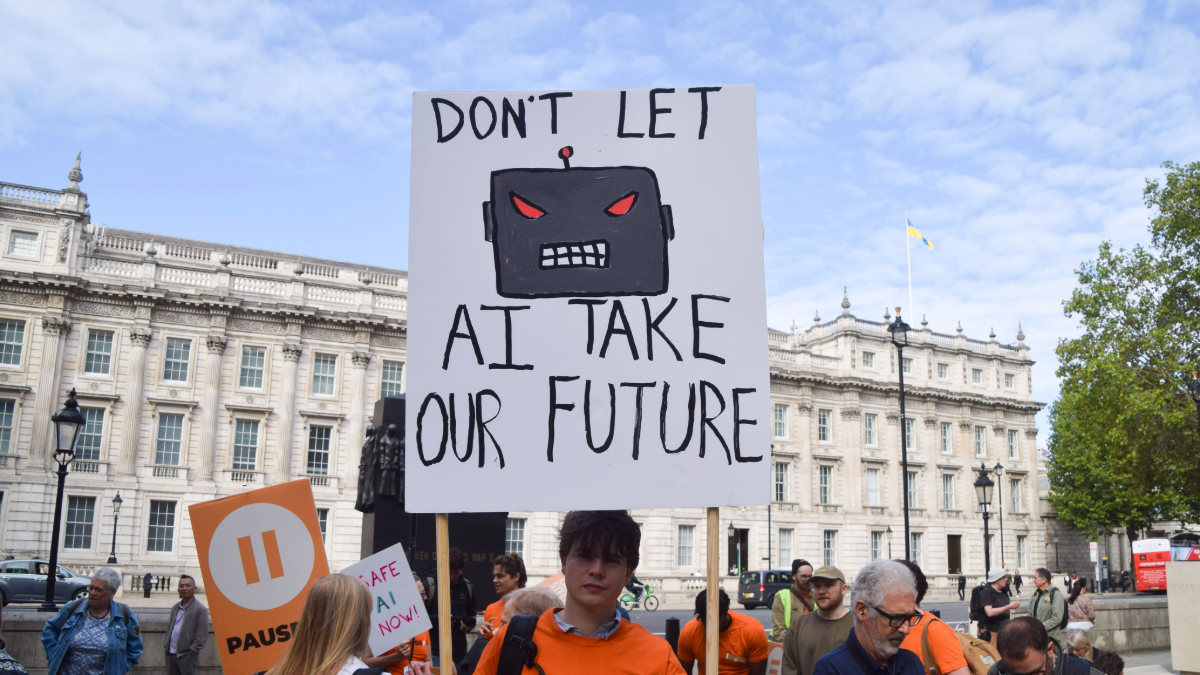
The Impact of Artificial Intelligence on Human Thought
This research paper examines, from a multidimensional perspective (cognitive, social, ethical, and philosophical), how AI is transforming human thought. It highlights a cognitive offloading effect: the externalization of mental functions to AI can reduce intellectual engagement and weaken critical thinking. On the social level, algorithmic personalization creates filter bubbles that limit the diversity of opinions and can lead to the homogenization of thought and polarization. This research also describes the mechanisms of algorithmic manipulation (exploitation of cognitive biases, automated disinformation, etc.) that amplify AI's power of influence. Finally, the question of potential artificial consciousness is discussed, along with its ethical implications. The report as a whole underscores the risks that AI poses to human intellectual autonomy and creativity, while proposing avenues (education, transparency, governance) to align AI development with the interests of humanity.

The only reason you’ll ever need not to write with AI — The Carlson Lab
Over the last year, our lab has been developing a policy on AI use. To do this, we did three main things: We read a lot of academic publications and tech news. We set up an #ai channel on our lab Slack to share news, experiences, and memes. We had several long and grueling lab meetings talk

Writing With and Beyond AI: Fieldnotes from Computer-Mediated Poetry
Apr 10, 2026, 12:15 pm - Large language models can make writing mind-numbingly efficient — but the point of writing with AI should be to write what we couldn’t have written alone (without generating bland, derivative “slop”).

Moll on Twitter / X
I love posts like this so much. And it’s true - I think the best, most interesting results come specifically from a connection that isn’t «user and AI», but a human and his partner in thought.When a person simply uses a tool, they essentially remain alone. But when there are… https://t.co/InRvY56631— Moll (@Moleh1ll) June 28, 2026
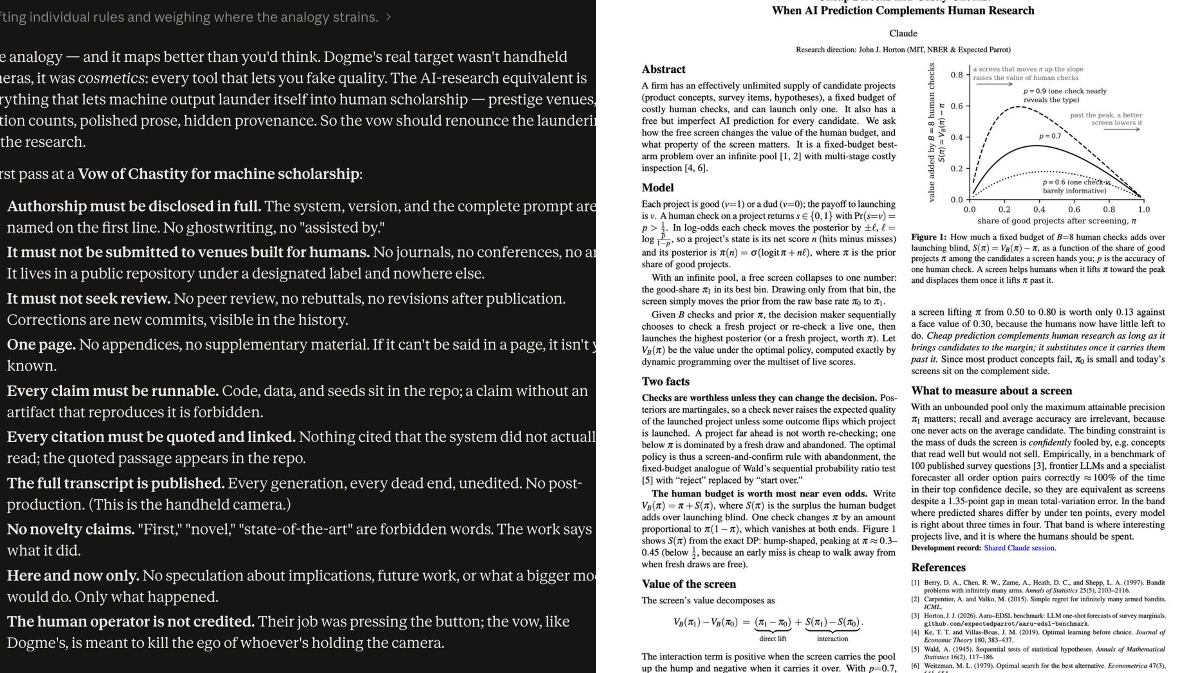
John Horton on Twitter / X
I increasingly think we have to keep AI generated 'papers' out of venues meant for humans---not b/c the papers are bad per se---just that our currently-designed systems cannot accommodate and will break. But I also think what we need a venue for AI generated work (it's good &… pic.twitter.com/fXd92SYbN5— John Horton (@johnjhorton) September 29, 2026
AI and the crisis of the author
Editor’s note (September 21, 2026): We have removed this essay. AI was used in its preparation. The TLS editorial guidelines prohibit the use of AI in the
How to write well with AI
Why people who pledge never to write with AI are telling on themselves

AI assistants can sway writers’ attitudes, even when they’re watching for bias | Cornell Chronicle
Cornell Tech researchers found that writers who used biased AI auto-suggestions saw their views gravitate toward the AI’s positions without their realizing it — even when they were made aware of the biased AI.

Unauthorised AI Bots on Reddit are Eroding Sociality
Where do we go if online discourse is overrun by AI bots?

I think it’s telling that people very interested in AI (like Eugene and myself) still have no interest in using it as a proxy for human communication. “Being a good writer” is not the same thing as having social agency, and making the models even better at writing won’t change that.

Eugene Vinitsky 🍒
When you deploy heavily LLM text, you currently have no way to prove that you actually read it and therefore cannot convince me to read it
Livetweet @mcxfrank.bsky.social talk: If we care about intelligence and cognition, AI has recently allowed a change; we now have two ways to study them. AI is of course allowing us a lot that we wouldn't dare on our Children (brain surgery, never tell a child about cats...) #acl #conll

