What happens when we consider Africa through a feminist lens and feminism through an African one? And what does it mean to centre selfhood in this journey? In this shining, wide-ranging inquiry, Minna Salami explores these questions through an unhesitating and incisive vision of African feminist political philosophy. Drawing from feminist thought, postcolonial theory, historical insights, and African knowledge systems, Salami combines personal reflection with cultural criticism to offer a vivid and cohesive discussion about power, identity, patriarchy, imagination, and the human condition. Grounded in Africa’s enduring visions of agency and autonomy, Can Feminism Be African? opens new paths for rethinking the narratives that shape our world. This is a timely and thought-provoking read, calling us to rethink the past, present, and future through new perspectives.
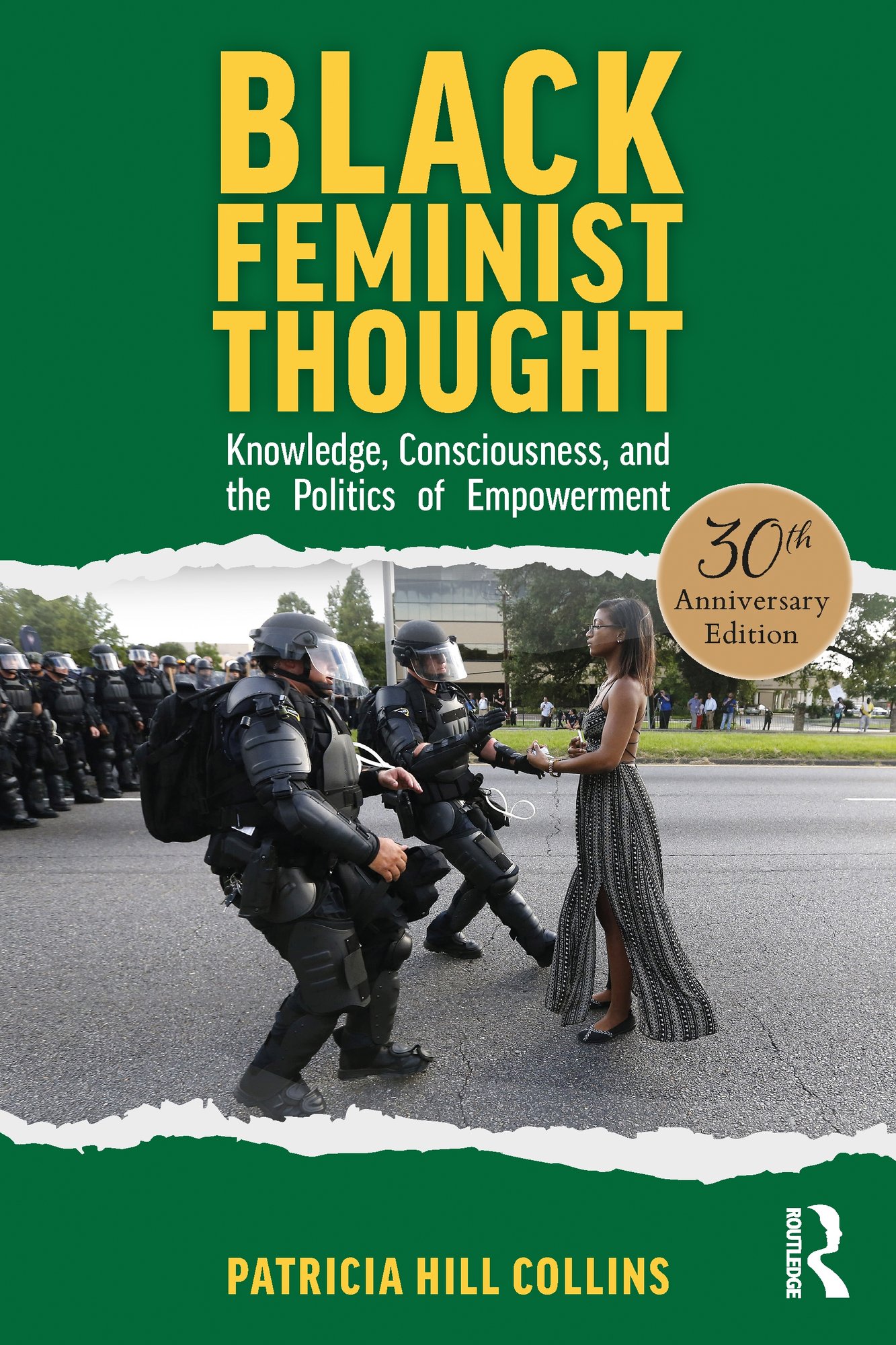
Black Feminist Thought, 30th Anniversary Edition: Knowledge, Consciousness, and the Politics of Empowerment
Knowledge, Consciousness, and the Politics of Empowerment
Re-enchanting the world: feminism and the politics of the commons
Silvia Federici is one of the most important contempora…

Re-enchanting the world : feminism and the politics of the commons
xviii, 227 pages ; 23 cm; "Silvia Federici is one of the most important contemporary theorists of capitalism and feminist movements. In this collection of her work spanning over twenty years, she provides a detailed history and critique of the politics of the commons from a feminist perspective. In her clear and combative voice, Federici provides readers with an analysis of some of the key issues and debates in contemporary thinking on this subject. Drawing on rich historical research, she maps the connections between the previous forms of enclosure that occurred with the birth of capitalism and the destruction of the commons and the "new enclosures" at the heart of the present phase of global capitalist accumulation. Considering the commons from a feminist perspective, this collection centers on women and reproductive work as crucial to both our economic survival and the construction of a world free from the hierarchies and divisions capital has planted in the body of the world proletariat. Federici is clear that the commons should not be understood as happy islands in a sea of exploitative relations but rather autonomous spaces from which to challenge the existing capitalist organization of life and labor"--; Foreward by Peter Linebaugh; Includes bibliographical references (pages198-216) and index; On primitive accumulation, globalization, and reproduction -- Introduction to the new enclosures -- The debt crisis, Africa, and the new enclosures -- China: breaking the iron rice bowl -- From commoning to debt: financialization, microcredit, and the changing architecture of capital accumulation -- Beneath the United States, the Commons -- Commons against and beyond Capitalism -- The University: a knowledge common? -- Feminism and the politics of the commons in an era of primitive accumulation -- Women's struggles for land in Africa and the reconstruction of the commons -- Women's struggles for land and the common good in Latin America -- Marxism, feminism, and the commons -- From crisis to commons: reproductive work, affective labor and technology, and the transformation of everyday life -- Re-enchanting the world: technology, the body, and the construction of the commons


African religions and philosophy
"A Doubleday Anchor book."; Includes indexes; Bibliography: p. [364]-371; Mode of access: Internet

Na crise atual, Kwame Nkrumah voltou a ser leitura obrigatória
O líder afromarxista Kwame Nkrumah nasceu neste dia em 1909. Ele dissecou os meandros do avanço imperialista na África do século XX em sua tese contra o neocolonialismo. Com a nova ofensiva estadunidense no Sul Global, reler e se armar com os argumentos de seu livro Neocolonialismo: estágio superior do imperialismo se torna uma tarefa incontornável dos dois lados do Atlântico.

A Black Feminist Apocalypse/Dystopian Survival Resource Compilation
A Black Feminist Apocalypse/Dystopian Survival Resource Compilation With the awful realization that we are indeed in a fight for our very survival coming over me for the past few years, I’ve asked myself this question: what can I do right now, today? With my resources limited or tapped out, I’ve...

We Do This 'Til We Free Us
New York Times Bestseller “Organizing is both science and art. It is thinking through a vision, a strategy, and then figuring out who your targets are, always being concerned about power, always being concerned about how you’re going to actually build power in order to be able to push your issues, in order to be able to get the target to actually move in the way that you want to.” What if social transformation and liberation isn’t about waiting for someone else to come along and save us? What if ordinary people have the power to collectively free ourselves? In this timely collection of essays and interviews, Mariame Kaba reflects on the deep work of abolition and transformative political struggle. With a foreword by Naomi Murakawa and chapters on seeking justice beyond the punishment system, transforming how we deal with harm and accountability, and finding hope in collective struggle for abolition, Kaba’s work is deeply rooted in the relentless belief that we can fundamentally change the world. As Kaba writes, “Nothing that we do that is worthwhile is done alone.”

Slave Songbook : Origin of the negro Spiritual
Towards a feminist HCI methodology: social science, feminism, and HCI
Feminism is a natural ally to interaction design, due to its central commitments to issues such as agency, fulfillment, identity, equity, empowerment, and social justice. In this paper, I summarize the state of the art of feminism in HCI and propose ...

Social Reproduction Theory: Remapping Class, Recentering Oppression
This groundbreaking collection explores the profound power of Social Reproduction Theory to deepen our understanding of everyday life under capitalism. While many Marxists tend to focus on the productive economy, this book focuses on issues such as child care, health care, education, family life and the roles of gender, race and sexuality, all of which are central to understanding the relationship between economic exploitation and social oppression. In this book, leading writers such as Lise Vogel, Nancy Fraser, David McNally and Susan Ferguson reveal the ways in which daily and generational reproductive labour, found in households, schools, hospitals and prisons, also sustains the drive for accumulation. Presenting a more sophisticated alternative to intersectionality, these essays provide ideas which have important strategic implications for anti-capitalists, anti-racists and feminists attempting to find a path through the seemingly ever more complex world we live in.
Who Deserves to Exist? Gender Fear and False Promises of Identity-Driven Neocolonial Aid - শুদ্ধস্বর
Non-profit industrial complex and neocolonial philanthropic entities are working toward their own self-preservation rather than fundamentally restructuring power and society.

Gender Trouble: Feminism and the Subversion of Identity
One of the most talked-about scholarly works of the past fifty years, Judith Butler’s Gender Trouble is as celebrated as it is controversial.Arguing that traditional feminism is wrong to look to a natural, 'essential' notion of the female, or indeed of sex or gender, Butler starts by questioning the category 'woman' and continues in this vein with examinations of 'the masculine' and 'the feminine'. Best known however, but also most often misinterpreted, is Butler's concept of gender as a reiterated social performance rather than the expression of a prior reality.Thrilling and provocative, few other academic works have roused passions to the same extent.

Feminism | The Paper Pilot
The Paper Pilot's digital garden of thoughts on philosophy, politics, and sociology
Feminist Icon Gloria Steinem Was An Anti-Communist CIA Operative who Kept Feminism From Discussing Class
Declassified Cold War Ties Show How U.S. Intelligence Shaped Feminism’s Focus On Gender Over Class.

Intersectional Antifeminism, or: What is a White Feminist, Anyway?
Regarding the most famous social theory no one has actually read.