


'Responsible but not beholden; substantial as well as symbolic; sympathetic but not pandering; political but not proscriptive: there's not an awful lot of wiggle room there, but it's the space in which I feel I need to both operate and expand.' In this incisive, moving and personal essay, one of the nation's leading political voices, explores the 'burden of representation'. Gary Younge analyses the pressures exerted upon the relatively small group of people from underrepresented communities, who break through into elite spaces and the expectations that may come from above, below, within and outwith, from those with power and those without. These are issues that have framed, frustrated, inspired, and inflected his entire working life as a writer. Younge offers reflections on how to navigate representation, power and responsibility while keeping your job, your sanity and your freedom both as a human being and as a writer.
Alasdair MacIntyre’s Philosophy in Practice
It is a curious thing when an artist, thinker, or writer gains influence outside the audience he intends or is comfortable with. When a thinker associated with the right becomes popular on the left, or a novelist associated with the progressive left becomes popular among conservative readers, there can be a sort of strain felt between the audience in fact and the “true” audience, or between those who feel themselves to be the authentic recipients of a work’s message and meaning and those who, to the true believers, come across as opportunistic in their enjoyment of works in tension with their own views. The same is true when a writer working within an academic discipline gets picked up by those outside it: Those working within that discipline may find the co-opting of these thinkers misplaced at best or malicious at worst.

Academia: Thoughtfulness With--and Without--Writing
Thursday’s Child Has Far To Go

Hyperpolitics: Extreme Politicization without Political Consequences
POLITICS AFTER THE END OF THE END OF HISTORYWhat happens when politics is everywhere, yet nothing seems to change? From the abandoned dance floors of Thatcher’s London to the mass mobilizations of Black Lives Matter, Anton Jäger traces how public life has become infused with protest, spectacle, and moral urgency — while the old infrastructure of parties, unions, and civic solidarity has been hollowed out.Hyperpolitics revisits the illusions of the “end of history” and dissects the strange energies that replaced them: viral outrage, endless culture wars, and the digital rush of causes that flare and vanish overnight. Jäger shows how the promises of post–Cold War liberalism gave way to a restless, unsteady public sphere where private passions overflow into politics but rarely build enduring power.Ranging from Guy Debord and Wolfgang Tillmans to Houellebecq’s disenchanted fictions, Hyperpolitics makes sense of a world in which collective action remains fragmented and the social fabric thinner than ever. For anyone trying to grasp why our age feels so charged yet so inconsequential, this book offers a vital map through the new contradictions of our hyperpolitical moment.
Solitude and Leadership - The American Scholar
If you want others to follow, learn to be alone with your thoughts

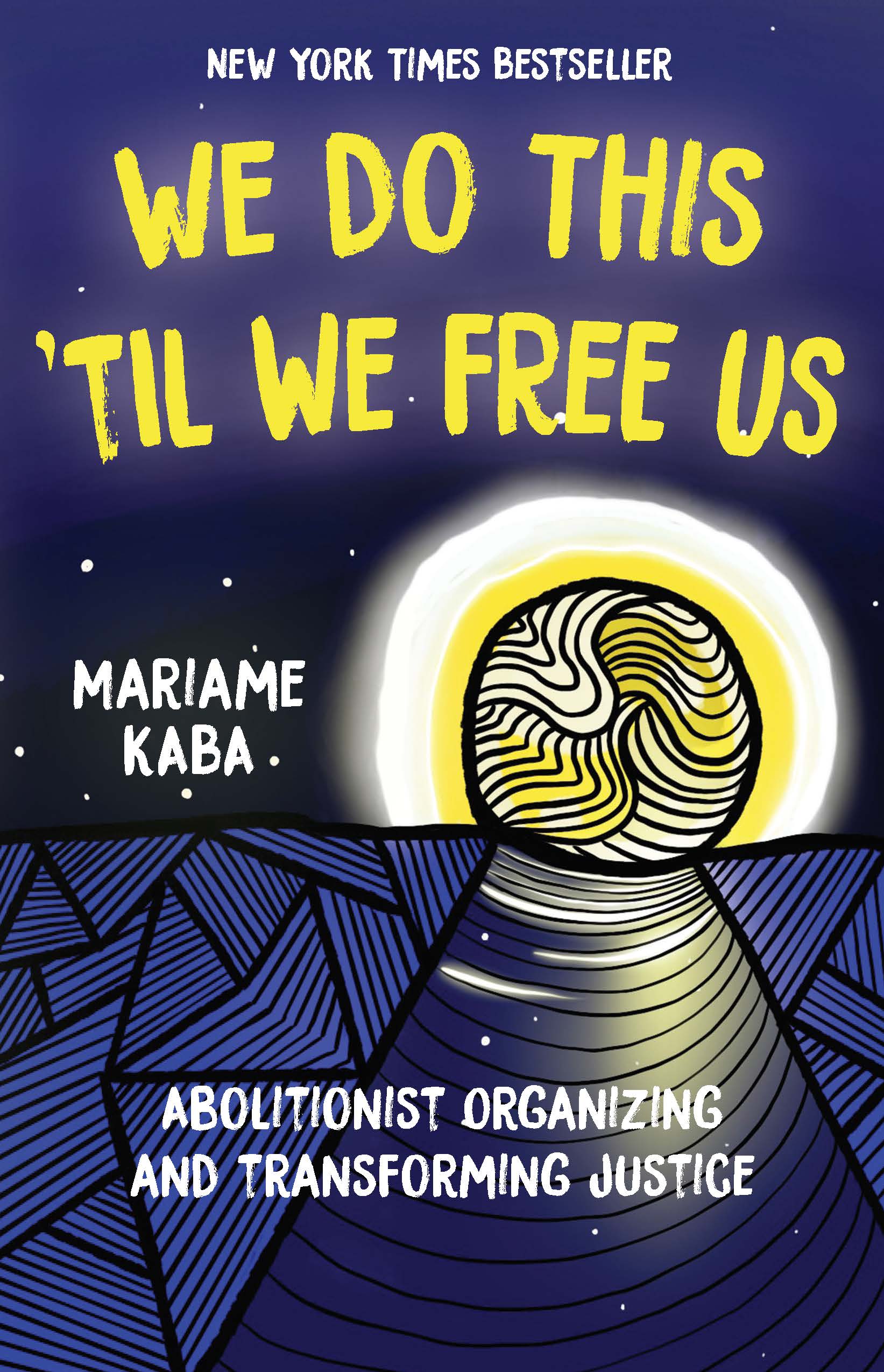
We Do This 'Til We Free Us
New York Times Bestseller “Organizing is both science and art. It is thinking through a vision, a strategy, and then figuring out who your targets are, always being concerned about power, always being concerned about how you’re going to actually build power in order to be able to push your issues, in order to be able to get the target to actually move in the way that you want to.” What if social transformation and liberation isn’t about waiting for someone else to come along and save us? What if ordinary people have the power to collectively free ourselves? In this timely collection of essays and interviews, Mariame Kaba reflects on the deep work of abolition and transformative political struggle. With a foreword by Naomi Murakawa and chapters on seeking justice beyond the punishment system, transforming how we deal with harm and accountability, and finding hope in collective struggle for abolition, Kaba’s work is deeply rooted in the relentless belief that we can fundamentally change the world. As Kaba writes, “Nothing that we do that is worthwhile is done alone.”
Governable Spaces: Democratic Design for Online Life – Writings and rehearsals by Nathan Schneider
Read the free, open access editionBuy: Amazon, Bookshop, Narrow Gauge Book Co-op, UC Press
The role of literature as the key to personal freedom | Aeon Essays
Stripped of easy moralising, literature makes us relish the search for truth in an age when many believe truth to be dead

The revolt of the reader | The Observation Deck
Reading is important to me. While I’m not a quick reader nor an especially voracious one, I have found that long-form reading has had a profound influence on me over my life. And because reading is important to me, writing is too: writing not only allows us to convey our ideas, but the very act forces us to test and distill them — at once making our ideas more robust while providing the vehicle by which to share them.
Writing Is Thinking
When you write about your work, it makes all of us smarter for the effort, including you. Done well, this kind of sharing means you’re contributing signal, instead of noise. But writers are made, n…

On Writing #3
Periodically I like to gather various observations about writing, and share my perspective.

Robert Hanks · On Putting Things Off
Job gone, I sat around trying to write, managing bits and pieces, but earning very little. And then my marriage drifted away too, leaving me, in Alan Partridge’s phrase, clinically fed-up boo-hoo. My wife, having said she would leave, took two and a half years to find a way of doing it – there is a small consolation in not being the only procrastinator in the relationship. While this was going on the LRB commissioned me to write about Richard Hughes, who wrote A High Wind in Jamaica. I like Hughes and it seemed like a job I could get on with. I cheerfully settled to the research, reading the novels I hadn’t read, rereading the ones I had. Then I started writing, or that’s what I told myself: some paragraphs, some sentences, a sketch of a plan, then some rewriting, rearranging, scrubbing, more rewriting, more scrubbing, pauses to reconsider. Then I did some more research: the short stories, the children’s stories, the poems and plays, the journalism, Richard Perceval Graves’s biography, then back to the rewriting …
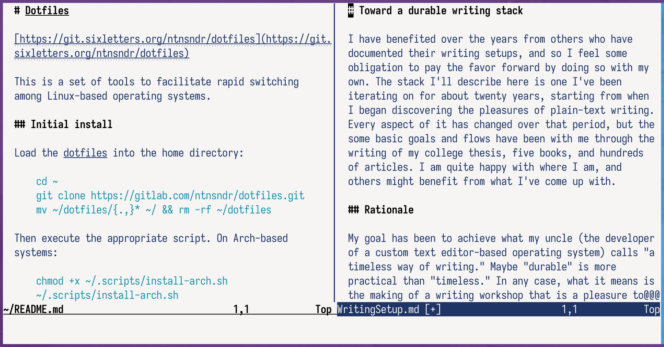
Toward a durable writing stack – Writings and rehearsals by Nathan Schneider
I have benefited over the years from others who have documented their writing setups, and so I feel some obligation to pay the favor forward by doing so with my own. The stack I’ll describe here is one I’ve been iterating on for about twenty years, starting from when I began discovering the pleasures of plain-text writing. Every aspect of it has changed over that period, but the some basic goals and flows have been with me through the writing of my college thesis, five books, and hundreds of articles. I am quite happy with where I am, and others might benefit from what I’ve come up with.

On liberty
Introductory -- Of the liberty of thought and discussion -- Of individuality, as one of the elements of well-being -- Of the limits to the authority of society over the individual -- Applications; Book, leather; Explanatory note by H.E. Barker attached; 18

Empathy | The Paper Pilot
The Paper Pilot's digital garden of thoughts on philosophy, politics, and sociology
Culture & truth : the remaking of social analysis
xii, 253 pages ; 22 cm; Argues for a new approach to thinking and writing about culture. Exposing old conceptions, the book argues that new ethnographic writing must come to terms with the dynamic nature of social reality - with history, spontaneity, and human emotions; Originally published: Boston: Beacon, 1989; Includes index; Self-Renewing 2017; Includes index
