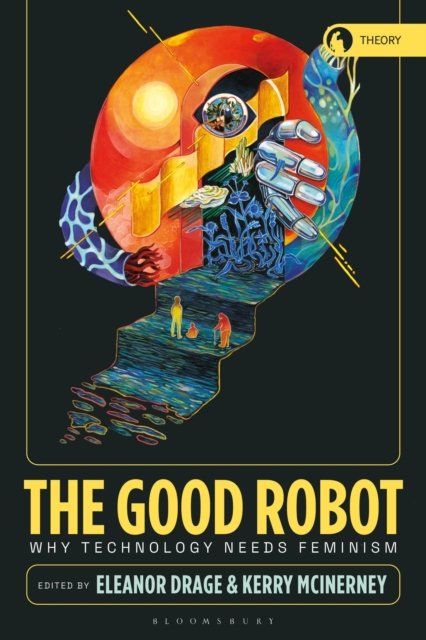
What is good technology? Is ‘good’ technology even possible? And how can feminism help us work towards it? The Good Robot addresses these crucial questions through the voices of leading feminist thinkers, activists and technologists. Each thinker provides a snapshot of key challenges, questions and provocations in the field of feminism and technology. While the question of whether various AI and technological advances can be ethical is not new, the embedded nature of feminist perspectives pulls out whether this perceived ‘goodness’ or ‘wrongness’ might actually impact our lives in the 21st century. This book explores both the radical possibilities of technology to disrupt practices of patriarchy, colonialism, racism and beyond but also provides a significant critique of how we can contain the ethical possibilities of entities we cannot predict. In exploring unjust technological practices and engaging critical voices in the tech industry, the existing moral issues are brought to light as well as the possible ethical quagmires. This book opens a new space of discussion on digital technologies – one that insists that the future of AI is an urgent feminist issue.
Feminist Technology
Feminist technology is not related to one specific community of practice, but it has been a field of research and has led to and is still leading to practices that are very valuable in the context of sustainable tech.
Calling for Ethical AI that Empowers Women and Protects Human Dignity
30 October 2024: Women4Ethical AI platform

The tech industry hijacking of the AI ethics research agenda and why we should reclaim it
This paper reflects on the tech industry’s colonization of the AI ethics research field and addresses conflicts of interest in public policymaking concerning AI. The AI ethics research community faces two intertwined challenges: In the first place, we have a tech industry heavily influencing the AI ethics research agenda. Secondly, cleaning up after the tech industry has implied that we have turned to value-driven design methods to bring ethics to AI design. But by framing research questions relevant to a technical practice, we have facilitated the technological solutionism behind the tech industry’s business model. Therefore, this paper takes the first steps to reshape the AI ethics research agenda by suggesting moving toward an emancipatory framework that brings politics to design while, at the same time, bearing in mind that AI is not to be treated as an inevitability. As a research community, we must focus on the repressive power dynamics exacerbated by AI and address challenges facing the vulnerable groups seldom heard, despite the fact that they are the ones most negatively affected by AI initiatives.

How AI is exacerbating technology-facilitated violence against women and girls
This paper examines how artificial intelligence is accelerating technology-facilitated violence against women and girls—from deepfakes and automated hate to sextortion, impersonation, and large-scale disinformation. It outlines emerging risks, legal and ethical challenges, and opportunities for prevention, while calling for urgent regulation, safety-by-design, and coordinated global action to ensure that AI technologies advance, rather than undermine, women’s rights and safety.

Women in AI: Numbers Behind the Gender Gap in Tech
How is AI changing the game for women in 2026? From job shifts and personal life-hacks to the rise of female AI founders, explore the unique impact of women in tech today.

The Future of AI
The Parents’ Paradox: AI, Ethics, and the Limits of Machine Morality This post is based on a talk I gave at The AI & Automation Conference in London on February 25, 2026, and my slides. A…
“The more women take part in shaping AI, the more balanced and responsible this techn | Ctech
With the AI revolution still in its relative infancy, leaders from Women in Tech Israel and KPMG say it presents a rare opportunity for women to establish themselves as leaders in a defining new sector. Just as importantly, they argue that to build technology that serves everyone, women must secure their place in the conversation.

From users to architects: Why girls must shape the future of AI
If girls aren’t shaping AI, we’re building a broken future. Empowering young women in tech is now a global necessity, not just a matter of fairness.

Anthropomorphism Is Breaking Our Ability to Judge AI
Tech Policy Press fellow James Ball asks, how should we interact with a technology designed to ‘speak’ with us on what appear to be human terms?

If AI is the future, gender equity is essential | NetHope
As the world faces many serious challenges — from climate change and poverty to displacement and social injustice – women and girls are key to tackling those issues and shaping future prosperity for all. Artificial Intelligence (AI), along with other digital tools, has the potential to help us address those challenges and open new opportunities. Seizing that potential requires us to take meaningful action to mitigate the risks AI poses to women and girls, and to use AI to advance gender equity.

Field Theory: AI as Social Science Question, Object & Tool
Uses of advanced artificial intelligence are changing how societies organize labor, govern, produce knowledge, and make meaning. In light of these developments, this essay argues that AI models, tools, and systems pose three interrelated imperatives for social science: they demand renewed attention to social theories of how technology, human experience, and social order are entangled; they require study as objects of inquiry in their own right; and they offer capabilities that may transform—or upend—the practice of social investigation itself. From Weber’s analysis of rationalization to Du Bois’s study of technology and inequality to contemporary scholarship on algorithmic governance, the essay examines what social science distinctively offers: the capacity to historicize the apparently unprecedented, to trace connections across scales, and to center those most affected by technological change. It identifies how algorithmic systems are remaking the distribution of opportunity and risk as a central task of social inquiry and asks what futures social science might help bring into being.
Moral Deskilling and Upskilling in a New Machine Age: Reflections on the Ambiguous Future of Character
This paper explores the ambiguous impact of new information and communications technologies (ICTs) on the cultivation of moral skills in human beings. Just as twentieth century advances in machine automation resulted in the economic devaluation of practical knowledge and skillsets historically cultivated by machinists, artisans, and other highly trained workers (Braverman 1974), while also driving the cultivation of new skills in a variety of engineering and white collar occupations, ICTs are also recognized as potential causes of a complex pattern of economic deskilling, reskilling, and upskilling. In this paper, I adapt the conceptual apparatus of sociological debates over economic deskilling to illuminate a different potential for technological deskilling/upskilling, namely the ability of ICTs to contribute to the moral deskilling of human users, a potential that exists alongside rich but currently underrealized possibilities for moral reskilling and/or upskilling. I flesh out this general hypothesis by means of examples involving automated weapons technology, new media practices, and social robotics. I conclude that since moral skills are essential prerequisites for the effective development of practical wisdom and virtuous character, and since market and cultural forces are not presently aligned to bring about the more salutary of the ambiguous potentials presented here, the future shape of these developments warrants our close attention—and perhaps active intervention.

Artificial Intelligence and Its Unique Threat to Women | Capitol Technology University
With the rise of artificial intelligence, the world is undergoing a big transformation. However, technology has been seen to display biases – and for women, this presents a complex set of challenges.

AI, Ethics, and Society — Home
The Gender Gap in AI: Why We Need More Women in Artificial Intelligence - EIT Campus
Artificial intelligence is shaping our future, but who is shaping AI? In this blog, we explore the insights of Megi Mejdrechová, co-founder of RoboTwin, a…

AI is unlocking new leadership paths for women in tech
A side benefit of the booming interest in GenAI is how it presents opportunities to women in tech.