


How do we get to know air? Aeropolis: Queering Air in Toxicpolluted Worlds offers a speculative and interdisciplinary framework to reorient common understandings of air and air pollution as matter “out there.” Aeropolis contests regimes of managing air which ultimately operate toward upholding dominant modes of world-making that are dependent on forms of exclusion and inequity. Instead, Aeropolis proposes that air is thought of as a city, to center its social, cultural, political, ecological entanglements. Drawing upon feminist technoscience and queer ecological frameworks, Aeropolis moves away from solutions toward a methodology of “designing-thinking-making” that redirects and connects our understandings of air—as designers, as citizens—with ongoing struggles for just futures. Moving through a series of design interventions, histories of air, and theoretical coordinates, Aeropolis thinks with air across its many forms—through smog and dust, bodies and breath, pollen and weeds, and from urban design to geopolitics, polluted environments to open data, parks to aerial infrastructures. It insists that we acknowledge the diversity of air and its relation to humans, non-humans, and environments, both physically and affectively. That we become sensible to air by following its unruliness—by living, breathing, seeing, holding, touching, queering airs. With contributions from María Puig de la Bellacasa and Timothy K. Choy.
ATmosphere Report #147 - Year's end reflections - Connected Places
Some themes I'm watching for 2026: censorship resistance, the politics of interoperable spaces, and who gets to shape how atproto talks about itself.
Reflections on AtmosphereConf
A reflection on AtmosphereConf, understanding this network as a subculture, joy, and what "We Can Just Do Things" actually means
About the Atmosphere
I’m writing this from the beautiful UBC campus in Vancouver where ATmosphereConf 2026 is taking place. It’s a gathering of developers, researchers, and entrepreneurs who are passionate about keepin…

Paris said au revoir to cars. Air pollution maps reveal a dramatic change.
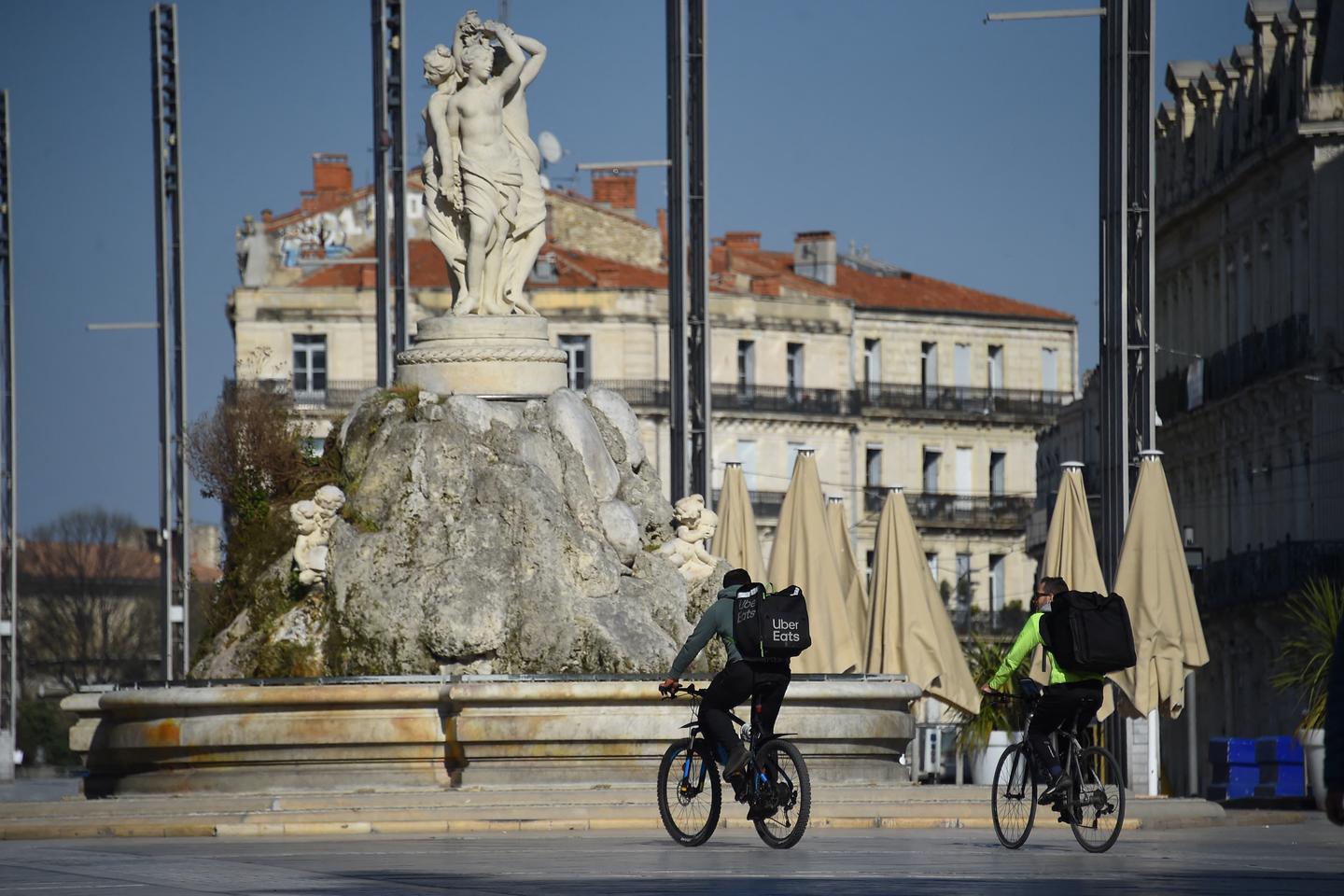
Air pollution fell substantially as the city restricted car traffic and made way for parks and bike lanes.

De la pollution de l’air à l’usage du vélo, l’impact sanitaire des choix d’urbanisme évalué
L’agence Santé publique France publie jeudi une étude menée dans trois métropoles pour évaluer les leviers environnementaux permettant de réduire la mortalité des populations urbaines.
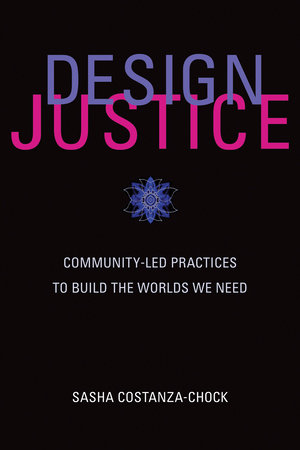
Design Justice: Community-Led Practices to Build the Worlds We Need
An exploration of how design might be led by marginalized communities, dismantle structural inequality, and advance collective liberation and ecological survival. What is the relationship between design, power, and social justice? “Design justice” is an approach to design that is led by marginalized communities and that aims expilcitly to challenge, rather than reproduce, structural inequalities. It has emerged from a growing community of designers in various fields who work closely with social movements and community-based organizations around the world. This book explores the theory and practice of design justice, demonstrates how universalist design principles and practices erase certain groups of people—specifically, those who are intersectionally disadvantaged or multiply burdened under the matrix of domination (white supremacist heteropatriarchy, ableism, capitalism, and settler colonialism)—and invites readers to “build a better world, a world where many worlds fit; linked worlds of collective liberation and ecological sustainability.” Along the way, the book documents a multitude of real-world community-led design practices, each grounded in a particular social movement. Design Justice goes beyond recent calls for design for good, user-centered design, and employment diversity in the technology and design professions; it connects design to larger struggles for collective liberation and ecological survival. The open access edition of this book was made possible by generous funding from Knowledge Unlatched and the MIT Press Frank Urbanowski Memorial Fund.
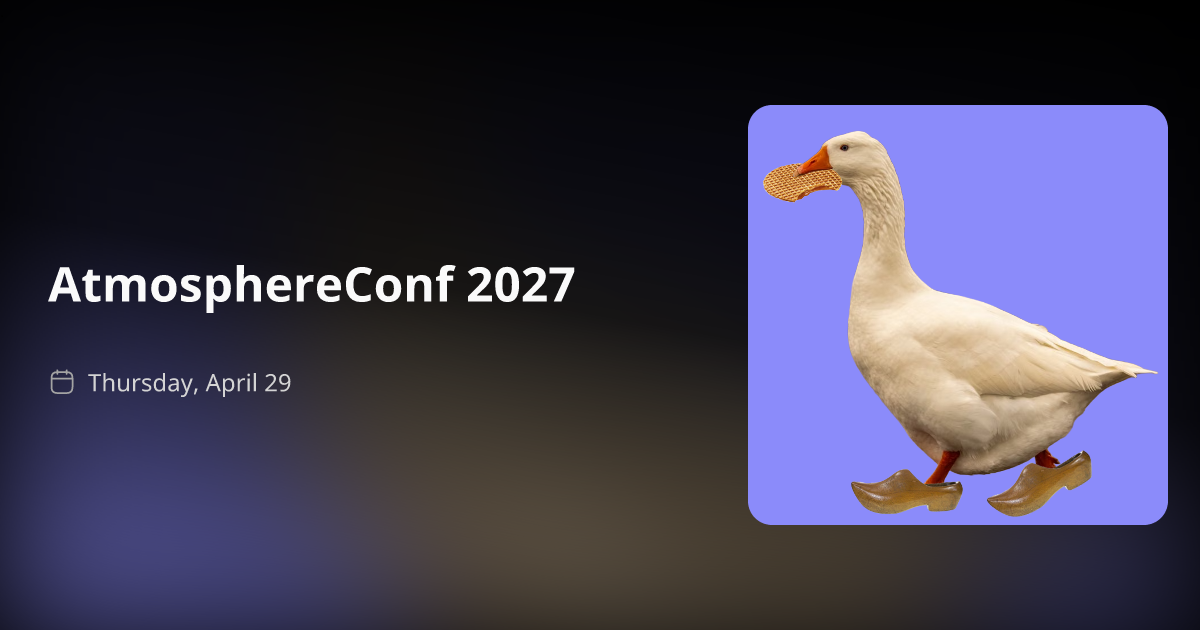
AtmosphereConf 2027
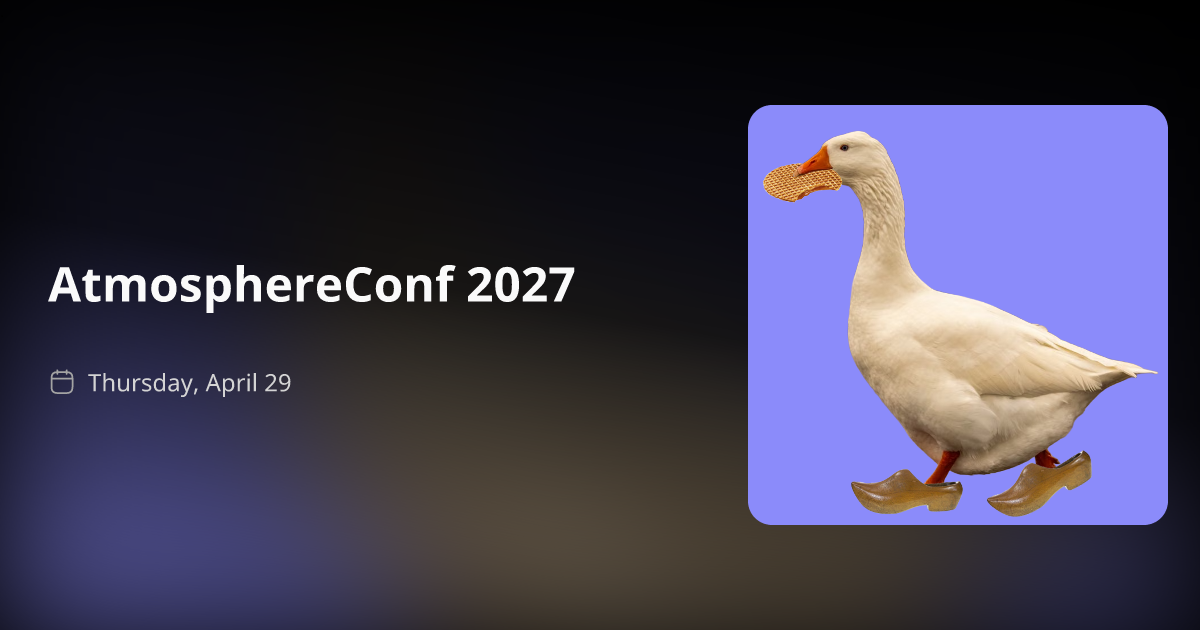
The third edition of the global gathering for the Atmosphere Community is taking place in Amsterdam, April 29th - May 2nd. This includes side-events and main conference days. Please RSVP with your interest, subscribe for updates at https://news.atmosphereconf.org, and watch us build out the website with lots of fun features https://atmosphereconf.org As well as in person, we'll also be streaming and have different ways to participate remotely. Atmosphere Conference is run by the community, for the community, as an annual global gathering to connect, share, celebrate, and learn from each other. We welcome newcomers and want to engage with new perspectives. It's a community home for builders, supporters, and participants in the atproto ecosystem. We maintain collective resources, seed projects, and convene our community to ensure every member has genuine voice in shaping the ecosystem's future. #atproto #atmosphereconf #atmosphereconf2027 #europe
AtmosphereConf 2027
The third edition of the global gathering for the Atmosphere Community is taking place in Amsterdam, April 29th - May 2nd. This includes side-events and main conference days. Please RSVP with your interest, subscribe for updates at https://news.atmosphereconf.org, and watch us build out the website with lots of fun features https://atmosphereconf.org As well as in person, we'll also be streaming and have different ways to participate remotely. Atmosphere Conference is run by the community, for the community, as an annual global gathering to connect, share, celebrate, and learn from each other. We welcome newcomers and want to engage with new perspectives. It's a community home for builders, supporters, and participants in the atproto ecosystem. We maintain collective resources, seed projects, and convene our community to ensure every member has genuine voice in shaping the ecosystem's future. #atproto #atmosphereconf #atmosphereconf2027 #europe
The Atmosphere as research infrastructure
A taxonomy of ATmosphere applications
Last week I spent an energizing, educational, occasionally infuriating week in Vancouver around the ATmosphereConf, a community event gathering developers, investors, data scientists, the odd academic
Stop Advertising The Atmosphere As Speculative Technology · thoughts (tiny)
The atproto enthusiast community is inadvertently turning others off to the ecosystem
Design Justice: Community-Led Practices to Build the Worlds We Need
An exploration of how design might be led by marginalized communities, dismantle structural inequality, and advance collective liberation and ecological su
Design for a Living Planet: Settlement, Science, & the Human Future
In this brief, accessible volume, the authors — an urban philosopher and a mathematician-physicist — explain the surprising new findings from the sciences that are beginning to transform environmental design in the modern era. Authors Michael Mehaffy and Nikos Salingaros explore fractals, networks, self-organization, dynamical systems and other revolutionary ideas, describing them to non-science readers in a direct and engaging way. The book also examines fascinating new topics of design, including Agile, Wiki, Design Patterns and other “open-source” approaches from the software world. The authors conclude that a profound transformation is under way in modern design — and today’s students and practitioners will need to be aware of its implications for our future.“Lucidly describes what’s coming in the world of design — and what needs to come.” — Ward Cunningham, Inventor of wiki, and pioneer of Pattern Languages of Programming, Agile, and Scrum“Essential reading for all urban designers.” — Jeff Speck, Author of Walkable City“Brilliant.” — Charles Montgomery, Author of Happy City“Inspired, compelling and fascinating… Recognizes that a true architecture can be dug from the facts, insights, and theories, that occur with a broadening of science to include the human being.” — Christopher Alexander, Author of A Pattern Language and Notes on the Synthesis of FormSome comments on the individual chapters:“Packed with detail and beautiful in presentation.” — Gil Friend“Human society must find a path of retreat. Salingaros and Mehaffy point the way.” — David Brussat, Providence Journal“Michael Mehaffy and Nikos Salingaros have written some brilliant articles on how we can co-create cities which are truly resilient, rather than being ‘engineered resilient’.” — Smallworld Urbanism“For me, this essay was like a flash of insight, and I suddenly saw the world in a new light.” — Oeyvind Holmstad, Permaliv“We’ve just come across a very thoughtful article by Michael Mehaffy and Nikos Salingaros… [who] draw a number of lessons from biological systems and use them to draw conclusions about how resilient human systems must be designed.” — Resilient Design Institute“Salingaros and Mehaffy take us from the configuration of city spaces to the order of cells in living beings.” — Jaap Dawson, Delft Institute of Technology“If you wanted to know where the cutting edge was in urban design, it is here.” — Patrick J. Kennedy, CarFreeInBigD“This is the single most intelligent and illuminating article I’ve seen on Archdaily in 3 years.” — Nìming Pínglùn Zhě, ChinaMichael Mehaffy is an urbanist and design theorist, and a periodic visiting professor or adjunct in five graduate universities in four countries and three disciplines (architecture, urban planning and philosophy) including the University of Oregon (US) and the University of Strathclyde (UK). He has been a close associate of the architect and software pioneer Christopher Alexander, and a Research Associate with the Center for Environmental Structure, Alexander’s research center founded in 1967. He is currently executive director of Portland, Oregon based Sustasis Foundation, and editor of Sustasis Press.Nikos A. Salingaros is a mathematician and polymath known for his work on urban theory, architectural theory, complexity theory, and design philosophy. He has been a close collaborator of the architect and computer software pioneer Christopher Alexander. Salingaros published substantive research on Algebras, Mathematical Physics, Electromagnetic Fields, and Thermonuclear Fusion before turning his attention to Architecture and Urbanism. He is Professor of Mathematics at the University of Texas at San Antonio and has been on the Architecture faculties of universities in Italy, Mexico, and The Netherlands.
Stop Advertising The Atmosphere As Speculative Technology - thoughts (tiny)
The atproto enthusiast community is inadvertently turning others off to the ecosystem

ATmosphere technology to support organizing and activism
There has been some good writing by Mosh, Erlend, and Meri about this topic worth pulling in. Permissioned spaces coming to atproto will also unlock a lot of important affordances for crafting protected spaces for organizers. For example, permissioned spaces on semble would turn into community-run search engines. My hope is that atproto is the missing infrastructural piece that enables us to really shape digital spaces around the specific needs organizers and their communities rather the...

Our community has gathered around the concept of Atmosphere. There’s work to do in explaining, culture building, and the concrete task of rallying around a brand / logo, especially around login.

Boris
For anyone that has come to a meetup, event, or conference - it’s not faceless. As a community, our goal is to imbue the Atmosphere with feelings and alignment. Designing a logo and brand that grows to mean that is something we need to do together. No one company can carry our flag.