


The circular economy prioritises the reuse of materials, preventing the over extraction of natural resources and usable materials that end up in landfill.
How Does Circular Economy Work In Sustainable Construction? - Construction Jobs

Circular economy in the building and construction sector: A scientific evolution analysis
The building industry is responsible for considerable environmental impacts due to its consumption of resources and energy, and the production of wastes. Circular Economy (CE), a new paradigm can significantly improve the sustainability of this sector. This paper performs a quantitative scientific evolution analysis of the application of CE in the building sector to detect new trends and highlight the evolvement of this research topic. Around 7000 documents published 2005 to 2020 at Web of Science and Scopus were collected and analyzed. The bibliometric indicators, network citation, and multivariate statistical analysis were obtained using Bibliometrix R-package and VOSviewer. The co-occurrence analysis showed five keyword-clusters, in which the three main ones are: (i) energy and energy efficiency in buildings; (ii) recycling, waste management and alternative construction materials; (iii) sustainable development. The analysis showed that researchers pay close attention to “sustainability”, “energy efficiency”, “life cycle assessment”, “renewable energy”, and “recycling” in the past five years. This paper highlights that (i) the development and use of alternative construction materials; (ii) the development of circular business models; (iii) smart cities, Industry 4.0 and their relations with CE, are the current research hotspots that may be considered as potential future research topics.
Circular economy in demolition: Repurposing waste to fuel new builds
Evelyn Long discusses the importance of the UK’s circular economy in demolition and how it should not only be maintained, but pushed further
Affording Disposal Control: The Effect of Circular Take-Back Programs on Psychological Ownership and Valuation
A circular economy is a “closed-loop” system designed so that products flow back into the production cycle after use. With many companies implementing take-back programs as part of their sustainability strategy, a fundamental shift in consumption has occurred, with consumers considering disposal during and even before purchase decision making. Eight experiments reveal that consumers indicate a greater willingness to pay for circular program products. An increase in psychological ownership underlies the difference in product valuation. Specifically, the additional disposal control uniquely afforded by circular products increases the capacity of circular take-back program products to evoke psychological ownership. The process explanation is directly tested through mediation. Experimentally manipulating antecedents of psychological ownership (i.e., disposal control and psychological ownership) provides further support for the conceptual framework.

Seven Key Elements of an Economy of Abundance
Our present economy is an economy of scarcity – only scarce commodities have economic value. Therefore there are strong incentives to make everything into a scarce commodity - first by making it into a commodity, and then by assuring that the demand for that commodity exceeds its supply, either by controlling supplies or by inflating demand, or doing both at the same time. This economy of scarcity leads to environmental destruction because the natural environment is treated as a “free” good to consume or pollute until it becomes scarce enough to commodify and monopolize. It also leads to social inequality because the major avenue to wealth is to control key assets and then make them scarce for everyone else, thus extracting profits.
L’incontournable trilemme de l'économie mondiale
Traduction française de Dani Rodrik (2012), « The inescapable trilemma of the world economy »
.png)
Reclaimed Systems
Reclaimed systems - ethical sustainable art & technology for people and planet

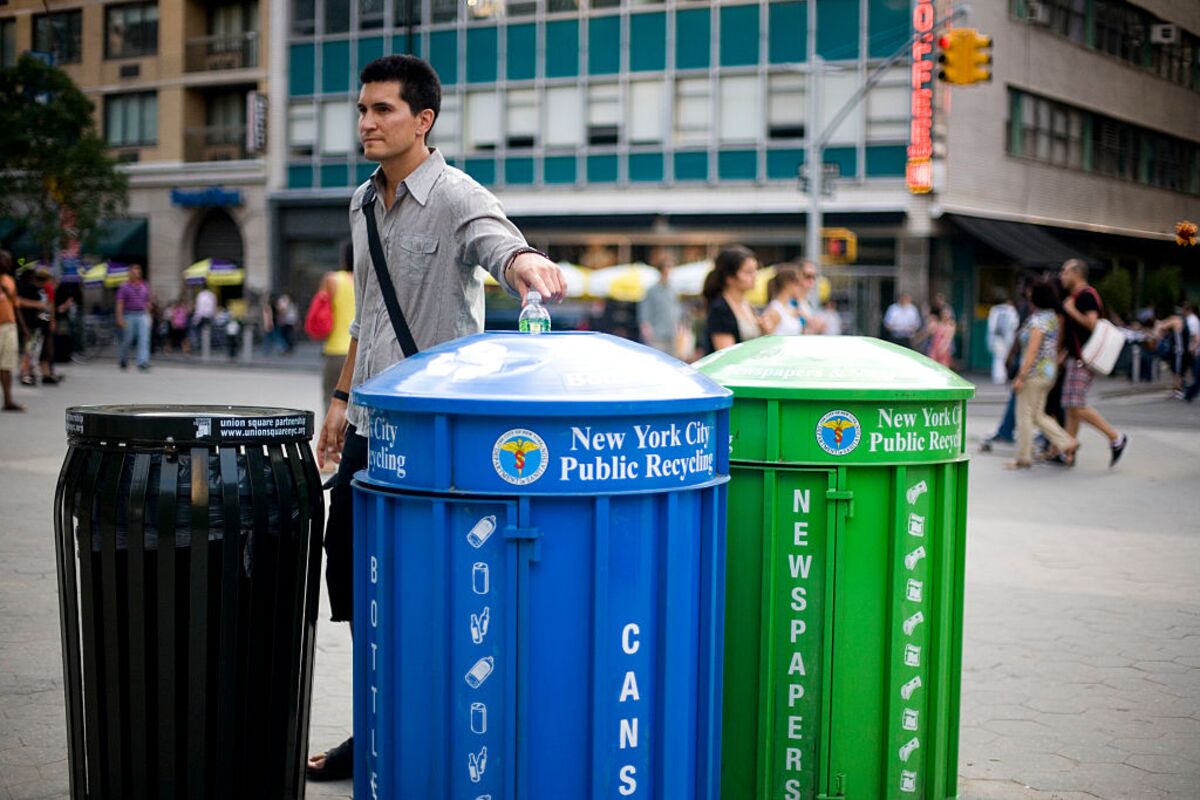
Plastic Recycling Is a Problem Consumers Can't Solve
Even if you put everything into the right blue bins, a lot of plastics will end up in landfills and the ocean. Consumers can't solve this problem.

Major circular construction hub opens in Royal Docks
New waste recycling hub to support Silvertown homes plan

Home - Schumacher Center for a New Economics
Our mission is to envision a just and regenerative economy; apply the concepts locally; then share the results for broad replication. Programs Library Lectures & Publications The Decentralism File Community Land Trust Local Currencies Reinventing The Commons All Programs eNewsletters All News “Since there is now increasing evidence of environmental deterioration, particularly in … Continued

E-waste challenges of generative artificial intelligence
Generative artificial intelligence (GAI) requires substantial computational resources for model training and inference, but the electronic-waste (e-waste) implications of GAI and its management strategies remain underexplored. Here we introduce a computational power-driven material flow analysis framework to quantify and explore ways of managing the e-waste generated by GAI, with a particular focus on large language models. Our findings indicate that this e-waste stream could increase, potentially reaching a total accumulation of 1.2–5.0 million tons during 2020–2030, under different future GAI development settings. This may be intensified in the context of geopolitical restrictions on semiconductor imports and the rapid server turnover for operational cost savings. Meanwhile, we show that the implementation of circular economy strategies along the GAI value chain could reduce e-waste generation by 16–86%. This underscores the importance of proactive e-waste management in the face of advancing GAI technologies.
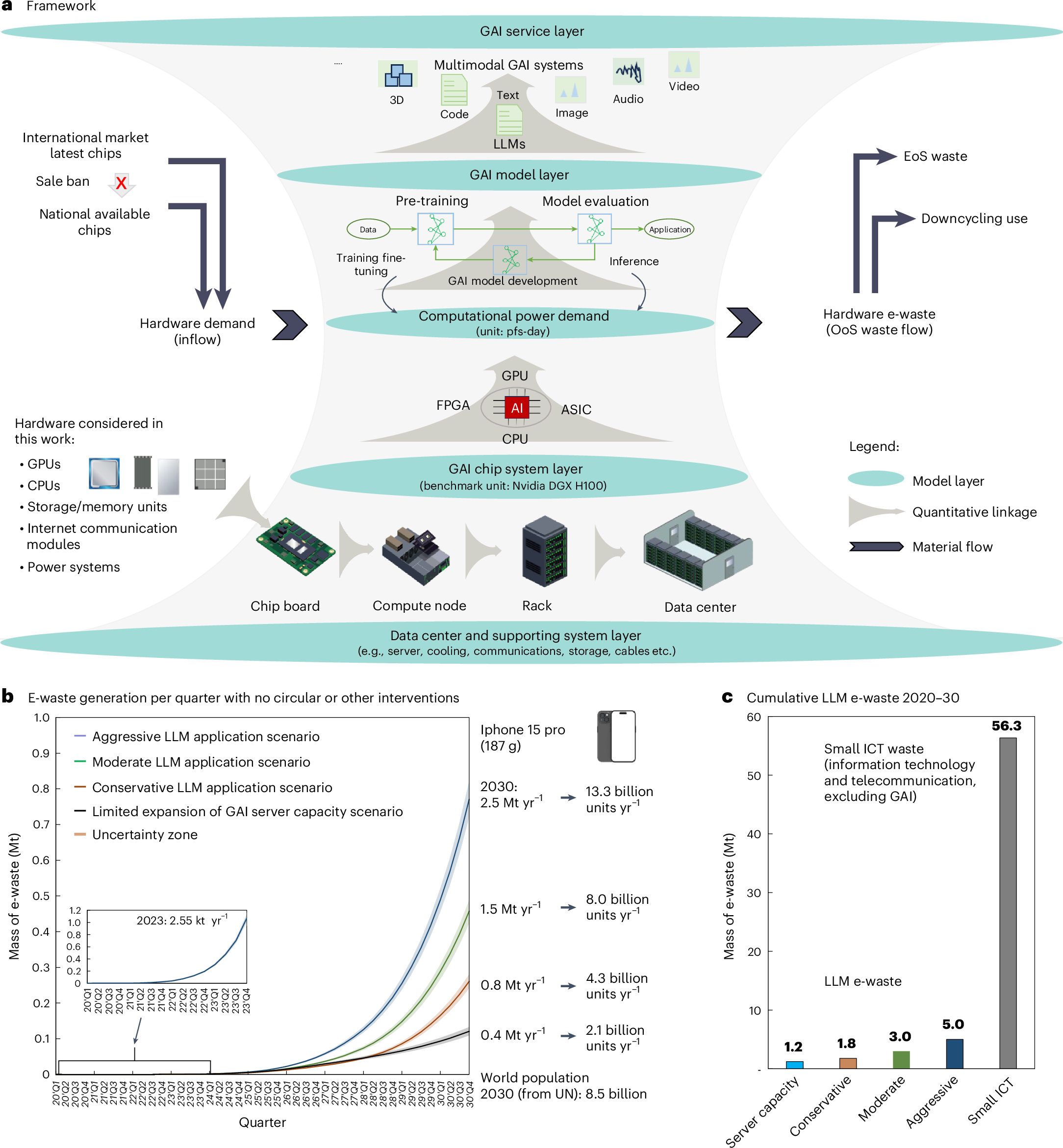
E-waste challenges of generative artificial intelligence
Generative artificial intelligence (GAI) requires substantial computational resources for model training and inference, but the electronic-waste (e-waste) implications of GAI and its management strategies remain underexplored. Here we introduce a computational power-driven material flow analysis framework to quantify and explore ways of managing the e-waste generated by GAI, with a particular focus on large language models. Our findings indicate that this e-waste stream could increase, potentially reaching a total accumulation of 1.2–5.0 million tons during 2020–2030, under different future GAI development settings. This may be intensified in the context of geopolitical restrictions on semiconductor imports and the rapid server turnover for operational cost savings. Meanwhile, we show that the implementation of circular economy strategies along the GAI value chain could reduce e-waste generation by 16–86%. This underscores the importance of proactive e-waste management in the face of advancing GAI technologies.
Design principles for long-lived circular organization: An Ostromian perspective
Circular organizational templates such as holacracy and sociocracy have gained popularity. In such organizations, all members have rights to participate in decision-making. Which factors enable such organizations to sustain their circular form? We investigate 18 highly diverse circular organizations to answer this question. Our findings show that Elinor Ostrom’s design principles for avoiding the tragedy of the commons may also explain circular organizations’ longevity. With regard to their relevance, we sort these principles into three groups: indispensable, queasy, and quite unproblematic principles. Our main theoretical contribution is to show that circular organizations can be understood as commons, and thus to make research on the governance of commons fruitful for the design of circular organizations. We show that implementing circular forms has to mind especially the queasy design principles of monitoring, graduated sanctions, conflict resolution mechanisms, and balancing individual contributions and rewards.
Imperialist appropriation in the world economy: Drain from the global South through unequal exchange, 1990–2015
Unequal exchange theory posits that economic growth in the “advanced economies” of the global North relies on a large net appropriation of resources and labour from the global South, extracted through price differentials in international trade. Past attempts to estimate the scale and value of this drain have faced a number of conceptual and empirical limitations, and have been unable to capture the upstream resources and labour embodied in traded goods. Here we use environmental input-output data and footprint analysis to quantify the physical scale of net appropriation from the South in terms of embodied resources and labour over the period 1990 to 2015. We then represent the value of appropriated resources in terms of prevailing market prices. Our results show that in 2015 the North net appropriated from the South 12 billion tons of embodied raw material equivalents, 822 million hectares of embodied land, 21 exajoules of embodied energy, and 188 million person-years of embodied labour, worth $10.8 trillion in Northern prices – enough to end extreme poverty 70 times over. Over the whole period, drain from the South totalled $242 trillion (constant 2010 USD). This drain represents a significant windfall for the global North, equivalent to a quarter of Northern GDP. For comparison, we also report drain in global average prices. Using this method, we find that the South’s losses due to unequal exchange outstrip their total aid receipts over the period by a factor of 30. Our analysis confirms that unequal exchange is a significant driver of global inequality, uneven development, and ecological breakdown.